
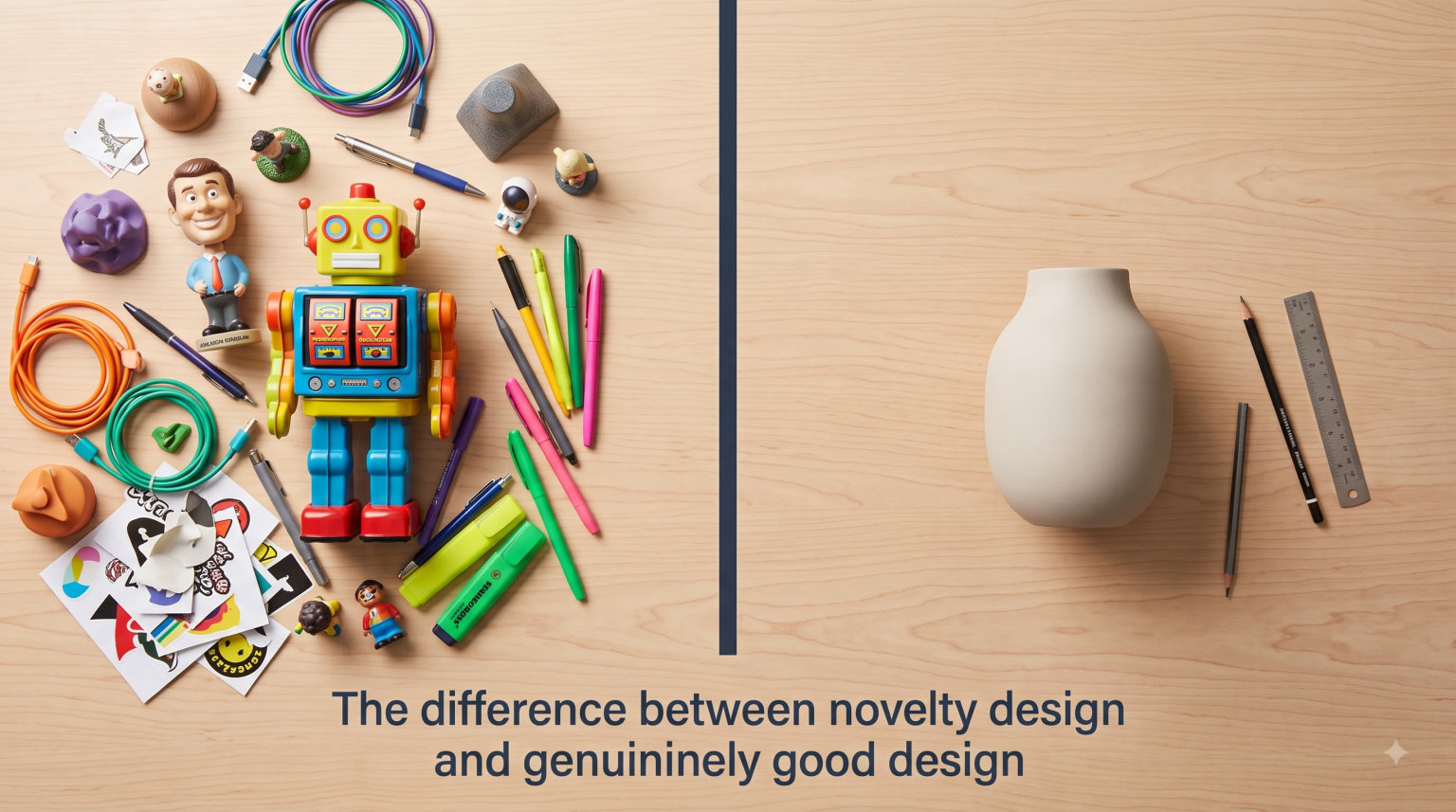
We have all seen products that looked stunning in a photo, generated buzz for a few weeks, and then quietly disappeared. That is the hallmark of novelty design: visually striking, conversation-worthy, and hollow underneath. On the other side sits genuinely good design, work that solves real problems and lasts for decades without needing attention. Understanding the difference between novelty design and genuinely good design is one of the most valuable skills a designer, product manager, or informed consumer can develop in 2026.
The distinction matters more than ever because we are flooded with options. Social media rewards eye-catching aesthetics over substance. Crowdfunding platforms showcase products that look revolutionary but ship with fatal usability flaws. When you cannot separate novelty from quality, you waste money, time, and trust on things that do not deliver.
In this guide, we break down what novelty design actually is, what makes design genuinely good, and how you can tell them apart using a practical framework. We ground everything in Dieter Rams’ famous principles and real-world examples so you leave with tools you can apply immediately.
Table of Contents
What Is Novelty Design?
Novelty design is work that prioritizes visual newness and trend appeal over functional purpose. It exists to grab attention first and solve problems second, if at all. The goal is surprise and delight in the short term, not usefulness over the long term.
Think of the novelty designer’s mindset as “different for the sake of different.” A chair shaped like a giant shoe might win a design award and go viral online. But if it is uncomfortable, fragile, and costs three times more than a standard chair, the novelty wore off the moment someone actually tried to sit in it.
Here are the core characteristics that define novelty design:
Surface-level innovation: The twist is visual or conceptual, not functional. Nothing about how the product works has actually improved.
Trend dependency: Remove the current trend, and the design loses its reason to exist. It ages in months, not years.
Form over function: Aesthetics drive every decision. Usability, durability, and practicality are afterthoughts.
Flashy presentation: Marketing relies on spectacle, limited editions, and influencer hype rather than demonstrated value.
Planned obsolescence: The product is not built to last because the goal is a quick sale, not a long relationship with the user.
Novelty design is tempting because it works in the short term. It generates clicks, social shares, and press coverage. Brands chase it because standing out in a crowded market feels urgent. But as forum discussions among working designers repeatedly point out, novelty for its own sake produces awkward, impractical results that fail real users.
What Makes Design Genuinely Good?
Genuinely good design serves users meaningfully through simplicity, durability, and thoughtful functionality. It starts with a real problem and solves it so well that the design becomes almost invisible. You do not notice a great door handle. You just walk through the door.
The phrase “form follows function” captures this idea at its core. A product’s appearance should grow naturally from what it needs to do, not be bolted on afterward as decoration. When form and function work together, you get objects that feel inevitable, like they could not have been designed any other way.
Here are the traits that set genuinely good design apart:
Purpose-driven: Every element exists for a reason. Nothing is decorative filler.
User-centered: Decisions are based on how real people actually use the product, not on what looks impressive in a render.
Timeless: The design does not rely on trends. It looks just as right ten years from now as it does today.
Honest: The product does not pretend to be something it is not. Materials, structure, and function are all transparent.
Durable: Good design is built to last, both physically and aesthetically. It resists wear and resists going out of style.
Unobtrusive: It leaves room for the user’s self-expression. It does not demand attention at every moment.
Consider the classic anglepoise lamp, designed in the 1930s. Its spring mechanism lets you position light exactly where you need it. The form exists entirely to serve that function. Decades later, the same design is still in production because it solves the problem so well that nobody has improved on it.
Dieter Rams’ 10 Principles of Good Design
Dieter Rams is the German industrial designer whose work at Braun in the 1960s and 1970s set the gold standard for functional, honest product design. His influence is visible in everything from Apple products to modern kitchen appliances. In the early 1980s, Rams asked himself a simple question: “Is my design good design?” His answer became the 10 principles that designers still treat as gospel.
These principles serve as a filter. Run any design through them, and novelty falls away while genuine quality reveals itself.
1. Good Design Is Innovative
True innovation advances how a product works, not just how it looks. It uses new technology or materials to solve problems better. Novelty design borrows the language of innovation without delivering its substance.
2. Good Design Makes a Product Useful
A product is bought to be used. Good design optimizes every detail for usefulness, removing anything that does not serve the user. If a feature exists only to sound impressive in marketing copy, it fails this test.
3. Good Design Is Aesthetic
Well-made tools affect our well-being, so they should be pleasing to use and look at. But Rams is clear: aesthetics must follow from function, not replace it. Beauty without purpose is decoration, not design.
4. Good Design Makes a Product Understandable
The best design explains itself. A user should know what a product does and how to use it without reading a manual. Novelty design often obscures function behind clever but confusing forms.
5. Good Design Is Unobtrusive
Products should be neutral and restrained, leaving room for self-expression. They are tools, not artworks demanding attention. Novelty design does the opposite, screaming for the spotlight.
6. Good Design Is Honest
A product should not manipulate consumers with promises it cannot keep. It should not appear more innovative, powerful, or valuable than it actually is. Honesty is where many novelty designs fail immediately.
7. Good Design Is Long-Lasting
Good design avoids being fashionable. It never appears antiquated. Unlike novelty design, which is designed to expire, genuinely good design outlasts trends by decades.
8. Good Design Is Thorough Down to the Last Detail
Care and accuracy show respect for the user. Nothing is left to chance or luck. Novelty design often looks polished on the surface but falls apart in the details.
9. Good Design Is Environmentally Friendly
Design should minimize pollution and waste throughout the product’s entire lifecycle. Novelty design, with its built-in obsolescence, is the opposite of environmentally conscious.
10. Good Design Is as Little Design as Possible
Less, but better. Focus on the essential aspects, and remove everything else. This is the principle that most directly rejects novelty design’s impulse to add, impress, and embellish.
Steve Jobs and Jonathan Ive openly cited Rams as a major influence on Apple’s design philosophy. That influence is why an iPhone from 2026 still feels restrained, purposeful, and understandable compared to competitors packed with gimmicky features.
Key Differences: Novelty vs Genuinely Good Design
The difference between novelty design and genuinely good design comes down to purpose and longevity. Novelty exists to impress. Good design exists to serve. Here is how they compare across the dimensions that matter most.
Starting point: Novelty design starts with a desire to stand out. Genuinely good design starts with a problem that needs solving.
Time horizon: Novelty targets the next trend cycle, which might be three months. Good design targets the next decade.
Relationship with the user: Novelty wants applause. Good design wants trust. One forum contributor put it well: “Authenticity is a long-term investment that yields trust. Novelty surprises and delights, but not permanently.”
Reaction to aging: Novelty design looks dated fast because it is tied to a specific moment. Good design ages gracefully because it was never tied to a trend in the first place.
Emotional payoff: Novelty delivers a spike of excitement followed by diminishing returns. Good design delivers steady satisfaction that often grows as you discover how well it works.
Cost of failure: When novelty fails, the product becomes waste. When good design fails, the underlying idea gets refined and improved because the problem was real.
Ask yourself one question when evaluating any design: “If this were stripped of its visual novelty, would the product still be worth using?” If the answer is no, you are looking at novelty. If the answer is yes, you may be looking at genuinely good design.
The Role of Authenticity and Substance in Design
Authenticity in design means the product is true to its purpose, its materials, and its users. It does not pretend to be something it is not. It does not borrow credibility from a trend it has no real connection to. Authentic design builds trust because users can feel the integrity behind the decisions.
Substance is what separates a design that earns loyalty from one that earns a click. A product with substance solves a real problem, solves it well, and keeps solving it for years. Substance is invisible when everything works and impossible to fake when something breaks.
The tension between authenticity and novelty shows up constantly in creative fields. Designers on community forums frequently debate whether originality or execution matters more. The consensus from experienced professionals is clear: execution beats originality every time. A well-executed solution to a common problem will always outlast a novel solution to a problem nobody had.
Authenticity also creates commercial value. McKinsey research has shown that companies with strong design practices outperform their peers in revenue growth and shareholder returns. That advantage comes from substance: solving real problems well, not from chasing viral moments.
How to Evaluate Design Quality: A Practical Framework
You can evaluate any design by running it through a structured checklist. This framework works whether you are reviewing a consumer product, a digital interface, or a piece of furniture. Use it to separate genuinely good design from novelty before you invest your time or money.
Step 1: Identify the Problem Being Solved
Start by asking what real problem this design addresses. If you cannot identify a clear, specific problem, you may be looking at novelty. Good design always begins with a problem worth solving, not a look worth copying.
Step 2: Test for Usefulness
Does the design make the product more useful, or just more interesting? Try to imagine using the product every day for a year. If the novelty would wear off by week two, the design is not serving you long-term. Genuinely good design gets better with daily use, not worse.
Step 3: Check for Honesty
Does the product promise more than it delivers? Look at the materials, the features list, and the marketing claims. If there is a gap between what the design suggests and what the product actually does, that gap is where novelty lives. Honesty is non-negotiable in good design.
Step 4: Evaluate Longevity
Will this design still make sense in five years? Strip away current trends and ask whether the core decisions still hold up. Timeless design principles like clarity, simplicity, and functionality do not expire. Trend-driven aesthetics do.
Step 5: Assess the Details
Run your hands over the product, so to speak. Are the details handled with care? Do the seams line up, do the buttons feel right, do the transitions feel smooth? Novelty design invests in the surface and neglects the details. Good design is thorough down to the elements most people will never notice.
Step 6: Consider the Full Lifecycle
Think beyond the unboxing moment. How will this product age? Can it be repaired? Will it create waste? Environmentally friendly design is a core principle of genuinely good work, and it is something novelty design almost never considers.
Step 7: Ask the Simplicity Question
Could anything be removed without harming the product? If the answer is yes and those elements remain, the designer chose to impress rather than serve. Genuinely good design is as little design as possible. Every surviving element earns its place.
Print this checklist or keep it on your phone. Run products through it before purchasing, and run your own work through it before shipping. It takes five minutes and saves you from months of regret.
Real-World Examples: Novelty Failures vs Timeless Triumphs
History is full of novelty designs that generated massive hype and then collapsed. The Segway was supposed to revolutionize transportation. It looked futuristic, attracted enormous investment, and solved a problem almost nobody had. Two decades later, it is a footnote and a mall cop meme.
Google Glass followed a similar path. The design was genuinely novel, a wearable computer on your face. But it failed because it prioritized novelty over usability, privacy concerns, and social acceptance. The product was honest about its ambitions but dishonest about its readiness.
Now consider genuinely good design that has stood the test of time. The Swiss Army Knife has been refined for over a century, with each tool earning its place through proven usefulness. The Post-it Note solved a problem so simply that the design has barely changed since its invention. The classic Coca-Cola bottle is recognizable by touch alone because its form follows its function perfectly.
These examples share a pattern. None of them were trying to be revolutionary. They were trying to be useful, and their usefulness made them enduring. As Don Norman, author of “The Design of Everyday Things,” has argued, good design is ultimately about making products that people can understand and use without frustration. That goal never goes out of style.
FAQs
What is a novelty design?
Novelty design is work that prioritizes visual newness, trend appeal, and attention-grabbing aesthetics over functional purpose. It exists to surprise and impress in the short term rather than solve real problems over the long term. Novelty designs often look striking but lack usefulness, durability, and honest communication with the user.
What is the difference between good design and great design?
Good design meets user needs effectively with clear functionality and solid aesthetics. Great design goes further by creating an emotional connection, anticipating needs the user has not yet articulated, and achieving a level of simplicity that makes the solution feel inevitable. Great design is memorable and influential, while good design is merely competent and useful.
What does authentic design mean?
Authentic design means a product is true to its purpose, materials, and users without pretending to be something it is not. Authentic design does not borrow credibility from trends or make promises it cannot keep. It builds long-term trust by being honest about what it does and how it works.
What makes bad design?
Bad design results from ignoring user needs, prioritizing aesthetics over function, adding unnecessary complexity, and failing to communicate clearly how a product should be used. Signs of bad design include confusing interfaces, fragile construction, dishonest marketing, planned obsolescence, and features that exist to impress rather than serve.
What is the difference between originality and novelty?
Originality introduces a genuinely new and meaningful approach to solving a problem. Novelty simply makes something look or feel different without adding real value. Original design can be subtle and timeless, while novelty design depends on surface-level surprise and typically fades quickly once the initial reaction wears off.
Conclusion
The difference between novelty design and genuinely good design is not subtle once you know what to look for. Novelty chases attention. Good design earns trust. Novelty ages in months. Good design lasts for decades. Novelty is different for the sake of being different. Good design is purposeful down to the last detail.
Dieter Rams gave us the framework nearly half a century ago, and it still works because it focuses on fundamentals that never change. Usefulness, honesty, simplicity, and longevity are not trends. They are principles. Start running every design you encounter through the evaluation checklist in this guide, and the distinction will become second nature.
Choose substance over novelty. Your users, your wallet, and the planet will thank you.