
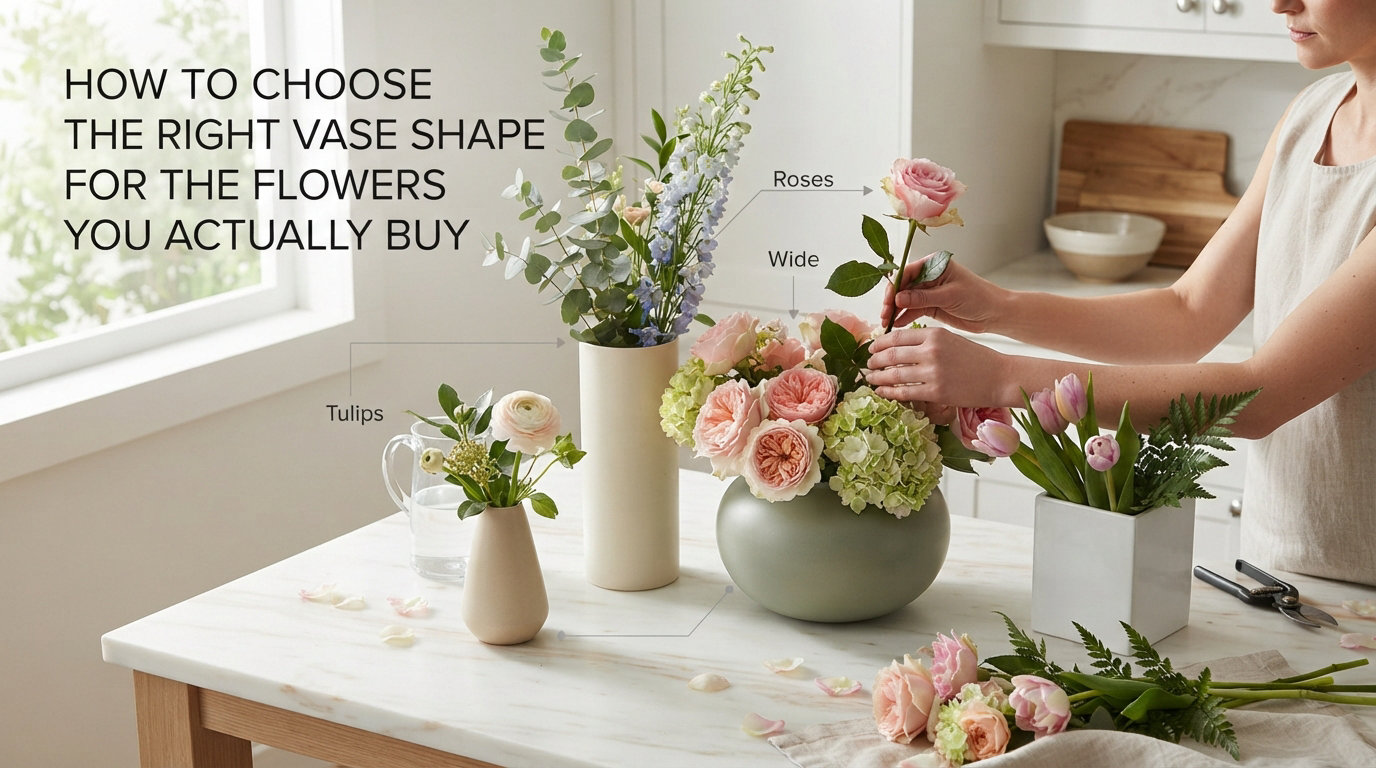
I used to grab whatever vase was clean and shove my grocery store flowers in it. Then I’d wonder why the arrangement looked tired, droopy, or just plain awkward. After years of buying tulips on a whim and inheriting vases from my grandmother, I finally cracked the code: the right vase shape makes or breaks your flowers, and choosing one isn’t complicated once you know the rules.
If you’ve been struggling with how to choose the right vase shape for the flowers you actually buy, this guide will walk you through the exact proportion rule florists use, the four main vase shape families, and which flowers match each one. No floral design degree required.
The short answer: your vase should be roughly one-third to one-half the height of your finished flower arrangement. This single rule solves most of the “why does this look weird” frustration people have with cut flowers at home.
Table of Contents
The Golden Rule: Match Vase Height to Your Flower Arrangement
The most reliable rule in floral design is also the simplest. Your vase height should equal about one-third to one-half the total height of your flower arrangement. Measure from the rim of the vase to the tallest tip of your flowers. If the flowers are 18 inches tall above the vase, the vase itself should be between 6 and 9 inches tall.
This proportion keeps two things in balance. The vase gives the flowers enough weight and presence to feel intentional, without overpowering them. The flowers get enough height to feel airy and natural, rather than crammed.
I tested this on my kitchen table with three arrangements last spring. The 12-inch vase paired with 24-inch lilies looked elegant. The 8-inch vase with the same lilies looked like a funereal arrangement. The 4-inch bud vase with those same lilies looked like a single stem trying too hard.
The 3-5-8 Rule for Visual Harmony
Beyond the proportion rule, designers often follow what’s called the 3-5-8 rule. This rule states that groupings of odd numbers (3, 5, 8 stems) tend to look more natural and visually pleasing than even groupings. Our brains read odd-numbered clusters as more dynamic.
When you pair this with vase selection, it means you should match the number of stems to the vase opening. Three stems work beautifully in a narrow bud vase. Five stems suit a medium cylinder. Eight or more stems belong in a wide-mouth vase where they can spread out.
How Stem Length Affects Your Vase Choice
Stem length is the second piece of the puzzle. Measure your stems before choosing a vase, not after. Long-stemmed flowers like roses, sunflowers, and lilies need tall vases or you’ll see stems sticking out awkwardly above the rim.
Short-stemmed flowers like daisies, hydrangeas, and peonies work better in low bowls or mid-height cylinders. If you cut long stems to fit a short vase, you lose the natural elegance of the flower. If you try to fit short stems in a tall vase, you’ll spend the whole afternoon wedging floral foam in to hold them up.
Vase Shape Categories and Their Best Flower Matches
There are roughly 14 named vase shapes out there, but you really only need to know about four families to handle the flowers you actually buy. Each family has a different job.
Cylinder Vases: The All-Purpose Workhorse
Cylinder vases are straight-sided with a uniform opening from top to bottom. They’re the most versatile shape for everyday flowers. A clear glass cylinder works for almost any bouquet from a florist or grocery store.
Best for: mixed bouquets, long-stemmed roses, tulips with their natural bend, and hydrangeas. The straight sides support stems without forcing them into awkward angles. A 10-inch tall cylinder with an opening between 3 and 5 inches wide handles most bouquets beautifully.
Bud Vases: For Single Stems and Tiny Touches
Bud vases are small (usually under 5 inches tall) with a narrow neck that holds a single stem upright. They’re the secret to scattering little moments of color across a kitchen counter, bathroom vanity, or bedside table.
Best for: a single rose, one ranunculus, a few sprigs of lavender, or one peony. The narrow opening keeps the stem from flopping. The small scale makes them ideal for places where a full bouquet would feel excessive. I keep three bud vases on my windowsill at all times, each holding one tulip when they bloom in early spring.
Bowl Vases and Low Compotes: For Floating Arrangements
Bowl vases and low compotes are wide and shallow, usually under 5 inches tall. They work for floating flower heads, short-stemmed clusters, or densely packed posies where the blooms sit just above the rim.
Best for: floating garden roses, peonies, hydrangea heads, or any flower you want to see from above. A shallow compote also works as a table centerpiece because the low profile keeps sight lines open across the dining table. Guests can talk without staring at flowers instead of each other.
Trumpet and Hourglass Vases: For Statement Stems
Trumpet vases flare outward at the top, while hourglass vases narrow in the middle and widen at both ends. Both are statement shapes that demand attention.
Best for: branches, single dramatic stems like magnolia or forsythia, or arrangements where you want the vase to be part of the visual story. The hourglass shape is particularly good for full bouquets because the narrow neck holds stems in a natural dome shape. The wide trumpet mouth suits anything with spreading, branchy growth.
Pedestal and Amphora Vases: For Tall Floor Displays
Pedestal vases have a narrow base, slim stem, and wider top. Amphora vases have two handles and a rounded body. Both work as floor vases or as tall accent pieces on console tables and entryways.
Best for: long branches, pampas grass, eucalyptus, or anything 3 to 5 feet tall. These vases are built to make a vertical statement. Avoid forcing short flowers into them – the height gap will make the arrangement look hollow.
Jug and Pitcher Vases: For Rustic, Casual Arrangements
Jug and pitcher vases have a handle and an asymmetric lip. They feel casual, farmhouse-style, and forgiving. Best for: wildflower mixes, sunflowers with leaves attached, garden-cut bouquets, or anything that doesn’t need to look formal.
I use a cream pitcher for sunflowers all summer because the warm color echoes the petals and the wide mouth can handle a thick bunch of stems without crowding.
Matching Vase Shape to the Specific Flowers You Buy
This is where most guides fall short. They tell you about 14 vase shapes but leave you guessing which one your specific bouquet actually needs. Here’s the direct match-up for the most common grocery store and florist flowers.
Roses: Tall Cylinder or Hourglass
Long-stemmed roses need a tall vase with enough weight to hold them steady. A 9 to 12 inch cylinder with a 3 to 4 inch opening works for a dozen roses. The cylinder keeps stems straight and lets the heads form a natural dome.
For garden roses with shorter, more curved stems, an hourglass vase gives that romantic, loose look florists achieve. The narrow neck lets the roses fall gently outward instead of splaying.
Tulips: Cylinder With Room to Bend
Tulips are unique because they keep growing in the vase and they naturally bend toward light. A straight cylinder gives them room to curve without snapping. Cut the stems short (around 6 to 8 inches) and let them lean into the room.
Don’t try to make tulips stand perfectly upright. They look best when they have a little casual droop. I learned this the hard way after years of fighting them with floral wire.
Sunflowers: Pitcher or Wide Cylinder
Sunflowers have thick, heavy stems and large heads. They need a vase with a wide mouth and a heavy base so they don’t tip over. A ceramic pitcher or a wide-mouth cylinder (at least 5 inches across) works perfectly.
For multi-stem sunflower arrangements, leave the leaves on and pack them densely. The leaves add support and visual weight. The wide mouth prevents the heavy heads from leaning.
Lilies: Tall Cylinder or Trumpet
Lilies are tall flowers with multiple blooms per stem. They need height and stability. A 10 to 14 inch cylinder holds a few stems without crowding. A trumpet vase shows off the elegant curve of the stems and lets the blooms cascade naturally.
Remember to remove the lily pollen stamens before they drop pollen on your tablecloth. This is the one trick I wish someone had told me years ago.
Hydrangeas: Low Bowl or Wide Cylinder
Hydrangeas have big, dome-shaped heads that drink a lot of water. They work beautifully in low bowls where the heads can spread out without crowding. A wide-mouth cylinder also works if you want some height.
The biggest mistake with hydrangeas is using a tall, narrow vase. The stems can’t support the head weight and they wilt fast. Keep them low and well-watered.
Peonies: Low Bowl or Compote
Peonies are short-stemmed and bloom in heavy, layered heads. They belong in a low bowl or compote where the blooms sit right at eye level when you walk past. A 4-inch tall bowl with a wide mouth is ideal for a clutch of 5 to 7 peonies.
Daisies and Wildflower Mixes: Pitcher or Mason Jar
Casual flowers like daisies, chamomile, and wildflower mixes belong in something unpretentious. A pitcher, a mason jar, or a milk bottle vase all work. The point is to let the flowers feel relaxed rather than arranged.
A pitcher with a slightly flared mouth handles the natural irregularity of garden-cut flowers. The handle makes it easy to move when you need to water or trim.
Common Vase Mistakes and How to Fix Them
After watching countless friends arrange flowers (and struggling myself for years), I’ve noticed the same five mistakes come up again and again. Here’s how to spot and fix each one.
Mistake 1: Vase Too Tall for the Flowers
The most common mistake. A tall vase with short flowers looks like a sad ceremony arrangement. Fix: either trim the stems to fit the vase, or move the flowers to a vase where they extend at least 1.5 times the vase height above the rim.
Mistake 2: Vase Too Short for the Flowers
The opposite problem. Long stems crammed into a short vase splay outward like a vase explosion. Fix: cut the stems so they reach no more than 1.5 to 2 times the vase height. If you don’t want to cut them, find a taller vase.
Mistake 3: Not Enough Stems for a Large Vase
A big vase with three lonely stems looks sparse. Florists call this “an arrangement with too much negative space.” Fix: either use a smaller vase, or add greenery, branches, or filler flowers to bulk up the arrangement. Eucalyptus and ferns are great for filling out a vase without adding bulk.
Mistake 4: Forcing Stems Into Awkward Angles
Some flowers fight their vase. Tulips that want to bend but are forced upright, or roses that need to lean but are stuffed too tight. Fix: respect the flower’s natural growth. Tulips want to lean. Roses like to fan out. Forcing them into unnatural positions looks stiff.
Mistake 5: Ignoring the Vase Weight and Base
A light vase with a heavy bouquet will tip over the first time you brush past it. A heavy vase with thin stems looks clunky. Fix: match the vase weight to the bouquet weight. Heavy flowers need heavy vases. Delicate flowers can use lighter glass or ceramic.
Vase Materials and Placement Tips
The material of your vase matters more than most people realize. Glass vases are transparent and let the stems show, which works for clean modern arrangements. Ceramic vases are opaque and ground an arrangement visually. Metal vases are dramatic but can taint water and shorten flower life.
For everyday flowers from the grocery store, clear glass is the safest choice. It works with any decor and lets you see when the water needs changing. For statement arrangements, ceramic in a color that complements your room adds a layer of design.
Placement by Vase Type
Tall floor vases belong in corners, entryways, and beside console tables. Medium cylinder vases work as dining table centerpieces or kitchen island accents. Bud vases scatter across windowsills, bathroom vanities, and bedside tables. Bowl vases sit low on coffee tables or dining tables where you want sight lines open.
One practical tip: keep vases where you’ll see them daily. A gorgeous arrangement in a forgotten corner does nothing. Put your flowers where you actually live and you’ll enjoy them more.
Frequently Asked Questions
What shape vase is best for flowers?
The best vase shape depends on your flowers, but a straight cylinder vase works for most everyday bouquets. The general rule is that the vase height should be about one-third to one-half of the total flower arrangement height for a balanced look.
What is the 3 5 8 rule for flowers?
The 3-5-8 rule refers to using odd-numbered stem groupings (3, 5, or 8 stems) because they create more visually pleasing, dynamic arrangements. Pair this with vase selection: 3 stems suit narrow bud vases, 5 stems fit medium cylinders, and 8 or more stems belong in wide-mouth vases.
What is the best vase shape for cut flowers?
For most cut flowers, a tall straight-sided cylinder vase with an opening 3 to 5 inches wide offers the best combination of support, visibility, and versatility. It holds stems upright, lets you see the water level, and accommodates mixed bouquets from the grocery store or florist.
How to choose the right size vase for flowers?
Measure your flowers first. The vase should be roughly one-third to one-half the total height of the arrangement. For a 24-inch tall bouquet, choose a vase between 8 and 12 inches tall. Match the vase opening width to the bouquet width: narrow opening for single stems, medium for 5-stem groupings, wide for 8 or more.
Final Thoughts on Choosing the Right Vase Shape
Choosing the right vase shape for the flowers you actually buy doesn’t require a designer’s eye or a wall of glassware. It comes down to three habits: measure your flowers before picking a vase, follow the one-third to one-half proportion rule, and match the vase opening to the bouquet size. Once you internalize those three things, you’ll never stare at a vase wondering why your flowers look off again.
Start with the cylinder vase. It’s the most forgiving shape for the bouquets you already bring home. Branch into bud vases for single stems and bowl vases for hydrangeas and peonies. Within a few arrangements, you’ll have a feel for what works. The flowers will tell you what they need. Your job is to listen.