
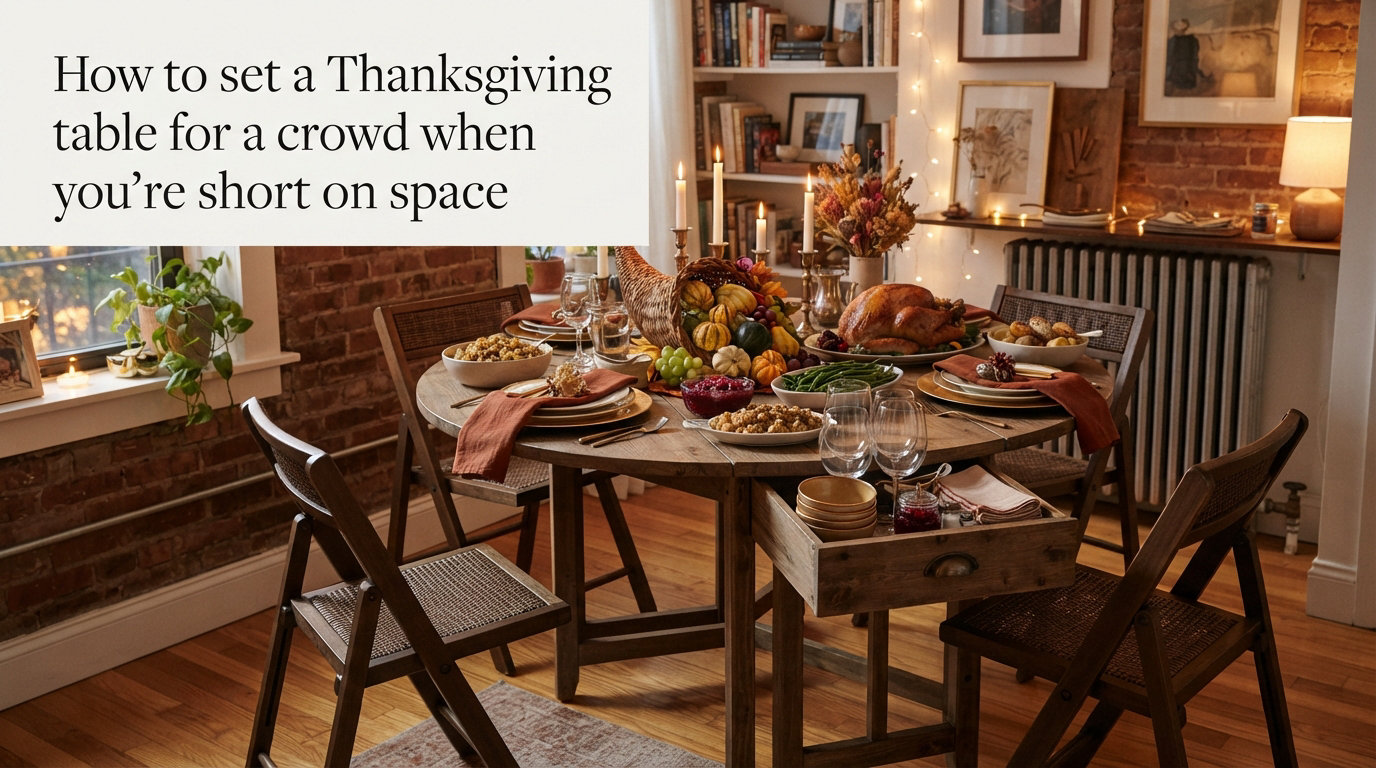
I still remember the year I decided to host 14 people in my 600-square-foot apartment for Thanksgiving. My dining table seated six, maybe eight if we really squeezed. My kitchen counter held exactly one casserole dish at a time.
And yet somehow, by the end of the night, everyone was fed, laughing, and already asking when they could come back. If you have ever stared at your tiny dining area and wondered how to fit everyone, you are in the right place.
Learning how to set a Thanksgiving table for a crowd when you’re short on space is less about having a big house and more about working with what you have. It comes down to smart table configurations, flexible seating, a serving style that keeps the table clear, and a few design tricks that make the whole thing feel intentional rather than chaotic.
I have hosted in cramped apartments, galley kitchens, and rooms that doubled as office space. Every single time, the same principles saved the day. Below I will walk you through each one, step by step, so you can stop worrying about square footage and start focusing on the people around your table.
Table of Contents
How to Set a Thanksgiving Table for a Crowd When You’re Short on Space: Start With the Right Configuration
The single biggest factor in fitting a crowd is your table configuration. Before you think about plates or centerpieces, figure out the physical shape of your eating area.
Use an L-Shaped Table Layout
An L-shaped setup pushes your main dining table against a wall and extends a second table perpendicular to it. This arrangement fits a surprising number of people because you are using floor space efficiently rather than trying to float one giant table in the middle of the room. One Reddit user who regularly hosts large gatherings described pushing a folding table against their regular table to create an L, then lining the outside with chairs and the inside corner with a bench.
The beauty of the L-shape is that one person at the corner can serve both sides. It also keeps traffic flowing along the open side of the room.
Try a U-Shaped Arrangement for Maximum Seating
If you have three tables, a U-shaped layout wraps them around three sides of a central open space. Guests sit on the outside of the U, which means the interior stays clear for serving dishes, drink pitchers, and shared sides. This is the configuration that homes.com recommends, and it works because the open middle functions like a shared serving island.
U-shaped seating works especially well in living-dining combo spaces where you can run the open side along your kitchen entryway.
Bring in Folding Tables and Extensions
Do not underestimate an inexpensive folding table from a big-box store. Covered with a tablecloth, nobody knows the difference. I have used folding tables for years, and when you drape them with a neutral linen table runner and add a few low decorations, they blend right in.
If your existing table has extension leaves buried in a closet, pull them out. Many people forget they own them. Measure your table fully extended and plan your seating around that larger footprint.
Keep Centerpieces Low for Better Conversation
Every competitor I researched agrees on one thing: keep your centerpieces low. When people are packed tightly around a table, a tall floral arrangement or a three-tier candle display becomes a wall between guests. Nobody wants to lean sideways to see their cousin across the table.
What Counts as Low?
Aim for centerpieces under 10 inches tall. That is roughly the height of a standard mason jar or a small cluster of pumpkins arranged in a line. If you can see over it while seated, it passes the test.
I like to run a simple row of mini gourds down the center of the table on top of a table runner. It looks intentional and never blocks anyone’s view.
Swap Tall Items for Long, Flat Arrangements
Instead of one big centerpiece, think horizontally. A garland of eucalyptus running the length of the table, dotted with pinecones and tea lights, fills the visual space without climbing upward. Pashai’s Home uses this approach with faux fur runners and clustered candles, and the effect is warm without being obstructive.
If you love candles, use short votives or tea lights in mercury glass holders. Skip the tall tapers in tight quarters.
Embrace Flexible Seating Solutions
Tables are only half the equation. Seating is where most small-space hosts hit a wall. The good news is that your guests care far more about being included than about sitting in a matching dining chair.
Benches Pack More People Per Foot
A bench seats roughly 30 percent more people than individual chairs along the same stretch of table. One long bench along one side of your table can turn a six-person table into a ten-person table instantly. Throw a cushion or a folded blanket on top and it looks deliberate.
I have used a storage bench from my entryway as dining seating for Thanksgiving more times than I can count. It works.
Folding Chairs and Borrowed Seating
Folding chairs are the workhorse of small-space hosting. Borrow them from neighbors, grab a few from a church or community center, or invest in a set that folds flat for storage. The Apartment Therapy writer who hosted 23 people in 300 square feet relied on a mix of folding chairs, floor cushions, and even hallway seating.
Do not worry about matching chairs. A mix of wood, metal, and upholstered seating looks eclectic and homey when you tie it together with matching seat cushions or a consistent color scheme.
Let the Kids Eat First
One of the smartest strategies I found in forum discussions comes from Nesting With Grace: feed the kids first at their own small table, then clear it and let adults take over that space. Kids finish quickly, they do not need the fancy place settings, and freeing up their table mid-meal gives adults a second wave of seating.
Set up a card table or a coffee table with a cloth, let the kids eat picnic-style, and reclaim that space for round two.
Accept That Not Everyone Sits at Once
In tight quarters, staggered eating is your friend. Some guests will be perfectly happy eating from a plate on the couch, standing at the kitchen counter, or sitting on the floor with a tray. Every Facebook group discussion I reviewed was unanimous on this point: people just want to be there, and nobody is judging your square footage.
Choose a Simple, Cohesive Color Scheme
A tight color palette makes a small, crowded table look deliberate instead of cluttered. When everything coordinates, the eye reads it as designed rather than thrown together.
Start With a Neutral Base
Begin with cream, white, or natural linen as your foundation. A neutral tablecloth or runner creates a clean canvas that works with any accent color. Neutral bases also photograph well and make the food the real star of the table.
If you only invest in one thing for your table, make it a neutral table runner. It covers a mismatched folding table and defines the eating zone instantly.
Add Fall Accents in One or Two Colors
Pick one or two accent colors and repeat them across the table. Think burnt orange and cream, sage green and gold, or burgundy and natural wood. Carry that combination through your napkins, charger plates, candles, and centerpiece elements.
Repetition is what makes a table look styled. Three burgundy napkins scattered randomly looks accidental, but twelve burgundy napkins at every place setting looks intentional.
Mix and Match Without Spending a Fortune
You do not need a matching set of anything. Mix charger plates from the dollar store with cloth napkins you already own. Use mason jars as water glasses alongside your regular wine glasses.
The common thread is your color scheme, not your dishware brand. When the palette ties everything together, nobody notices that the plates are different.
Set Up Buffet-Style Serving to Free Up Table Space
If you take one tip from this entire article, let it be this: serve buffet-style. Plating food for a crowd at a small table is a recipe for chaos, spills, and cold dishes. A buffet line keeps the eating surface clear and lets people control their portions.
Why Buffet Beats Plated Service in Small Spaces
When you plate individual servings, you need space for serving dishes plus plates plus glassware plus silverware on the same surface. That surface is already too small. Buffet-style moves all the food to a separate station and leaves the dining table for eating and drinking only.
The Apartment Therapy host who fed 23 people put it simply: buffet-style was the only way it worked. Every serving dish stayed on the sideboard, and the table held nothing but place settings.
Build Your Buffet Line for Flow
Set up your buffet on a kitchen counter, a sideboard, or a separate folding table. Arrange dishes in a logical order: plates first, then mains, then sides, then utensils and napkins at the end. This prevents bottlenecks and keeps people moving.
Stack plates at the start of the line so people are not reaching across food. Put drinks on a completely separate surface to avoid congestion.
Use Vertical Space on Your Buffet
This is where DIY risers come in. A cake stand elevates the turkey so it is visible and frees up counter space below it. Stack a few books under a cutting board to create a two-tier serving station.
Use what you already have to build height. Suddenly a four-foot counter holds what used to need six feet of flat surface.
Create Functional Stations Around Your Home
When your dining area is small, spread the function across your home. Instead of cramming everything into one room, set up stations that pull traffic away from the main eating space.
Drinks Station in Another Room
Put the bar in the living room, on a console table, or even on a bookshelf you have cleared off. A drinks station with cups, ice, wine, and a water pitcher keeps the drink-line congestion far from the food line. Guests naturally migrate and spread out.
If you have a rolling cart, load it with drinks and park it wherever there is space. A bar cart is mobile hosting infrastructure.
Appetizer and Dessert Stations
Set appetizers on the coffee table so early arrivals have somewhere to gather that is not the kitchen. Put dessert on a separate surface, like a bedroom dresser or a hallway console, so it is ready to go after dinner without crowding the buffet.
Spreading food across multiple rooms means no single space feels overwhelmed. It also gives guests a reason to move around, which naturally creates conversation between groups.
Maximize Every Inch With Space-Saving Strategies
Beyond the big structural decisions, a handful of small moves add up to serious space savings.
Clear Every Surface Before the Event
The day before Thanksgiving, clear your kitchen counters, dining table, coffee table, and any other flat surface. Remove the mail, the laptop, the houseplant. Everything that is not Thanksgiving-related goes into a bedroom or closet temporarily.
You will be shocked at how much functional space you gain. This is the cheapest hosting hack there is, and it adds feet of usable surface area.
Use Carts, Sideboards, and Bookshelves as Extra Counters
A bar cart becomes a mobile prep station. A dresser in the hallway becomes a dessert buffet. A bookshelf becomes a drink station.
Look at every piece of furniture in your home as potential hosting infrastructure, not just its intended purpose. That entryway table you never use? It is now an appetizer bar.
Skip the Charger Plates When Space Is Tight
Charger plates look beautiful, but they add width to every place setting. When every inch matters, skip them and let your tablecloth or runner provide the visual layering instead. If you do use chargers, choose flat ones rather than rimmed designs that eat into the neighboring setting.
Stack Glassware Instead of Spreading It
Instead of placing a water glass and a wine glass side by side, stack the water glass inside the wine glass at each setting. It halves the glassware footprint and looks tidy. Guests simply lift the top glass to use the bottom one.
Prepare for the Reality of Small-Space Hosting
Hosting a crowd in a small space is not the same as hosting in a big one. A few practical preparations will keep the day from spiraling.
Plan for Spills Before They Happen
When people are packed tightly, spills are inevitable. Have a dedicated rag or roll of paper towels within arm’s reach of the table, not across the room. Pre-treat your tablecloth with spray if you are worried about wine.
If you are using a nice tablecloth you cannot bear to ruin, layer a clear vinyl protector underneath the cloth. I once watched an entire glass of red wine dump across my Thanksgiving table in a 500-square-foot apartment, and the only reason it did not ruin the meal was because I had paper towels staged three feet away.
Work From a Day-Of Timeline
None of the top competitors offer a complete day-of timeline, so here is mine. Start by clearing and cleaning all surfaces by the night before. Set the table and arrange stations by mid-morning.
Cook whatever can be prepped ahead, then use the last hour before guests arrive to set up the buffet and do a final surface wipe. Once guests arrive, stop cooking. Everything that can be done ahead should be done ahead because the kitchen will be too crowded for last-minute work.
Set Expectations With Yourself First
It will be tight. Someone will end up eating on the couch, and the kitchen will look like a disaster by the end. That is what happens when you pack a dozen people into a small home, and it is completely fine.
Every forum discussion I reviewed echoed the same sentiment: guests are grateful to be included. They are not scoring your square footage.
Frequently Asked Questions
How to fit a lot of people in a small space for Thanksgiving?
Use L-shaped or U-shaped table configurations to maximize seating along walls and corners. Add folding tables to extend your main dining table, use bench seating along one side, and serve buffet-style so the table only holds place settings instead of serving dishes. You can also spread seating across multiple rooms.
How to set a simple Thanksgiving table?
Start with a neutral tablecloth or runner as your base. Add cloth napkins in one accent color, a low row of seasonal items like mini pumpkins or gourds down the center, and a few tea light candles. Keep centerpieces under 10 inches tall so guests can see each other. Repeat the same elements at every place setting for a cohesive look.
How to host a friendsgiving in a small space?
Serve food buffet-style on a separate surface like a kitchen counter or sideboard. Set up a drinks station in a different room to spread foot traffic. Let guests eat wherever they are comfortable, including couches, floor cushions, or folding chairs. Feed kids first at a small table, then reclaim that space for adults. People care about being included, not about matching chairs.
What are some Thanksgiving table setting etiquette rules?
Place the napkin on the plate or to the left of the forks. Arrange utensils with forks on the left and knife and spoon on the right, blade facing the plate. The water glass goes above the knife. Keep centerpieces low enough for conversation. In a casual crowd setting, strict etiquette matters far less than making everyone feel welcome and comfortable.
How to seat 20 for Thanksgiving?
Combine your main table with folding tables in an L-shaped or U-shaped layout to maximize perimeter seating. Use benches along one side to fit more people per foot. Set up a second eating area in another room for overflow. Serve buffet-style to keep serving dishes off the table. Stagger the meal so kids eat first, then clear their table for a second wave of adults.
Do you serve dishes at the table or set up a buffet for a crowd?
For crowds in small spaces, buffet-style is almost always the better choice. Serving dishes at the table takes up precious surface area that guests need for plates and glasses. A buffet on a separate counter or folding table keeps the eating surface clear and lets people control their portions and flow.
The Bottom Line on Small-Space Thanksgiving Hosting
Figuring out how to set a Thanksgiving table for a crowd when you’re short on space is really about letting go of the picture-perfect vision and leaning into practical solutions. Use an L-shaped or U-shaped configuration to squeeze in more seats, keep centerpieces low so conversation flows, and serve buffet-style so the table stays clear.
Spread stations across your home so no single room bears the full load. The flexible seating, the cohesive color scheme, the folding tables covered in cloth, and the kids eating first are not compromises. They are strategies that experienced hosts use in homes of every size.
If there is one thing I have learned from hosting in tiny spaces, and from every forum thread and real-world story I have read, it is this: your guests are not measuring your square footage. They are measuring whether they felt welcome, whether the food was good, and whether they laughed.
Give them those three things and nobody will remember that they ate off a folding table. Clear your surfaces, set up your buffet, hand someone a cushion for the bench, and open the door. You have got this.