
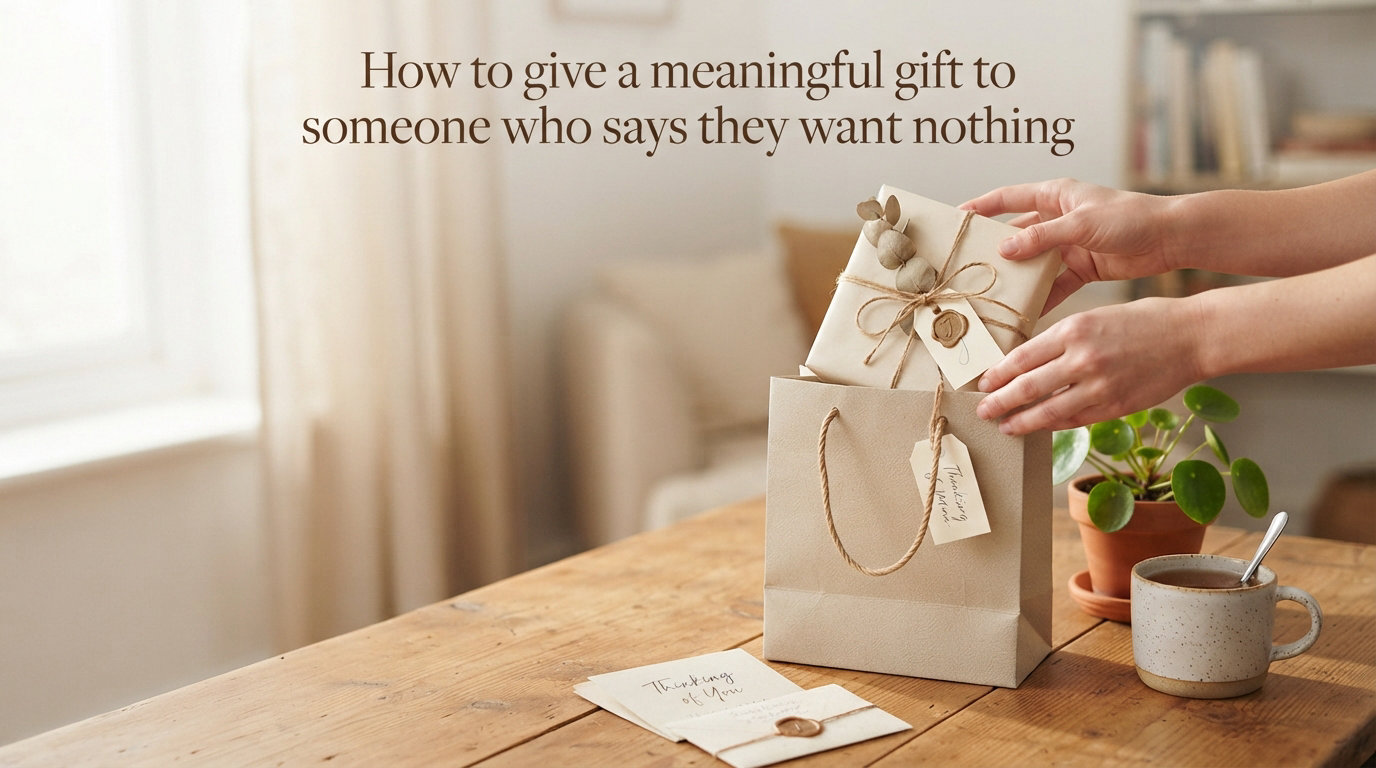
The best way to give a meaningful gift to someone who says they want nothing is to focus on experiences, sentiment, or utility instead of objects. I learned this after years of watching close friends wave off every birthday and holiday, then quietly cherish a handwritten letter or a shared afternoon far more than anything boxed and wrapped.
That tension is what this guide is built around. You want to honour the relationship. You also want to respect the fact that some people really do not want more things. The good news is that those two goals stop being in conflict once you understand what they actually mean by “nothing,” and once you have a flexible toolkit of alternatives ready to go.
In the next few minutes, I will walk you through why people say “I want nothing,” the five categories of gifts that almost always land well, quick picks based on who you are shopping for, presentation tips, and a short FAQ that addresses the most common awkward moments. By the end, you will have a clear plan instead of a sinking feeling every December.
Table of Contents
Why People Say They Want Nothing?
People say they want nothing for one of three reasons, and figuring out which one applies to your recipient is the first step to giving a gift they will actually appreciate. In my experience coaching friends through gift-giving stress, I have found that the phrase almost never means “I do not care about you.” It usually means something quieter, and most of the time it is one of the following.
Minimalism or Decluttering
Many adults hit a point where they actively curate what enters their home. They have read the books, they have done the KonMari pass, and they feel good about living with less. When they say “I want nothing,” they are often protecting a value they have worked hard to build. A big wrapped box feels like a small violation of that value, and they will smile politely while quietly hoping the item ends up in a donation bin within a month.
Past Disappointment
Some recipients have received so many useless gadgets, novelty mugs, and re-gifted candles that they have simply stopped hoping. Saying “nothing” is their way of dodging another drawer full of things they will not use. I have heard this from older parents especially, who tend to be polite about unwanted gifts for years before quietly giving up. The kindest gift you can give is one that respects their taste and attention.
Genuine Contentment
A smaller group truly does not want anything, and that is fine. They have what they need, they are not shopping for dopamine, and they would rather spend time with you than receive a parcel. The right move here is often a small gesture or an experience, not a missed opportunity to “still get them something.” Forcing a gift on this person can feel like refusing to hear them, which is the opposite of thoughtful.
Across all three groups, one pattern holds. Almost no one is upset when a gift reflects attention rather than expense. The mistake is treating “I want nothing” as a hard no. Treat it as a clue, and the rest of this guide will help you decode it.
Five Strategies for Giving a Meaningful Gift to Someone Who Says They Want Nothing
The most reliable approach is to pick a strategy, then match the gift to the person. Below are five strategies I return to again and again, whether I am shopping for a minimalist friend, a parent who has everything, or a partner who insists they are happy with what they already own. Each strategy is something you can use on its own or combine with another for a layered gift.
1. Shift From Things to Experiences
Experience gifts are the single best answer for the hard-to-shop-for person, because memories do not take up shelf space. A cooking class, a concert ticket, a weekend hike, or a dinner at a restaurant you both love gives you something to look forward to together. I gave my brother a pottery class last spring, and he still mentions it every time we talk. The shared experience gave us an inside joke, a finished mug for his coffee, and a story that has lasted longer than any device I could have bought him.
For people who are very busy, the experience does not even need to be elaborate. A printed voucher for “one afternoon of my help, your choice” works beautifully. Lawn care, babysitting, house cleaning, or assembling IKEA furniture are all things that buy back their most precious resource: time. Reddit threads on this topic are full of adults saying that the offer of a few hours of help was the most meaningful gift they ever received. The plain truth is that the kind of help most people need is rarely the kind they will ask for.
If you want to add a small physical anchor, pair the experience with something tiny. A fold-out map of a city you will visit together, a handwritten itinerary with the planned stops, or a small notebook for capturing reflections during the day all give the recipient something to hold onto while they wait for the day to arrive.
2. Choose Sentimental and Personalized Items
Personalized gifts succeed where generic gifts fail, because they cannot be replicated. A custom star map of the night you met, an embroidered blanket with a child’s handwriting, a framed recipe in a loved one’s handwriting, or a piece of custom artwork featuring their home all carry emotional weight. The physical item is small. The thought behind it is what makes it matter.
If you are on a budget, personalization is your friend. A handwritten letter, a photo book of the year you spent together, or a curated playlist with notes for each song can cost almost nothing and mean everything. I have kept a single folded note from my grandfather for over a decade, and it has outlived dozens of presents that cost far more. The reason it lasted is simple: I cannot buy another one, and he cannot make another one, and so it carries the full weight of a specific moment in time.
The best sentimental gifts share three traits. They reference a shared memory the recipient will recognize. They are made or chosen by a person who matters to them, not a stranger. And they are small enough that the recipient does not have to find a place for them. If your gift hits those three marks, it will almost always be a hit.
3. Pick Practical Everyday Essentials
Practical gifts work because they quietly make daily life better without adding clutter. Think of a really good pair of slippers, a luxury hand cream, a thermos that keeps coffee hot for eight hours, or a set of sheets the recipient would never buy for themselves. These are the items people use every single day, which means your gift becomes a small daily reminder of you.
The trick is to upgrade, not duplicate. If your sister already has a perfectly fine water bottle, do not buy her another one. Buy her the insulated version she keeps talking about, or the smart version that tracks how much she drinks. Practical gifts land when they fill a gap the recipient would not close for themselves, usually because the cost felt self-indulgent or the item was hard to justify on a regular shopping trip.
A useful framing is to ask: what is the small thing they keep mentioning but have never bought? If a friend has been complaining about a leaky travel mug for six months, a new one is a gift. If a parent keeps saying their kitchen scissors are dull, a sharp new pair is a gift. Listen for those small mentions, and you will find the answer faster than any gift guide could help.
4. Give Consumable Treats
Consumables are the unsung hero of clutter-free gifting. A really good olive oil, a tin of loose-leaf tea, a small-batch chocolate box, a gourmet popcorn basket, or a fancy hot sauce collection will be enjoyed and then gone. Nothing left on a shelf to feel guilty about, nothing to dust, nothing to remember to throw away during the next move.
This category is especially good for colleagues, neighbours, teachers, and other people you want to thank without crossing into personal territory. A nicely packaged consumable gift says “I thought of you” without asking anything of the recipient. I keep a small stock of nice pantry items in my closet year-round for exactly this reason. When a host, teacher, or neighbour does something kind, I can thank them that same week without panic-shopping.
To make consumables feel like a real gift rather than a last-minute grab, give them a story. A tin of olive oil from a specific region, a coffee from a small roaster you visited, or a chocolate bar from a maker whose owner you have met all turn a generic consumable into a small piece of your world. The recipient gets something delicious, and they also get a story to share when they serve it.
5. Try Subscription Services or Charitable Donations
Subscriptions turn one moment of gift-giving into many months of small joys. A coffee subscription, a book club, a streaming service, a curated snack box, or a specialty magazine all keep showing up long after the wrapping paper is gone. You can usually pair the first month or two with a physical item so there is something to unwrap on the day, and then the subscription continues to remind the recipient of you for months.
For the person who truly does not want anything, a donation in their name can be the most meaningful gift of all. Many charities offer tribute cards you can present at the celebration. A gift that funds school supplies, plants trees, or rescues animals reflects the recipient’s values in a way that no wrapped object can. One Reddit user put it simply: “Buy some chickens or a well or something,” and the thread lit up with agreement. People who say they want nothing often mean they want their values to be respected.
If you go this route, do not skip the presentation. A printed card explaining the cause, a small note in your handwriting, and a reason why you chose this specific charity gives the recipient a story to share when someone asks about the gift. Charitable gifts land best when they feel chosen, not defaulted to.
Quick Gift Categories by Recipient Type
Once you know your strategy, narrowing down by recipient gets much easier. Here is how I think about the people I find hardest to shop for, and how I match the gift to the relationship.
For the Minimalist or Declutterer
Stick to consumables, experiences, or charitable donations. Skip anything that becomes a fixture in their home. A high-quality consumable gift basket or an experience you can enjoy together will be received with genuine relief instead of polite smiling. The minimalist in your life cares more about the absence of clutter than the size of the gift, and they will notice immediately if you respected that.
For an Older Parent or Grandparent
Personalized photo gifts, a handwritten family letter, or an experience that includes family time all work beautifully. Older relatives often want to feel remembered, not fussed over. A framed photo of the whole family, or a hand-bound recipe book of family favourites, can become a treasured heirloom. Many older adults also love a recurring subscription, because each delivery is a small reminder of you showing up.
For a Partner or Spouse
The 5 gift rule is useful here: something they want, something they need, something to wear, something to read, and something to experience. Adjust the categories to your partner’s actual life. A “want” plus an “experience” often outperforms ten small surprises. With partners especially, the most meaningful gifts are usually the ones that prove you have been paying attention to the small things they mention in passing.
For a Difficult Colleague or Acquaintance
Stay neutral and consumable. A nice candle, a coffee gift card, a small box of biscuits, or a plant that is hard to kill all keep things warm without being too personal. Avoid anything that requires them to display it, wear it, or commit to using it. The point of a workplace gift is to acknowledge the relationship, not to test it.
Presentation and Delivery Tips
How you give the gift matters as much as what you give. For someone who said they want nothing, deliver with a low-pressure line like “I saw this and thought of you” instead of “I got you something.” Offer to take it back if they genuinely cannot use it. Pair any object with a handwritten note that names what they mean to you. These small shifts remove the awkwardness and let the gesture land.
Wrapping also sends a signal. Heavy, ribboned gift wrap can amplify pressure. A simple paper bag, a cloth wrap, or even a handwritten envelope often feels right for the recipient who prefers less. Whatever you choose, make the outside honest about the inside. Surprise is fun, but misdirection is not.
Finally, do not underestimate the value of timing. A gift given in a quiet, unhurried moment often lands better than the same gift given at a chaotic party. If the recipient is shy, give your gift ahead of the event by dropping it off. If they are private, give it privately. If they are a public person, lean into the moment. Match the gift to the person, including the moment.
Frequently Asked Questions
What to gift someone who needs nothing?
The best gifts for someone who needs nothing are experiences, consumables, and personalized items. Tickets to a show, a cooking class, a handwritten letter, or a donation in their name all carry meaning without adding to their belongings.
What kind of gift to give someone who has everything?
For someone who has everything, focus on what cannot be bought in a store. Time, attention, and shared experiences usually win. A weekend trip together, a private dinner, a custom photo book, or a charitable donation in their name are all strong options.
What is a gift for people who don’t want more stuff?
Consumables, experiences, subscriptions, and gifts of service are perfect for people who don’t want more stuff. Think gourmet food baskets, streaming subscriptions, restaurant gift cards, or offers of help with chores, errands, or projects.
What is the 5 gift rule for adults?
The 5 gift rule for adults suggests giving something they want, something they need, something to wear, something to read, and something to experience. It keeps gifting balanced between practical and emotional, and avoids the trap of giving five versions of the same idea.
What to buy someone who isn’t materialistic?
For someone who isn’t materialistic, choose gifts that create time, comfort, or memory. A spa voucher, a high-quality consumable they would not buy for themselves, a workshop they have mentioned, or simply a thoughtful letter often works better than any physical object.
How do you gracefully give a gift to someone who said they don’t want anything?
Keep your delivery low-pressure. Use a phrase like u0022I saw this and thought of you,u0022 give them an opening to decline without awkwardness, and pair the gift with a handwritten note. If they genuinely do not want it, accept that gracefully and remember the gesture was the point.
Final Thoughts on Giving Meaningful Gifts
Knowing how to give a meaningful gift to someone who says they want nothing comes down to one shift: pay attention to what they value, not what is on sale. Experiences, sentiment, practicality, consumables, subscriptions, and donations are the five categories that almost always land, and they apply whether you are shopping for a minimalist, a parent, a partner, or someone you barely know.
Pick one category that fits the person, give yourself permission to skip the wrapping paper frenzy, and write a short note. That is the whole formula. The rest is just showing up with care, and accepting that sometimes the most meaningful gift is the one you almost did not give.