
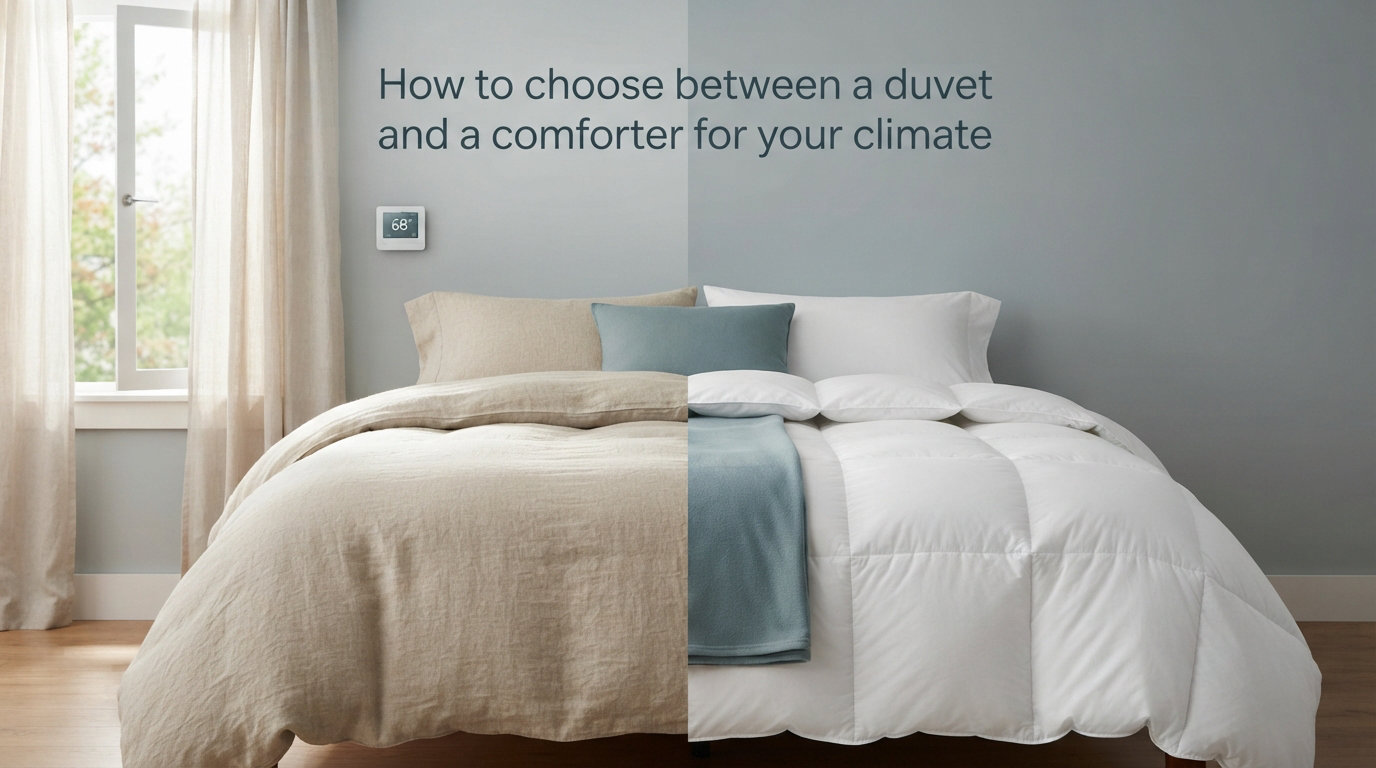
If you have ever stood in the bedding aisle wondering whether you need a duvet or a comforter, the answer almost always comes down to two things: your climate and how you sleep. I have spent the last decade testing bedding in everything from damp coastal apartments to dry mountain cabins, and I can tell you the duvet vs comforter climate question is more important than most shoppers realize.
Pick the wrong bedding and you spend years either sweating through summer nights or piling on extra blankets in winter. Pick the right one and your bed quietly does its job in every season. In this guide for 2026, I will walk you through the real differences between a duvet and a comforter, how each handles heat and humidity, and which one fits your bedroom, your washing machine, and your weather. By the end, you will know exactly which to pick.
Table of Contents
What Is a Duvet and How Does It Work?
A duvet is a soft, flat bag filled with insulation, usually down, feathers, wool, silk, or a synthetic alternative, that goes inside a removable cover. The duvet itself is just the insert. You slip it into a duvet cover that closes with buttons or a zipper, and the cover is what you actually see on your bed. The word duvet actually comes from the French word for down, because the original European duvets were stuffed with goose or duck down.
The practical benefit is simple. You wash the cover, not the insert. Most duvet covers fit in a standard home washing machine, while the insert stays clean inside. This two-piece system makes duvets especially popular in Europe and in homes where the bedroom temperature changes with the seasons. It is also a big reason why duvets became the default in apartments where washing machine space is tight.
Duvets are usually held in place inside the cover with corner ties or loops sewn into the inside corners of the cover. A good insert uses baffle box construction, which means small fabric walls inside the squares that keep the fill from clumping and let it loft fully. That detail matters more in cold or humid climates because flat, channel-stitched inserts develop cold spots faster and let moisture sit against your body.
One more thing worth knowing. The duvet insert itself is not designed to be the decorative layer. It is the engine. The cover is the part of your bedding that people actually see, and the cover is what you change when your style or the season changes.
What Is a Comforter and How Does It Work?
A comforter is a single-piece bedding layer. The outer fabric and the fill are sewn together at the factory, so what you buy is what goes on the bed. There is no separate cover required, and most comforters arrive ready to use, often packaged in a clear bag with a folded sample of the fill on the front.
The practical benefit is convenience. You unfold it, put it on the bed, and you are done. There are no ties, no stuffing, no wrestling with fabric at 11 p.m. For Americans who move frequently, live in smaller apartments, or want a low-fuss bedroom, this matters a lot. Comforters are also commonly sold as part of a full bedding set, so a comforter, sheets, shams, and pillowcases can come in one matching bundle.
Comforters usually use channel or box stitching to hold the fill in place, but the layers are thinner than a typical duvet insert. That is why comforters often feel flatter and lighter, and why they tend to work better in mild climates or as part of a layered bed. Many people use a comforter as the top layer over a flat sheet and call it a day.
The word comforter is mostly American. In the UK, what Americans call a comforter is often called a quilt or a bedspread, which causes real confusion when you shop online across regions. If you are ordering from a UK site and see quilt listed, check whether it is a thin decorative top layer or a thick all-in-one comforter.
Duvet vs Comforter: Key Differences at a Glance
The duvet vs comforter climate conversation really comes down to five things: construction, warmth, maintenance, style flexibility, and cost over time. Each system has clear strengths depending on what you need from your bed.
Construction: A duvet is two pieces (insert plus cover). A comforter is one piece with the shell and fill sewn together.
Warmth: Duvets typically hold more fill and trap more air, so they run warmer per unit weight. Comforters usually feel lighter and cooler.
Maintenance: You wash a duvet cover often and the insert rarely. You wash the whole comforter, which is bulky.
Style: Duvets let you swap covers by season. Comforters come in fixed colors and patterns.
Cost over time: Duvets cost more up front but the cover is cheap to replace. Comforters are cheaper at purchase but the whole unit must be replaced when worn out.
Storage: Comforters are bulkier and harder to store in a small closet. Duvet covers fold flat like sheets, and the insert can be stored in a vacuum bag during the off-season.
Allergen control: Duvets let you swap the cover for a hypoallergenic version easily. Comforters require buying a new unit to change allergen performance.
If you sleep hot, live in a warm or humid climate, or change your bedroom style often, those trade-offs point strongly toward a duvet with a lightweight insert. If you want a simple bed in a cold, dry climate and do not want to fuss with covers, a comforter can be a smarter fit.
Climate Suitability Guide: Matching Bedding to Your Region
Climate is the single biggest factor when you choose between a duvet and a comforter. The tog rating system, originally developed in the UK, measures how warm a duvet is. One tog equals about 1.5 times the insulation of a thin summer blanket. Higher tog numbers mean more warmth. Comforters do not use tog ratings officially, but the same warmth logic applies based on fill weight and fill power.
Here is a quick climate-to-tog guide I built after comparing notes with bedding specialists and reviewing user feedback from r/Bedding and r/AskSF. It is the chart I wish I had when I bought my first duvet years ago.
Hot, humid climate (tropical, coastal, Gulf states): 1.0 to 4.5 tog duvet insert, or a lightweight cotton comforter. Look for breathable down alternative or silk. Skip anything labeled all-season because it will trap too much heat.
Mild, four-season climate (most of the US, Western Europe, Pacific Northwest): 7.0 to 10.5 tog duvet, or an all-season comforter. This is the most common range and the easiest to live with year-round.
Cold, dry climate (mountain regions, Northern US, Canada, Scandinavia, Alps): 11.0 to 13.5 tog duvet, or a heavyweight down comforter. Go for baffle box construction to prevent cold spots.
Hot sleepers in any climate: Drop one tog level from the chart above. A hot sleeper in a mild climate should aim for about 4.5 tog. Look for covers in cotton, linen, or bamboo for breathability.
Cold sleepers in any climate: Add one tog level. A cold sleeper in a mild climate should aim for about 10.5 to 13.5 tog. Layer with a flat sheet for extra insulation.
Comforters do not use the tog system, but the logic is the same. A lightweight cotton comforter with thin fill matches hot climates. A heavyweight down comforter with thick fill matches cold climates. The trick is reading the fill weight in grams and the fill power if it is listed. A comforter with 200 to 300 GSM (grams per square meter) of fill is roughly equivalent to a 4.5 tog duvet. A comforter with 400+ GSM of fill is roughly equivalent to a 10.5 tog duvet.
Humidity matters too. In humid climates, down can clump and lose loft, so a treated down or a synthetic fill is usually a better pick than untreated down. In dry climates, down performs beautifully because it stays light and full.
Fill Materials Explained: Down, Down Alternative, Silk, and Wool
The fill inside your duvet or comforter decides how it handles temperature, moisture, and allergies. I have slept under all four major fills, and they behave very differently across climates. Each has a sweet spot and a few weak spots.
Down: Goose or duck down clusters trap air and create excellent insulation. Fill power measures loft, with 600+ being good and 800+ being premium. Higher fill power means more warmth for less weight. Down is warm for its weight but can be too hot in humid climates. It is also less suitable for people with feather allergies unless the down has been treated and thoroughly washed. Responsibly sourced down is a good pick for cold, dry climates.
Down alternative (PrimaLoft, recycled polyester): Hypoallergenic, machine washable, and less expensive. Modern alternatives mimic down loft closely, and the best ones are nearly indistinguishable from real down to most sleepers. This is the safest pick for hot sleepers, for kids’ rooms, and for anyone with allergies in mild climates. The trade-off is a slightly heavier feel and a shorter lifespan, usually around 5 to 7 years.
Mulberry silk: Naturally hypoallergenic, breathable, and excellent at moisture wicking. Silk-filled duvets feel light and temperature-regulating, which makes them a strong fit for warm or four-season climates. Silk is also good for skin and hair, which is why it is popular in luxury hotels. The downside is cost and dry-clean-only care for most silk inserts.
Wool: Temperature regulating and moisture absorbing. Wool keeps you warm in winter and cooler than down in summer. It is heavier than down but a strong choice for cold, damp climates where humidity is a problem. Wool is also naturally resistant to dust mites, which makes it a good match for allergy sufferers.
One more option worth mentioning: cotton. Cotton-filled comforters and duvets are less common but very breathable. They work best in hot climates and as summer bedding layers. Cotton fills wash more easily than down but compress over time, so they need fluffing.
Cleaning and Maintenance: What Is Easier to Wash
This is the part most guides undersell. Real user feedback from r/Bedding and r/Random_Acts_Of_Amazon shows that maintenance is the number one reason people switch from one to the other after a few years. The easiest bedding to live with is the one you actually keep clean.
A duvet cover is essentially two sheets sewn together. You unzip it, pull the insert out, and toss the cover in the wash with your regular laundry. Most duvet covers fit in a standard home washing machine, even at queen and king sizes, when washed alone. Most duvet inserts only need washing every few years, and many can be freshened up by hanging them outside on a dry, breezy day for an hour or two.
A comforter, by contrast, is one bulky piece. It often fills an entire washing machine, and in a small apartment that is a real problem. Larger comforters need a commercial machine at a laundromat, which adds time and cost to your routine. If you live somewhere with frequent storms, allergies, or pets on the bed, washing a comforter regularly becomes a chore that many people quietly stop doing.
Dry cleaning is another factor. Some down and silk comforters are labeled dry clean only, which means an annual bill of around $30 to $80 depending on size. Duvet inserts can usually be laundered at home if needed, and the cover is always machine washable. Over ten years, the dry cleaning cost alone can rival the price of a new duvet cover.
For anyone who hates wrestling with a king-size comforter in a tiny washer, the duvet setup wins on practicality. For anyone who values a quick bed setup with no fuss, the comforter wins. There is no right answer here, just the answer that matches how often you want to do laundry.
Style and Design Flexibility for Every Bedroom
Duvets win on style by a wide margin. A duvet cover is a single swap that changes the entire look of the bedroom. You can keep a white linen cover for summer, a heavyweight velvet cover for winter, and a printed cotton cover when you want something playful. It is the easiest, cheapest way to refresh a room without buying new furniture, and it is exactly how most interior designers stage bedrooms in magazines.
Comforters are fixed. Once you pick a color and pattern, you live with it. Some people love the simplicity of a single patterned comforter as the visual anchor of the bedroom. Others get bored and end up replacing the whole comforter every few years, which is more expensive than swapping a duvet cover. A mid-range duvet cover often costs less than a new comforter, and it is easier to find one you like because the cover market is much larger.
If your climate changes a lot between seasons and you want your bedding to follow, the duvet system is the better long-term play. Pair a heavyweight duvet insert with a light summer cover and a heavy winter cover, and you have one bed that works in January and July without buying twice.
Size Guide for Duvets and Comforters by Bed Type
Duvets and comforters are sized differently depending on where they are made. In the US, sizes usually run twin, full/queen, and king. In Europe, you will see single, double, king, and super king, often measured in centimeters. A US king duvet is usually 104 by 90 inches, while a UK super king duvet is closer to 120 by 102 inches. The difference is real, and ordering the wrong size is one of the most common bedding mistakes.
A good rule of thumb: the bedding should drape over the sides of the mattress by about 8 to 14 inches. Duvets tend to drape more because they are fluffier. Comforters usually sit flatter and closer to the mattress edge. If you share the bed with a partner who steals covers, always size up so the drape fully covers both of you without a nightly tug of war.
For a US queen bed, look for a duvet around 90 by 90 inches or a comforter around 86 by 86 inches. For a US king, a duvet around 104 by 90 inches or a comforter around 102 by 90 inches works well. For a US twin, a duvet around 68 by 86 inches or a comforter around 63 by 86 inches is standard. Always check the measurements on the product page before you order, because sizing can vary by brand.
Regional Differences: Why Americans Prefer Comforters and Europeans Prefer Duvets
This is one of the most-searched questions about duvet vs comforter, and the answer is mostly cultural and practical. The regional split is real, and it has been steady for decades.
In most of Europe, washing machines tend to be smaller, apartments are tighter, and people change their bedroom style often. A duvet cover fits in any home washer, and swapping covers is a normal seasonal habit. Duvets are also sold as part of the standard bedding set in most European stores, so they are simply more available. Walking into a French, German, or Scandinavian home almost guarantees seeing a duvet.
In the US, comforters are the default because they are sold as complete bed-in-a-bag sets, they are easier to display in stores, and they require no assembly. Apartment sizes in the US are also often larger, so a bulky comforter is less of a storage problem. The bed-in-a-bag model is fast, convenient, and very American in its one-and-done approach.
Climate plays a role too. Much of Europe has colder winters and milder summers, which favors the layered, swappable duvet approach. The US has more regional climate swings, but the comforter tradition is strong enough that many people never switch even when a duvet would suit them better. Generational habit matters here. If your parents used a comforter, you probably did too.
The practical takeaway: if you live in a small apartment with a small washer and you like to refresh your bedroom seasonally, the European duvet approach will probably feel more natural. If you live in a larger home with a big washer and you like to buy one matching bedding set, the American comforter approach will feel easier.
Hotel Bedding Practices and What You Can Replicate at Home
Most mid-range to luxury hotels use duvets, not comforters. Walk into a hotel room and you will usually see a white duvet with a white cover, layered over a fitted sheet, a flat sheet, and sometimes a thin blanket folded at the foot of the bed. The look is clean, the bed is easy to remake between guests, and the duvet cover can be swapped after every stay without touching the insert.
The reasons are operational. Hotels wash duvet covers after every guest, just like sheets, but they only wash the actual duvet insert occasionally. That keeps laundry costs and turnaround time down. It also lets hotels store one style of duvet insert in multiple weights and swap covers to match the season. A hotel in Miami and a hotel in Boston can use the same insert style with different tog weights, and both look identical from the guest’s perspective.
You can copy this setup at home with a quality duvet insert in the right tog for your climate, two duvet covers (one light, one heavy), and a simple top sheet. White covers are the easiest to bleach and keep looking fresh. Layer a folded blanket at the foot of the bed for that final hotel touch. It is the easiest way to get a hotel-quality bed in your own bedroom without paying hotel prices for ten years.
Frequently Asked Questions
Is it better to have a comforter or a duvet?
A duvet is better for most climates because it is warmer for its weight, easier to wash, and lets you swap covers by season. A comforter is better if you want a single-piece bed with no setup and you live in a mild climate.
Why do Americans use comforters instead of duvets?
Comforters became standard in the US because they are sold as all-in-one bedding sets, require no assembly, and fit the larger average bedroom and washing machine. In Europe, smaller washers and tighter apartments made the duvet and cover system more practical.
Do hotels use duvet or comforter?
Most hotels use a duvet inside a white duvet cover. The cover is washed after every guest, while the insert is washed only occasionally. This setup is faster, cheaper, and easier to remake between stays.
Why would someone get a duvet over a comforter?
People choose duvets for easier washing, better temperature control, stronger climate matching through tog ratings, and the ability to change the look of the bedroom by swapping the cover instead of replacing the whole bedding.
Final Verdict: Choosing the Right Bedding for Your Climate
Choosing between a duvet and a comforter for your climate comes down to temperature, washing, and style. If you live in a cold or four-season area, sleep cold, or want to swap covers often, go with a duvet and match the tog rating to your region. If you live in a mild climate, want a no-fuss bed, and do not mind washing one bulky piece, a comforter will serve you well.
Start by checking your local average winter and summer temperatures, decide how often you want to wash, and pick the system that fits your routine. Your bed is the place you spend a third of your life. A small change here pays back every single night, and the right duvet or comforter for your climate will quietly improve your sleep for years to come.