
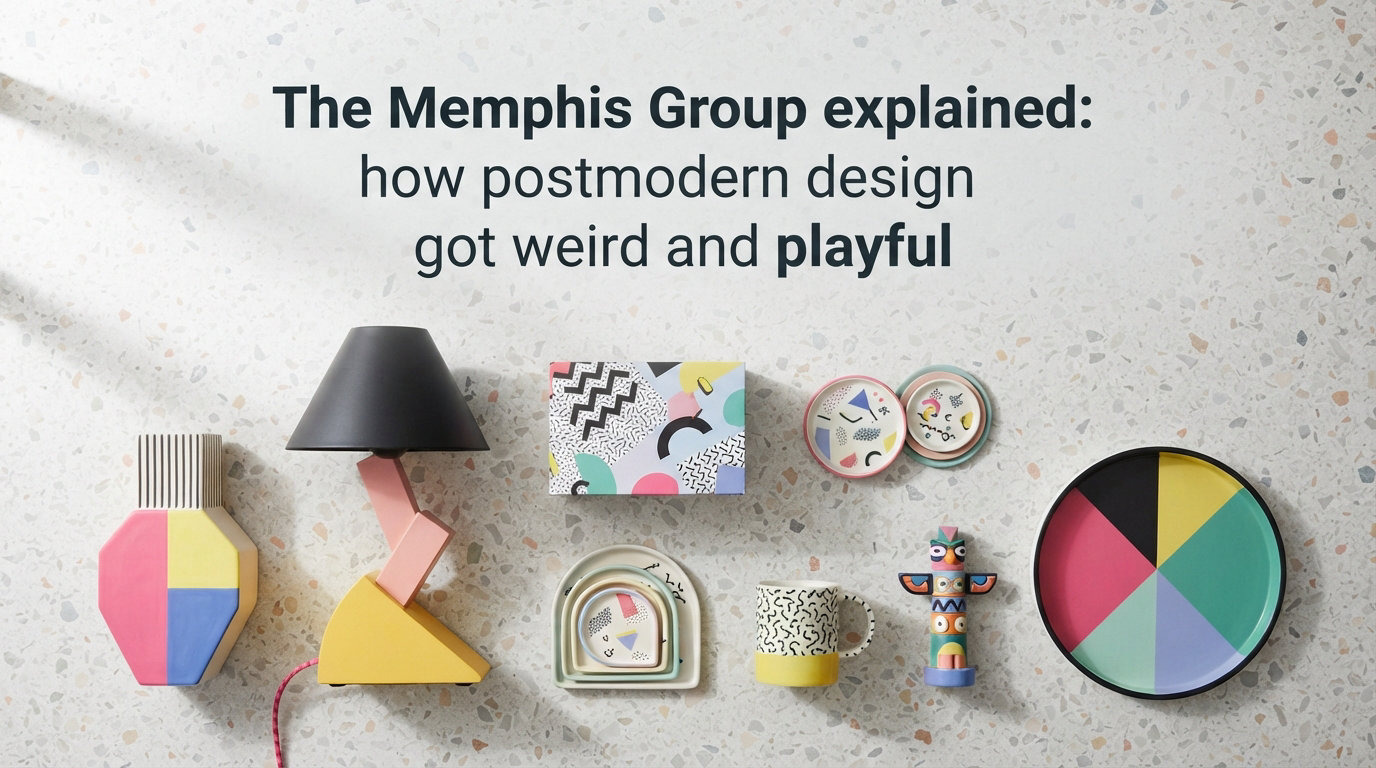
I remember the first time I walked into a room full of Memphis Milano furniture. My eyes went everywhere at once. Squiggles, dots, stripes, neon yellow meeting soft pink meeting a jagged triangle in primary blue. It felt like someone had shaken up a toy box and built a bookshelf out of it.
That reaction, somewhere between delight and confusion, is exactly what the Memphis Group wanted. Founded in Milan in December 1980, this small Italian design collective spent seven years smashing the seriousness out of 1980s interiors. Their furniture, lamps, ceramics, and textiles still feel fresh today, more than four decades later.
In this guide, I will walk you through the Memphis Group explained in full. You will learn who founded it, why they picked such a strange name, what made their designs so different, and why your favorite designers and fashion houses keep stealing from them in 2026.
Table of Contents
What is the Memphis Group? A clear definition
The Memphis Group was an Italian design and architecture collective founded by Ettore Sottsass in Milan in December 1980, active until 1987. The group designed postmodern furniture, lighting, fabrics, carpets, ceramics, glass, and metal objects.
If you have ever seen a brightly colored room with squiggly patterns, asymmetric shapes, and a playful sense of chaos, you have probably seen Memphis influence. The movement is one of the most recognizable design styles of the 20th century, and arguably the one most people either love or hate.
Memphis is short for Memphis Milano, the name used by the company Sottsass founded to produce and sell the collective’s work. It is not named after the city of Memphis, Tennessee, nor the ancient Egyptian capital. The name came from a Bob Dylan song, as I will explain in the next section.
The origin story: December 1980 in Milan
The Memphis Group was born on December 11, 1980, in a small Milan apartment. Ettore Sottsass, then 63, invited a handful of younger designers and architects to his home for what was meant to be a late-night creative conversation. By the end of that single evening, the group had a manifesto, a name, and a clear vision for tearing up the rulebook of European design.
The trigger for that meeting was frustration. The early 1980s design scene was dominated by what Italians called “good taste”: clean lines, neutral palettes, modular systems, and the rationalist tradition stretching back to the Bauhaus. Sottsass felt this aesthetic had become a cage. He wanted furniture that made you smile, laugh, and maybe even feel a little uncomfortable.
Here is the famous detail almost no one remembers. When the group needed a name, someone put on a record. Bob Dylan’s “Stuck Inside of Mobile with the Memphis Blues Again” was playing on repeat that night. The opening line repeats the word Memphis so often that it stuck in everyone’s head. Memphis it was. There is no deeper meaning, no city being honored. Just a song that would not stop playing.
The group launched publicly at the Salone del Mobile in Milan in September 1981. Their debut collection shocked the design world. Critics called it childish, garish, and even insulting. But the younger generation of architects, artists, and pop stars saw something completely different. They saw freedom.
Key designers of the Memphis Group
The Memphis Group was led by Ettore Sottsass, the founder and spiritual center. Sottsass was already a legend in Italian design by 1980, having worked with Olivetti for decades and made architecture that bent modernist rules. He was the elder statesman who gave Memphis its confidence to be weird.
Around him sat a rotating cast of about 18 core members and many collaborators. The names you will see most often are Martine Bedin, a French designer famous for her yellow “Super” lamp with a little ball on a wire. Peter Shire, an American from Los Angeles who brought playful ceramics and bright color combinations. Nathalie Du Pasquier, who became the face of the group’s graphic textile work. George Sowden, the British designer behind some of the most iconic geometric patterns. And Marco Zanini, who shaped many of the early furniture silhouettes.
Other members who shaped the movement include Matteo Thun, Aldo Cibic, Javier Mariscal, Masanori Umeda, and the German group Kurtenbach + Partner. Each brought a different national sensibility, which is why Memphis never feels like one style. It feels like a family of styles arguing in the same room.
One detail I love: the group had no formal application process. Sottsass invited people he trusted, or who had shown work he liked. This loose, club-like structure is why Memphis feels more like a band than a brand. People drifted in, drifted out, and made things together for the joy of it.
What makes Memphis Design distinctive? The four key features
Memphis Design is defined by four core features that show up in almost every piece from the collective. Understanding these is the fastest way to spot Memphis influence anywhere, from a 1982 cabinet to a 2026 lifestyle brand campaign.
1. Bold, clashing colors. Memphis pieces use color the way a child uses crayons. Hot pink sits next to mint green next to mustard yellow, often with no attempt to harmonize. The palette is bright, saturated, and intentionally overwhelming. There is almost no black, white, or beige. Neutral was the enemy.
2. Geometric shapes with playful asymmetry. Triangles, circles, stripes, grids, and zigzags appear constantly. The shapes are rarely balanced in the classical sense. A table might have three legs at different angles. A bookcase might lean slightly to one side, like it is mid-motion. The asymmetry is the point. It makes the object feel alive.
3. Decorative patterns and graphics. Squiggles, dots, checkerboards, “bacterio” patterns (those tiny squirmy shapes), and terrazzo-style speckles cover almost every surface. Patterns are layered on patterns. A single cabinet might combine a striped side, a polka-dot door, and a squiggle handle. The visual noise is the message.
4. Unconventional materials and combinations. Memphis designers mixed materials the design world had kept apart. Plastic laminate sat next to wood veneer. Terrazzo met brass. Painted surfaces hid cheap particleboard underneath. The mix was partly ideological (rejecting luxury as the only path to good design) and partly playful (what if we tried this anyway).
Together, these features add up to one big idea: design does not have to be serious to be good. It can make you laugh, confuse you, or even annoy you, and that is fine.
Materials and techniques
The Memphis Group used materials that were, by 1980s standards, completely wrong for high design. Plastic laminate (the same stuff on cheap kitchen counters) was the star. Sottsass loved it because it came in bright colors and wild printed patterns straight from the factory. No painting, no hand finishing. Just glue, press, done.
Terrazzo, a composite of marble chips in cement, was another favorite. Memphis terrazzo used bright red, blue, and yellow chips instead of the usual muted palette. It showed up in tabletops, vases, and even small household objects.
The group also used bent plywood, lacquered MDF, chrome tubing, mirrored glass, and brass. The rule was simple: if a material could carry color or pattern, use it. If it was considered “low class,” even better. Memphis wanted to bring the energy of pop culture and everyday objects into the gallery space.
One technique Sottsass called “skin and bone” mattered too. Pieces often had a cheap internal structure (the bone) hidden under a vivid decorative skin. This was partly practical. Memphis had to be affordable to be democratic. But it was also philosophical. The group rejected the idea that good design had to mean expensive materials.
Iconic Memphis Group pieces
You cannot talk about Memphis without a few hero objects. These are the pieces that show up in every museum show, every auction catalog, and every design student’s reference folder.
The Carlton bookcase by Ettore Sottsass (1981) is the unofficial mascot of the movement. It is a wooden room divider covered in pink, blue, black, and yellow laminate, with shelves at impossible angles and a cartoonish zigzag base. It looks like a dollhouse furniture set grown to human size. The Carlton is in the collections of the Metropolitan Museum of Art, the Victoria and Albert Museum, and most major design museums worldwide.
The Tahiti lamp by Mario Botta (1985) is a yellow metal cylinder wrapped in a striped, candy-colored sleeve, with a round bulb that glows like a setting sun. It is one of the most photographed Memphis objects, partly because it looks so ridiculous and partly because it actually works beautifully as a lamp.
Other essential pieces include the Ultrafragola mirror by Sottsass (1970, before Memphis but in the same spirit), whose pink neon wavy frame set the visual template for the whole movement. The Casablanca sideboard by Zanini (1981) with its checkerboard doors. The Super lamp by Martine Bedin, a yellow tube balancing a small white globe. And the Estate 1 sofa by Umeda, which looks like an enormous wrapped candy.
Memphis Design vs Bauhaus: a postmodern rebellion
Memphis Design is best understood as a direct reaction against the Bauhaus tradition. The Bauhaus, founded in 1919 Germany, taught that good design should be functional, minimal, and available to ordinary people. “Form follows function” was its famous motto. A chair should be a chair, no decoration needed.
Memphis agreed with the democratic spirit. It also wanted furniture for everyone, not just the rich. But it threw out the rule about minimalism. For Memphis, function was only one ingredient. A chair could be a chair, but it could also be a joke, a sculpture, or a piece of pop art.
The materials also flipped. Bauhaus leaned on tubular steel, bent plywood, and honest materials. Memphis covered cheap materials in loud skin and called it philosophy. Both movements wanted a better world through better objects. They just disagreed on what better looked like.
That contrast is why the Memphis Group still feels so fresh. In a design world that keeps swinging between minimalism and maximalism, Memphis is the loudest voice for the idea that objects can be joyful without being useless.
Cultural impact and lasting legacy
The Memphis Group influenced far more than furniture. Its visual language spread into fashion, music, film, and graphic design almost immediately after its 1981 debut.
Collectors jumped in early. Karl Lagerfeld filled his Paris apartment with Memphis pieces. David Bowie was a known fan, who once described the visceral jolt of seeing a Memphis piece in person for the first time. Jasper Morrison, now a famous minimalist designer himself, has admitted he broke out in a “cold sweat” the first time he walked into a Memphis exhibition. Even the harshest critic in the design world, Terence Conran, dismissed the group as “joke junk.” The arguments alone gave Memphis more visibility than a hundred paid campaigns.
By the late 1980s, Memphis influence was everywhere. MTV graphics borrowed the colors and shapes. Music videos used Memphis sets as backdrops. Fashion houses, especially Dior and Missoni, sent Memphis-inspired prints down their runways. Even early Microsoft Encarta and consumer packaging picked up the geometric style.
Museums locked in the legacy. Today you can find Memphis Group pieces in the permanent collections of the Metropolitan Museum of Art, the Victoria and Albert Museum, MoMA, and the Centre Pompidou. The 40th anniversary of the movement in 2021 was marked by major exhibitions at MK Gallery in the UK and the Vitra Design Museum in Germany.
The contemporary revival: how to spot Memphis today
Memphis never really went away. Original pieces kept selling at auction for record prices. But around 2018, a louder revival started. Younger designers, stylists, and brands rediscovered the playful shapes and bold palettes the 1980s had left behind.
You have probably seen the most famous modern offshoot without realizing its roots. “Corporate Memphis” is the flat illustration style of friendly, geometric, brightly colored figures used by tech companies, banks, and consulting firms in their marketing. Every “person at a laptop with floating shapes around them” image traces back, however loosely, to the visual language the Memphis Group invented. Critics call it bland. Designers call it unavoidable.
In real interiors, contemporary Memphis-inspired designers include the Italian brand Skate & Strike, the Dutch duo Mae Atelier, and young studios like Cold Picnic and Wedge. They make rugs, lamps, and small furniture that borrow Memphis color and shape without copying the 1981 originals. Original Memphis Milano pieces are still produced under license and sold through galleries like Gallery Libby Sellers in London.
If you want to bring Memphis energy home, start small. A single patterned vase, a striped lamp shade, or one bold geometric cushion can shift an entire room. The Memphis ethos was always about mixing one wild object into a calm space, not covering every surface in squiggles.
FAQs
What is the Memphis Design concept?
The Memphis Design concept is a postmodern approach to furniture and objects that rejects the seriousness of modernism. It uses bright clashing colors, geometric shapes, decorative patterns, and unconventional materials to create playful, memorable pieces that often feel closer to art or pop culture than traditional design.
What are the four key features of Memphis Design?
The four key features of Memphis Design are bold clashing colors, geometric shapes with playful asymmetry, decorative patterns and graphics like squiggles and dots, and unconventional material combinations such as plastic laminate, terrazzo, and bent plywood layered together.
Why are the designs of Memphis iconic?
The designs of Memphis are iconic because they broke the dominance of minimalism in 1980s design, introduced playful maximalism into serious architecture and furniture, and influenced fashion, music, and graphic design for decades. Their pieces are instantly recognizable, collectible, and still feel contemporary more than 40 years later.
What is postmodern Memphis inspired by?
Postmodern Memphis is inspired by a mix of sources including 1950s kitsch, Pop Art, Art Deco, the colors of Italian popular culture, ancient geometric patterns, and a reaction against the rationalist tradition of Bauhaus modernism. The Bob Dylan song ‘Stuck Inside of Mobile with the Memphis Blues Again’ gave the group its name.
Who founded the Memphis Group?
The Memphis Group was founded by Ettore Sottsass, an Italian designer and architect, in December 1980 in Milan. He led the group with a core circle of designers including Martine Bedin, Peter Shire, Nathalie Du Pasquier, George Sowden, and Marco Zanini.
When was the Memphis Group active?
The Memphis Group was active from December 1980 until 1987, when it was officially disbanded. During those seven years it produced furniture, lighting, fabrics, carpets, ceramics, glass, and metal objects, plus the Memphis Milano company that continues to license and produce selected pieces today.
Why did they call themselves Memphis?
They called themselves Memphis because Bob Dylan’s song ‘Stuck Inside of Mobile with the Memphis Blues Again’ was playing on repeat during the founding meeting on December 11, 1980 in Milan. The group liked the sound of the word and chose it almost on a whim. It has no connection to the city in Tennessee.
Final thoughts on The Memphis Group explained
The Memphis Group is one of the few design movements that genuinely changed what people thought furniture could be. By turning away from minimalism and toward play, color, and pattern, Ettore Sottsass and his circle gave us a way to design that still feels rebellious today.
Whether you love it or find it too loud, the Memphis Group explained above is impossible to ignore. Its shapes live in your favorite app, its colors show up in your favorite fashion house, and its furniture still makes people stop in museums. If you are designing a space in 2026 and want it to feel alive, a single Memphis-inspired piece is one of the quickest ways to get there.
Start with one object. A patterned lamp. A squiggly mirror. A striped vase. See how the room changes.