
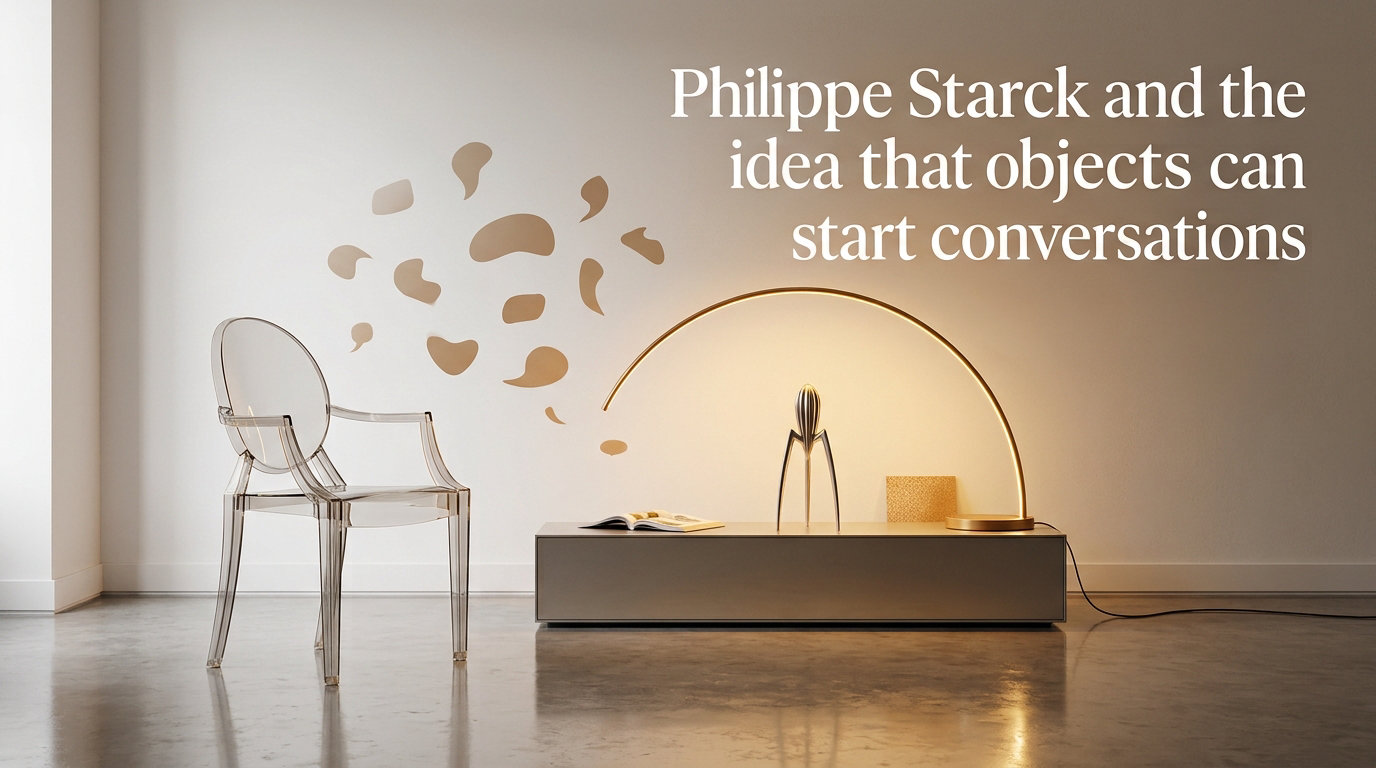
I’ve spent years walking through design fairs, hotel lobbies, and living rooms, and one name keeps pulling me back into a conversation: Philippe Starck. Not because every chair he makes is comfortable (some famously are not) or because every object he dreams up works perfectly (one of his most iconic pieces barely works at all). I keep coming back to him because his work is loud, opinionated, and impossible to ignore.
Starck’s design philosophy rests on a deceptively simple belief. He thinks objects should not just sit quietly on a shelf. They should argue with you, amuse you, embarrass you, or make you think. That idea is the engine behind his entire career, and it is what we are going to dig into here.
If you have ever wondered why a lemon squeezer looks like a robot spider, or why a transparent chair became the most copied seat in the world, this article is for you. We are going to break down Philippe Starck’s design philosophy through the lens that defines him best. The idea that objects can start conversations.
Table of Contents
Who Is Philippe Starck? A Designer Who Turns Objects Into Stories
Philippe Starck is a French industrial designer and architect born in Paris in 1949. He has spent more than five decades designing everything from lemon squeezers and toothbrushes to yachts, wind turbines, and presidential interiors. Few living designers have reshaped as many everyday objects as he has.
What makes him unusual is that he treats design as an act of authorship. He does not just solve problems. He tells stories, picks fights, and provokes reactions. To understand his work, you have to understand that every Starck object is meant to do something the user did not expect.
From Paris to the World: A Brief Biography
Starck was born into a creative family. His father was an aeronautical engineer, and the household encouraged both technical curiosity and visual experimentation. He studied at the École Nissim de Camondo in Paris, where he trained as an architect but quickly drifted toward product and interior design.
His first major break came in 1976. He designed the Les Bains Douches nightclub in Paris, which became a hangout for celebrities and musicians. That single project put him on the map as someone who could shape a mood with shapes, light, and materials. From there, he went on to design the Café Costes (1984), the Royalton Hotel in New York (1988), and the Delano Hotel in Miami (1995).
Starck has also redesigned the apartments inside the Élysée Palace for the President of France and designed the interiors of the Royal Monceau in Paris. Each project has built his reputation as a designer who does not hide behind his objects. He speaks for them.
Why His Background Shaped His Philosophy
Starck grew up in a France that was rebuilding after World War II. The country had to decide what objects belonged in everyday life. Should they be cheap and disposable, or should they be elevated and worth keeping? Starck chose the second path, but with a twist. He wanted good design to be affordable enough that anyone could own it.
That childhood context still drives his work today. He talks often about his father, his grandfather, and the discipline of growing up in a household where craft mattered. He also talks about ecology, mortality, and human connection, three topics that keep surfacing in his interviews. He does not separate design from ethics. He treats them as the same project.
The Core of Philippe Starck’s Design Philosophy
Philippe Starck’s design philosophy can be summed up in a single sentence: objects should be beautiful, useful, and available to as many people as possible. Everything else flows from that idea.
He has talked about this in hundreds of interviews. In his own words, his job is to “create emotion.” That is the line that sits at the heart of everything he has ever made. If an object does not create emotion, he considers it a failure, no matter how functional it is.
Democratic Design: Beauty for Everyone
Democratic design is the part of Starck’s philosophy that gets the most attention, and for good reason. Starck believes design excellence should not be reserved for the rich. Good ideas deserve to live in mass-produced objects that ordinary people can afford.
This belief has shaped his choices for decades. He designed a now-famous toothbrush for Duravit that sells at an accessible price. He partnered with Target on a budget-friendly collection called “Starck for Target,” which included everything from alarm clocks to garden furniture. He designed a stackable polycarbonate chair, the Louis Ghost, that costs a fraction of what a hand-crafted wooden seat would.
For Starck, democratic design is not about cutting corners. It is about respecting people enough to give them great objects at fair prices. He calls it a moral position, not a marketing one.
Human-Centered Design and Bionics
Starck talks often about bionics. For him, bionics is not just about borrowing shapes from nature. It is about asking what an object can do for the human body, the human eye, the human mind. Good design should adapt to people, not the other way around.
This is why his chairs often test the boundary between comfort and concept. The Costes chair, for instance, looks sculptural, even harsh. Sit in it, though, and you find that the curves match the shape of your back. The form follows feeling, not the other way around.
He has called himself “a sort of bionics researcher.” That phrase sums up how he works. He studies the body, studies the environment, then creates something that talks back.
Sustainability as a Moral Duty
Starck treats sustainability as non-negotiable. He has said that any object which cannot be recycled, repaired, or reused is a small crime against the planet. He pushes manufacturers to use single materials so products can be broken down and rebuilt.
This commitment shows up in everything from his chairs made of recyclable polycarbonate to his wind turbine designs. He does not see sustainability as a selling point. He sees it as a baseline.
How Philippe Starck Designs Objects That Start Conversations
This is the question that runs through everything Starck has ever done. How do you design an object that does not just function, but also speaks? It is one thing to make something useful. It is another to make it memorable enough that a stranger in a kitchen turns it around in their hands and says, “What is this?”
Starck’s trick is to break expectations in the smallest, most specific way possible. He does not redesign the whole object. He nudges one detail until the entire thing feels new.
The Power of the Unexpected Form
Most objects hide their cleverness. A good toaster, for example, looks like a toaster. A Starck toaster would still look like a toaster, but the lever might be the wrong size, or the color might be a soft green that nobody expects.
That small break in expectation is what turns a passive user into an active one. The brain notices the difference. It pays attention. It starts asking questions. By the time the user has finished using the object, they have had a private conversation with the designer who made it.
This is why his Juicy Salif looks like an alien tripod, and why his Ghost Chair looks like a royal throne made of glass. They are not just functional objects. They are conversation pieces in the truest sense of the word.
Objects That Demand a Response
Some Starck designs are deliberately uncomfortable. The Costes chair has been called both beautiful and punishing. The Juicy Salif is famously bad at squeezing lemons. The WOW pen looks like a folded piece of paper rather than a writing tool.
None of this is accidental. Starck wants you to react. He wants you to pick the object up, study it, argue with it. If you leave a room thinking about a chair, the chair has done its job.
He has said in interviews that the worst object in the world is the one nobody talks about. He has built an entire career on objects people cannot stop talking about.
Humor, Provocation, and the Conversation-Starter
Look at the most famous Starck pieces and you will find a streak of humor running through them. His products are not afraid to be playful. The Juicy Salif’s spider-like stance has been called a joke. The Mr. Impossible chair for Kartell combines two transparent shells into a single shape, which feels like a visual pun.
That humor is what lowers people’s defenses. Once someone laughs at a lemon squeezer, they are open to thinking about what design can be. That is the opening Starck uses to start a real conversation about beauty, accessibility, and how we live.
Iconic Works That Prove the Conversation-Starter Theory
If you want proof that objects can start conversations, look at the catalogue Starck has built over five decades. The pieces below are not just commercially successful. They are pieces that show up in museums, in design textbooks, and in arguments between designers who still cannot agree on whether they are genius or nonsense.
Juicy Salif: The Lemon Squeezer That Sparked a Global Debate
The Juicy Salif, designed in 1990 for Alessi, is the poster child for everything Starck believes about objects and conversation. It is a lemon squeezer shaped like a three-legged spider, cast in aluminum, and finished in bright colors.
It is also, by most accounts, terrible at squeezing lemons. The juice runs down the legs and onto the counter. The pulp clogs in the wrong places. It is heavy, awkward to clean, and prone to scratching. None of this has hurt its popularity. It has sold millions of copies since 1990.
What the Juicy Salif proves is that an object does not need to be efficient to be loved. It needs to be talked about. Every home that owns one ends up with a story about it. That story is the real product.
Louis Ghost Chair: Transparency That Talks
The Louis Ghost Chair, designed in 2002 for Kartell, takes the classic Louis XV armchair and rebuilds it in transparent polycarbonate. It looks like a ghost of an 18th-century chair, hence the name.
The chair is light, stackable, weatherproof, and surprisingly comfortable. It also looks stunning in almost any room. It blends in while standing out. You can put it in a palace or on a balcony, and it will hold its own.
This is democratic design in its purest form. It borrows from history, brings it into the present, and makes it affordable. Every Louis Ghost Chair is a quiet argument that good design should not belong only to museums.
Alessi, Kartell, Flos: Brands That Carry His Voice
Starck’s relationship with Italian and European manufacturers has shaped his legacy as much as his designs have. Alessi gave him the Juicy Salif and dozens of other household objects. Kartell gave him the tools to experiment with polycarbonate. Flos, the lighting company, has produced his lamps for years.
These brands share Starck’s belief that an object can be both functional and expressive. Together, they have produced objects that are now in the permanent collections of museums like MoMA in New York and the V&A in London. That kind of cultural reach is rare for any designer, and it is built on objects that do not stop talking once they leave the store.
Starck’s Influence on Interior Design and Hospitality
Starck’s impact on interior design goes far beyond furniture. He helped invent the boutique hotel as we know it. Before his work on the Royalton in New York (1988) and the Delano in Miami (1995), hotel lobbies were grand and forgettable. After them, lobbies became stages. They became places where guests hung out, took photos, and started conversations with strangers.
Boutique Hotels as Conversation Spaces
The Delano hotel in Miami is a textbook example of Starck’s hospitality philosophy. The lobby feels more like a dreamy living room than a reception area. Furniture, lighting, and art all carry his voice. Guests do not just pass through. They linger. They take pictures. They start talking to each other about what they see.
This is a deliberate choice. Starck designs hotels the same way he designs objects. He wants the space to provoke. He wants guests to leave with a memory they can describe to friends. That is the conversation-starter idea scaled up to architecture.
From Café Costes to the Royal Monceau
Café Costes, in the heart of Paris, opened in 1984 and is still considered a turning point for restaurant design. The Costes chair, with its woven back and minimal frame, has been copied thousands of times. The space mixes dark wood, hanging lamps, and almost theatrical lighting to create a place that feels intimate and exciting at the same time.
The Royal Monceau, a luxury hotel in Paris redesigned by Starck in 2010, took the same instinct and pushed it further. The lobby feels like a private library from a black-and-white film. The rooms mix art, photography, and custom furniture. Every corner is meant to be noticed. Every detail is meant to be discussed.
Across all of these projects, the rule is the same. A space should not be a backdrop. It should be a participant in the conversation.
The Controversies: Why Critics Argue About Starck
No article about Philippe Starck’s design philosophy would be honest without addressing the criticisms. He has been called arrogant, repetitive, and commercial. The Juicy Salif is still used as proof that Starck cares more about style than function. Some critics think he has flooded the market with branding rather than ideas.
Form vs Function: The Juicy Salif Debate
The Juicy Salif debate is older than most of his fans. Designers still argue about whether it is a sculpture that happens to squeeze lemons, or a lemon squeezer that happens to look like a sculpture. Starck himself has said he does not care how well it works. He cares how it makes people feel.
To his critics, that answer is exactly the problem. They believe design should respect the user by making tools that work well. To his fans, that answer is exactly the point. A lemon squeezer does not have to be a serious object. It can be a small piece of art that lives in your kitchen.
Cheapening Design or Liberating It?
Some critics think Starck’s mass-market work has cheapened design. They point to his Target collection and say it turned design into a trend rather than a discipline. Others think the opposite. They argue he has done more than any other designer to bring design into ordinary homes.
The truth is probably somewhere in the middle. Starck has flooded the market, but he has also raised expectations. People who would never have bought a designer object now expect more from everyday products. That shift in expectation is one of his quietest, biggest contributions.
The Future of Starck’s Design Philosophy in 2026
Starck is still working in 2026. He is in his late seventies, and his studio is still releasing products, hotels, and ideas. He has also moved deeper into technology and ecology, working on hydrogen-powered boats, electric vehicles, and sustainable architecture.
Starck’s Views on Technology and Humanity
Starck often talks about technology as a human right. He believes technology should serve people, not the other way around. That is why his designs rarely hide their mechanisms. The object shows you how it works. The user feels included, not patronized.
This belief is going to shape his next decade. As artificial intelligence, robotics, and renewable energy reshape our homes, Starck is already asking how those technologies can be made beautiful, accessible, and worth talking about.
A Legacy of Conversation
When we look back at Starck’s career in 2026, the through line is clear. He has spent fifty years designing objects that refuse to be ignored. Whether you love him or hate him, his work makes you react. That reaction is the conversation he has been chasing all along.
For designers, students, and curious owners, that is a useful reminder. Objects are not just tools. They are voices. The right object can teach us, surprise us, and connect us to the people around us.
If you are designing something yourself, ask the question Starck has spent his life answering. What will this object make people say?
Frequently Asked Questions About Philippe Starck’s Design Philosophy
What is the philosophy of Philippe Starck design?
Philippe Starck’s design philosophy rests on three main ideas: democratic design, human-centered creation, and emotional expression. He believes good design should be available to everyone, not just the wealthy. He treats objects as tools for shaping feelings and starting conversations, which is why his work often balances simplicity with surprise.
What is Philippe Starck’s most famous design?
The Juicy Salif lemon squeezer, designed for Alessi in 1990, is the design most people associate with Philippe Starck. It is a sculptural aluminum object shaped like a three-legged spider. It is widely sold, widely copied, and widely debated. Its fame comes not from how well it works, but from how much conversation it creates.
What was Philippe Starck thinking of when he designed the Juicy Salif?
Philippe Starck has described the Juicy Salif as a small piece of sculpture that happens to squeeze lemons. He wanted an everyday object that looked like it belonged in an art gallery. His goal was to make people pause, laugh, and talk about a kitchen tool, which is exactly what has happened for more than 30 years.
What design style does Starck use?
Philippe Starck uses an avant-garde design style that blends minimalism, surrealism, and pop culture. His work often combines clean lines with playful forms. He mixes industrial materials like polycarbonate and aluminum with soft shapes inspired by nature. The end result feels modern but warm, simple but expressive.
Final Thoughts: Objects That Refuse to Stay Quiet
Philippe Starck’s design philosophy has always been about more than shapes. It is about how a chair makes you feel when you sit down, what a lamp does to a room, and why a lemon squeezer can become the most talked-about object in a kitchen.
If you take one thing from this article, let it be this. The next time you pick up an everyday object, ask yourself whether it says anything. If it does not, you are holding a tool. If it does, you are holding a small piece of design, and you have just joined a conversation that has been running since 1949.