
The stack on my kitchen counter used to grow back every week, no matter how many times I sorted it. I tested paper sorters, labeled folders, and even a fancy inbox tray, and within seven days the piles had returned. The reason was simple: I had a place to put papers, but I had no system to process them or a routine to maintain it.
This guide shows you how to organize paperwork and mail so it stops piling up for good. You will learn the RAFT sorting method, a small set of filing categories that actually fit real life, a mail station that catches paper the moment it enters your home, and a daily plus weekly routine that prevents the pile from ever coming back.
Table of Contents
Step 1: Set Up a Sorting System (RAFT) So You Always Know What to Do With a Paper
The fastest way to clear a paper pile is to give every sheet a single decision in under five seconds. That is what the RAFT system was built for, and it is the foundation of any real solution for how to organize paperwork and mail at home.
What is the RAFT system?
RAFT stands for Read, Act, File, and Toss. Each piece of paper you touch gets sorted into one of those four actions, which removes the freeze that happens when you stand over a stack and try to think about every document at once.
Read: Junk mail, flyers, school notices, and anything that only needs a glance. Read it, then immediately toss it, recycle it, or move it to your calendar.
Act: Bills, forms that need a signature, appointment reminders, and any deadline-driven document. Put these in a single “Act” tray and schedule a 15-minute block once a week to handle them.
File: Tax records, insurance policies, medical history, contracts, warranties, and anything you may need to look up later. These go straight into a labeled folder in your filing system.
Toss: Receipts for non-deductible purchases under $75, expired coupons, old takeout menus, and anything that has no future purpose. If you have not looked at it in a year, toss it.
The first time you run RAFT on an existing pile, set a 45-minute timer and stop when it ends. You will not finish everything in one sitting, and that is fine. Sorting a small mountain is what creates lasting paper management habits.
Step 2: Create Filing Categories That Match Your Real Life
A filing system only works if you remember where to put things. Forget the alphabet. Most households need fewer than ten categories, and naming them based on your real life beats naming them after official document types every time.
Start with these core folders and add or remove as you sort your first batch of papers.
Action: Bills to pay, forms to sign, things waiting on a response.
Banking: Statements, tax records, loan documents, investment reports.
Medical: Insurance cards, test results, immunization records, prescriptions.
Home: Mortgage or lease, utility contracts, warranties, repair receipts.
Family: School records, child care paperwork, pet vet records, emergency contacts.
Work: Pay stubs, W-2s, freelance invoices, business cards you actually use.
Sentimental: Kids’ artwork you cannot part with, greeting cards, diplomas.
Use vertical storage wherever possible. Hanging file folders, magazine holders, or even a stack of labeled banker boxes on a shelf all let you see every folder at once. Storing papers flat in drawers hides the problem and gives the pile permission to grow again.
If you do not have a filing cabinet, do not let that stop you. A small two-drawer plastic cart, a desktop organizer with tiers, or a labeled accordion file works just as well. The container matters less than the fact that every paper has one named home.
Step 3: Build a Mail Station That Stops Clutter Before It Starts
The reason mail piles up on counters is that mail has no home. The moment you give it one, the pile problem drops by about 70 percent. A mail station is a small, dedicated zone near the door where you walk in, and it is the single best habit for how to organize mail in any home.
Your mail station only needs four items.
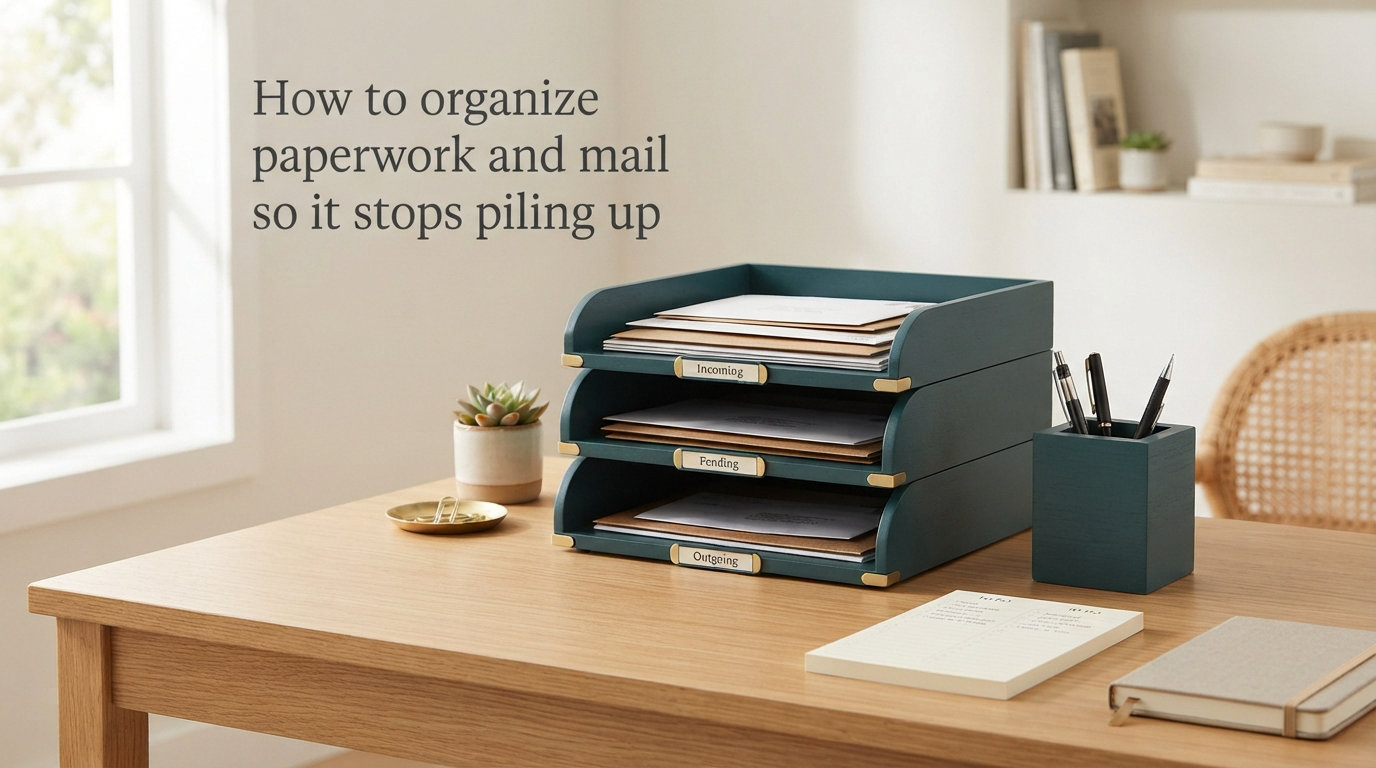
An open inbox tray: This catches every envelope the moment it enters the house. Nothing goes on the counter, table, or couch.
A small shredder or recycling bin: Place it right next to the tray so tossing junk mail is the path of least resistance.
A wall calendar or planner: School events, appointment reminders, and payment due dates go here the moment you read them.
A pen and a stack of small sticky notes: For marking urgent items, circling dates, or leaving yourself reminders.
The rule is simple: the minute you walk in with the mail, you put it in the tray, not on the counter. Even if you are tired, even if you are holding groceries, even if you have a child in your arms. The paper goes in the tray. Sorting happens later, at your scheduled time.
Step 4: Run a Daily and Weekly Routine So Paper Can’t Pile Up
This is the step most guides skip, and it is the only reason paper piles come back. A system without a routine is just decoration. To learn how to organize paperwork and mail so it stops piling up, you need three recurring time blocks.
Daily 10-minute sweep
Pick the same time every day. Many people do this right after dinner or after the kids are in bed. Pull every paper out of the mail station tray and run it through RAFT. Bills go in the Act folder, junk goes in the shredder, reference goes in the right labeled folder, and anything that needs a future reminder goes on the calendar.
Weekly 30-minute review
On the same day each week, sit down and clear the Act folder. Pay the bills, sign the forms, return the calls. Anything still sitting in Act after the weekly review gets a sticky note with a deadline and a final home. This is also a good moment to do a quick bill organization sweep and make sure nothing is about to slip through the cracks.
Monthly reset
Once a month, spend 20 minutes looking at the bigger folders: Medical, Banking, Home, and Family. Shred anything that has expired, move anything over a year old into an archive box, and restock supplies like stamps, envelopes, and shredder bags. A small monthly reset keeps the active folders from bloating into the same problem you started with.
If you live with other people, delegate one of these blocks. A partner or older child can own the daily sweep. A roommate can own the shredding. Paper management stops being your private project the moment more than one person lives in the home, and splitting the routine is what keeps it alive during busy weeks.
What to Keep vs. Toss: A Quick Decision Guide
The single biggest reason people keep paper piles is fear of throwing away something important. Use this quick rule set to clear the doubt.
Keep for 7 years: Tax returns, W-2s, and any document that supports a tax deduction.
Keep until the warranty expires plus one year: Major purchase receipts and product manuals.
Keep while active, then shred: Insurance policies, medical bills, and loan statements.
Toss immediately: Duplicate statements, expired coupons, junk mail, and ATM receipts.
If you are unsure, take a photo with your phone and store it in a single cloud folder called “Paper Backup.” That gives you the safety net without the physical clutter.
Common Mistakes to Avoid When You Organize Paperwork
Even a good system fails when it runs into these classic traps. Watch for them as you set up your routine.
Sorting the entire backlog in one weekend. You will burn out by Sunday night and the pile will return by Wednesday.
Building a system that is too pretty to use. If your labels are color-coded but you cannot find a pen, the system will not survive contact with real life.
Keeping papers out of guilt. A flyer for a sale you did not attend is not a memory. Toss it.
Skipping the daily sweep. The 10-minute habit is what makes the rest of the system work.
FAQs
How to keep mail from piling up?
Sort mail the moment you walk in the door. Place a tray near the entry, put every envelope in it immediately, and run each piece through the RAFT system (Read, Act, File, Toss) during a 10-minute daily sweep. Junk mail goes straight to the shredder or recycling bin. Bills and action items go in a single Act folder. Reference documents go in their labeled folder. A consistent daily habit is the only real way to keep mail from piling up again.
What is the 5 5 5 rule for decluttering?
The 5 5 5 rule is a quick decluttering method: find 5 items to throw away, 5 items to donate, and 5 items to return to their proper home, repeated in every room. It works well as a fast paper purge before you set up your filing system because it forces small, repeatable action instead of one giant sorting marathon.
How to organize piles of paperwork?
Use the RAFT sorting method. Pull out one pile, set a 45-minute timer, and decide each paper in under five seconds: Read it, Act on it, File it, or Toss it. After the timer ends, stop and run the same RAFT sweep daily on new mail. Most piles disappear within one week of consistent daily sorting.
What is the 12-12-12 rule for decluttering?
The 12-12-12 rule means finding 12 items to throw away, 12 items to donate, and 12 items to return to their proper place. It is a slightly deeper version of the 5 5 5 rule and works well for clearing a long-neglected paperwork backlog before you build your daily routine.
How do you organize paper clutter?
Set up the RAFT system, build 5 to 8 labeled filing categories that match your life, place an inbox tray by the door as a mail station, and run a daily 10-minute sweep plus a weekly 30-minute review. Vertical storage, a small shredder, and a shared household routine are what stop the clutter from coming back.
Start Small and the Pile Stays Gone
You do not need a perfect weekend or a new piece of furniture to learn how to organize paperwork and mail so it stops piling up. You need four things: the RAFT sorting system, a small set of labeled folders, a mail station by the door, and a 10-minute daily habit.
Set the timer tonight. Run one pile through RAFT. Build the mail station tomorrow morning. Run the first daily sweep after dinner. By the end of the week, the kitchen counter will be clear, and more importantly, it will stay clear.