
Most layered rugs look bad for the same handful of reasons. Either the top rug is too small, the angles are off, or the colors clash with no plan behind them. I have made every one of those mistakes in my own home, and I have watched other people do it on Reddit threads where the comments are brutal.
This guide will walk you through how to layer rugs the way interior designers actually do it. You will learn the 60-70% coverage rule, the pattern mixing logic, the texture combinations that work, and the cases where you should not layer at all. By the end, you will know when layering rugs looks intentional and when it just looks like a rug on top of another rug.
Table of Contents
What is rug layering and why it actually works?
Rug layering is the practice of placing one rug on top of another to add visual depth, define zones, and combine different patterns or textures in a single room. It works when the two rugs have a clear relationship, usually through proportion, color, or texture.
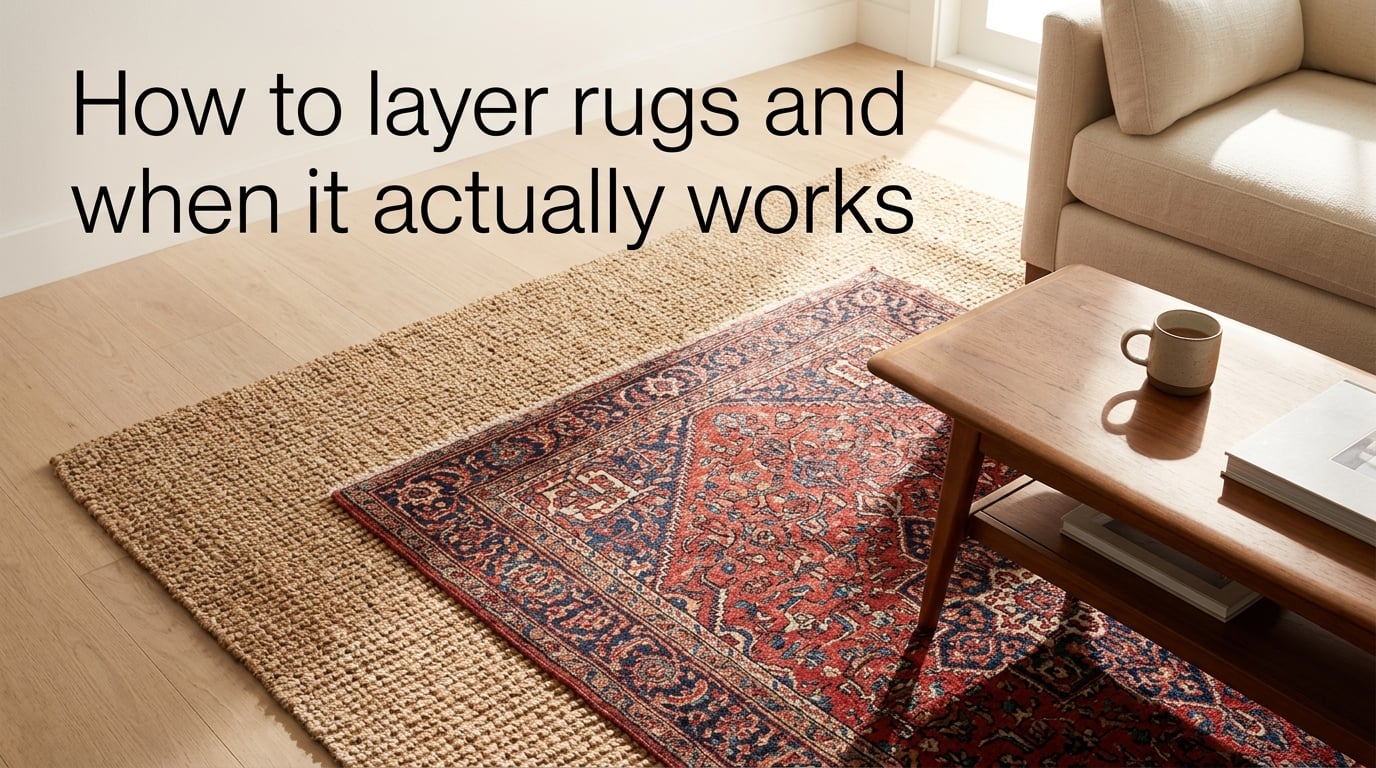
I started layering rugs after a designer friend pointed out that my living room looked “flat.” She brought a 6×9 vintage rug and laid it at an angle over my 8×10 jute, and the entire room woke up. That was the first time I understood that layering is not about adding more rugs. It is about giving the eye a reason to travel.
When done right, layered rugs add warmth, create distinct zones in open-plan spaces, and let you mix patterns without committing to one bold statement. When done wrong, it looks like you forgot to put away a rug. The difference comes down to a few measurable rules.
When rug layering looks bad (and why)
Let me get the failures out of the way first, because the title asked when it actually works. Reddit users have very strong opinions about poorly executed layered rugs, and most of the complaints hit the same notes.
The first sign of a bad layered look is rugs that do not connect visually. If the top rug is a completely unrelated color palette to the base rug, the eye reads them as two separate accidents instead of one design choice. I have seen living rooms where the base was a muted gray wool and the top was a loud hot pink kilim. They were not layered. They were just stacked.
The second issue is the weird angled second rug that pretends to be intentional but reads as wrong. Designers sometimes layer at a diagonal, but only when the rotation makes the layering feel like a deliberate design move. When the angle looks accidental, it just feels awkward. As a design rule I learned the hard way: if you have to ask whether the angle is working, it is not working.
The third problem is rug sizes that are too close together. If the top rug covers almost all of the base rug, you do not have layering. You just have one rug with a strange border poking out. The base rug needs to be visible enough to play a role.
Finally, layering rugs fail when the pieces fight each other in style. A heavy traditional Persian over a sleek modern flatweave will rarely feel cohesive, no matter how good the colors are. Style consistency matters as much as color.
The 60-70% coverage rule for layering rugs
The single most important rule for layering rugs is the 60-70% coverage rule. The top rug should cover 60-70% of the surface area of the base rug, leaving 30-40% of the base border visible on all sides. This proportion is what makes the layering look intentional instead of accidental.
Here are the size pairings that follow this rule cleanly:
9×12 base with a 5×7 or 6×9 top rug
8×10 base with a 5×7 or 5×8 top rug
8×10 base with a 6×9 top rug (closer to 70% coverage)
6×9 base with a 4×6 or 5×7 top rug
5×7 base with a 2×3 or 3×5 top rug
Yes, you can layer an 8×10 rug over a 9×12 base. The 8×10 will cover about 74% of the 9×12, which is right at the upper edge of the rule and creates a substantial border that grounds the room. Designers reach for this pairing often because the 9×12 anchors the seating area while the 8×10 adds a tighter focal point under the coffee table.
When the coverage drops below 60%, the top rug looks like a small island floating on a sea of base. When it climbs above 75%, the base rug becomes a thin frame and the layering feels claustrophobic. The 60-70% range is the sweet spot.
How to layer rugs in a living room (step by step)
The living room is where most people try layering first, and where the rules are easiest to apply. Here is the step-by-step process I use in my own home and recommend to clients.
Step 1: Choose the base rug first. The base rug should be the larger, usually neutral, and the one that grounds the furniture layout. Jute, sisal, and flatweave wool are popular choices because they are forgiving and textured enough to act as a quiet backdrop.
Step 2: Match the base rug to your seating placement. Designers recommend keeping at least the front two feet of your sofa on top of the base rug. This anchors the seating and prevents the room from feeling disjointed. If the sofa floats off the rug entirely, the layering loses its purpose.
Step 3: Pick the top rug with intention. The top rug should bring the personality, the pattern, or the color that the base rug cannot. It is the focal piece. Common choices include vintage Persians, Moroccan rugs, hides, or textured shag pieces.
Step 4: Center the top rug under the coffee table. Place the top rug so it sits under the coffee table, with the front legs of the sofa lightly resting on it. This creates the zone-defining effect that layering is supposed to deliver.
Step 5: Decide on angle or straight layout. Straight rectangular layering feels modern and orderly. Diagonal layering feels bohemian and relaxed. Pick one and commit. Mixing both styles in the same room almost never works.
Step 6: Add a rug pad between layers. A non-slip pad between the rugs keeps everything in place and prevents sliding. This is not optional. Without a pad, the top rug will creep outward every time you vacuum.
Pattern mixing techniques that work
Pattern mixing is where most people panic and end up with two solids. You can absolutely layer two patterned rugs, but you need a strategy. The two techniques that work are contrast in scale and connecting with color.
Contrast in scale means pairing a large-scale pattern with a small-scale pattern. A bold oversized medallion on the base rug pairs naturally with a tight geometric or striped top rug. The eye reads the two patterns as different objects rather than competing versions of the same idea. If both rugs have medium-scale patterns of similar density, they tend to vibrate and look messy.
Connecting with color means pulling one color from the base rug’s palette and using it as the dominant color of the top rug. This is the most reliable trick in pattern mixing. If your base rug has a deep blue and rust palette, the top rug should include that same deep blue or rust as a primary color. Borrow one anchor.
There is a third technique that I use when I want to keep things simple. Use one patterned rug and one solid or textured rug. The visual interest lives in the pattern, and the texture provides richness without competition. This is the safest layered look for beginners.
Texture layering approaches that designers recommend
Texture layering is the easiest way to combine rugs without pattern conflicts. The contrast lives in the surface, not the print. Here are the combinations that I have seen work consistently in real homes.
Flatweave + shag is the classic combination. The flatweave base provides a clean, low-pile foundation, while the shag top adds plushness and warmth. This pairing reads instantly as designer intentional. The pile height difference is what makes it interesting.
Natural fiber + patterned uses jute or sisal as the base and a patterned wool or vintage rug on top. This is the most common combination in design magazines because the natural fiber is neutral enough to handle almost any pattern without competing.
Hide + natural fiber pairs a cowhide on top of a jute or sisal base. The hide brings irregular shape and natural texture, while the base grounds it. This works well in reading nooks and beside beds.
Low pile + high pile is the underlying principle. The bigger the contrast in pile height, the more dimensional the layering reads. A plush tufted rug on a flat kilim will always look more layered than two flatweaves stacked on top of each other.
Color coordination principles
Color coordination is the part that intimidates people, but it follows a simple rule. Pick one anchor color and let it travel through both rugs. The anchor color does not have to be the dominant color in either rug. It can be a small detail in one rug and a major color in the other.
Temperature family matters too. Pair warm tones with warm tones (rust, ochre, terracotta, cream) and cool tones with cool tones (blue, gray, slate, sage). Crossing the temperature line creates a jarring effect that even careful pattern mixing cannot fix.
Neutrals are useful for both base and top rugs, but neutral on neutral looks flat. If you go neutral on neutral, bring in texture or a subtle pattern to keep things interesting. Otherwise, the rule of coverage drops by half because the eye does not register the layering.
What about layering rugs over carpet or in a bedroom?
Layering rugs over existing wall-to-wall carpet works in bedrooms and low-traffic areas. The base “rug” is the carpet itself, and you add a smaller patterned or textured rug on top to define the bed area or create a soft landing under your feet. Designers use this approach often to add personality to rental bedrooms where you cannot replace the carpet.
For bedrooms, the rule is similar to living rooms but with one twist. The top rug should extend at least 18-24 inches beyond the sides of the bed. This gives you a soft surface to step onto in the morning and grounds the room. A 5×7 top rug over a 9×12 base carpet is a common pairing in bedrooms.
In bedrooms, you can use shag on top of a low-pile carpet because the contrast in texture still registers. This is one of the few places where two high-pile rugs can work because the carpet itself is acting as the structural base, not as a visual element.
A rug pad is still required over wall-to-wall carpet. Without a pad, the top rug will slide and bunch up, especially in doorways and high-traffic transitions. Use a felt or rubber pad with a low profile to keep the pile height reasonable.
Common rug layering mistakes to avoid
These are the mistakes I see most often, and the ones Reddit users complain about in nearly every layering thread.
Mistake 1: Top rug too small. If the top rug disappears into the base, it looks like a patch. The 60-70% coverage rule exists to prevent this. A 2×3 rug over a 5×7 base is a small accent, not a layered look.
Mistake 2: No connection between rugs. Two rugs with no color, texture, or pattern relationship will read as a design accident. Always pull one anchor color or texture through both pieces.
Mistake 3: Skipping the rug pad. Without a pad, the top rug slides and bunches. The whole setup looks sloppy within a week. Spend the extra few dollars on a quality non-slip pad.
Mistake 4: Mixing too many styles. A traditional Persian over a coastal jute over a boho kilim is three different design languages. Pick one style direction and let that guide both rugs.
Mistake 5: Wrong angle for the wrong room. Diagonal layering looks great in boho and eclectic rooms. It looks confused in a modern minimalist space. Match the angle to the room’s style.
Mistake 6: Hiding the base rug. If the base rug is barely visible, you are not layering. You are just placing a small rug on top of a larger one. The base needs to contribute to the design, not just disappear.
Frequently asked questions about layering rugs
What is the rule for layering rugs?
The main rule for layering rugs is the 60-70% coverage rule. The top rug should cover 60-70% of the base rug so that 30-40% of the base remains visible as a border on all sides. Both rugs should also share an anchor color or a clear texture relationship to look intentional.
What are some rug layering mistakes to avoid?
The most common rug layering mistakes are using a top rug that is too small, skipping the rug pad, choosing two rugs with no color or texture connection, mixing too many design styles, and hiding the base rug entirely. A bad layered look almost always comes from one of these five problems.
Can you layer an 8×10 rug over a 9×12?
Yes, you can layer an 8×10 rug over a 9×12. The 8×10 will cover about 74% of the 9×12 surface, which sits right at the upper range of the 60-70% coverage rule. This pairing is common in living rooms because the larger 9×12 anchors the seating and the 8×10 creates a tighter focal point under the coffee table.
Can you layer rugs on top of each other?
Yes, you can layer rugs on top of each other in living rooms, bedrooms, and over wall-to-wall carpet. The combination works best when the top rug covers 60-70% of the base rug, both rugs share an anchor color or texture, and a non-slip pad is placed between them to prevent sliding.
Final thoughts on layering rugs
Layering rugs is one of the easiest ways to add depth and personality to a room, but it only works when the rules are followed. The 60-70% coverage rule, an anchor color, and a clear texture relationship are the three pieces that turn a stacked pair of rugs into a designed look. Skip those and you have just two rugs on the floor.
Start with one rug you already love and find a complementary piece that respects the coverage rule. Use what you have learned here about how to layer rugs, and you will end up with a room that finally feels finished in 2026.