
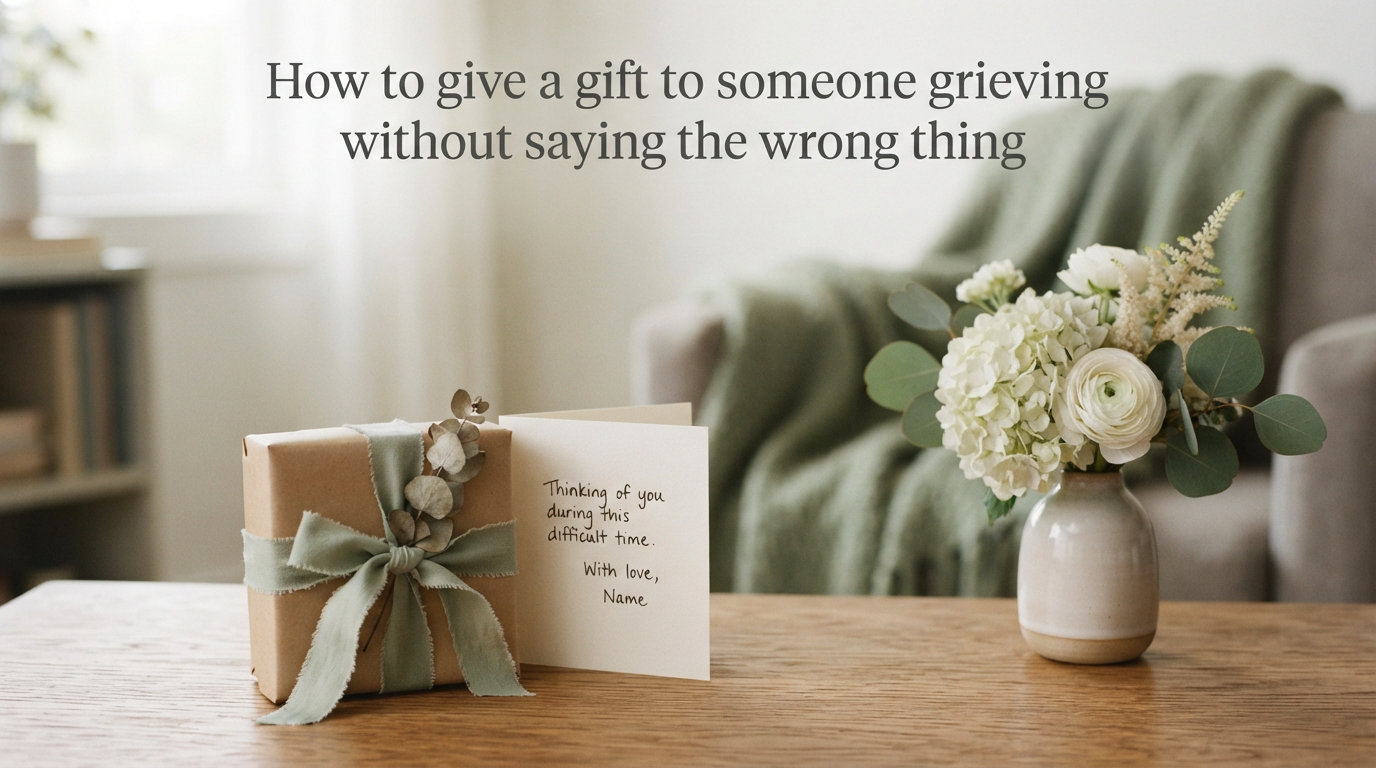
I still remember standing in the card aisle of a small shop, holding a sympathy card that began with “In this difficult time,” and feeling my throat tighten. My cousin had just lost her mother, and every word on that rack looked either too cold or too much.
If you have ever frozen at the thought of sending a sympathy gift because you are terrified of saying the wrong thing, you are not alone. Our team has spent weeks talking with grief counselors, social workers, and people who have been on the receiving end of well-meant but clumsy condolences. This guide is the result.
By the end, you will know exactly how to give a gift to someone grieving without saying the wrong thing, including which phrases to swap out, which gifts lighten a heavy week, and how to keep showing up long after the funeral flowers have wilted.
Table of Contents
Why Giving Gifts to Someone Grieving Feels So Hard?
Grief shrinks a person’s world. After a loss, even small decisions (what to eat, when to shower, whether to answer the door) can feel enormous. That is why a well-meaning gift can accidentally become one more thing to manage.
The challenge is that the same gift can feel like a warm hug to one person and an unwanted chore to another. A potted plant might comfort a friend with a green thumb and overwhelm someone whose kitchen is already cluttered with casseroles.
The Emotional Minefield of Grief Support
Most of us were never taught how to comfort someone in deep pain. We inherit scripts from movies and greeting cards: “They’re in a better place,” “Everything happens for a reason,” “Time heals all wounds.”
Those scripts feel safe to say, but they often leave the grieving person feeling unseen. According to grief.com, the worst phrases tend to be the ones that try to rush or minimize the loss. The best ones simply acknowledge it.
When you are choosing a gift, that emotional reality is the filter. The right gift removes a small burden. The wrong gift adds one. Keep that in mind as you read on.
What NOT to Say: Clichés to Avoid When Giving a Sympathy Gift
Here is the hard truth I learned from bereaved friends on Reddit and from hospice volunteers: certain phrases, even when said with love, sting. They imply that the griever should feel or behave differently than they do.
Avoid these common phrases, even when you mean well:
“They’re in a better place.” (Assumes the bereaved shares your belief system.)
“Everything happens for a reason.” (Feels like the loss was necessary.)
“At least they lived a long life.” (Minimizes the pain right now.)
“I know exactly how you feel.” (No two griefs are the same.)
“You should be over this by now.” (Grief has no deadline.)
“Stay strong” or “Be strong for the kids.” (Puts on a performance.)
“Let me know if you need anything.” (Places the burden back on them.)
“God needed another angel.” (Often deeply painful for parents.)
“Look on the bright side.” (There is no bright side yet.)
“Call me if you want to talk.” (Too open-ended for someone with no energy.)
One bereaved mother told me, “I heard ‘they’re in a better place’ so many times I started wondering why no one wanted them here with me.” That sentence stayed with me for years.
What TO Say: Empathetic Phrases That Actually Help
Replacing a cliché is easier than you think. You do not need perfect words. You need honest ones. The phrases below come from grief counselors and from people who have walked through loss themselves.
Try one of these instead:
“I am so sorry. I don’t know what to say, but I care about you.”
“I can’t imagine how painful this is for you.”
“There is no right way to grieve. Take all the time you need.”
“I loved hearing about [name]. Will you tell me one of your favorite stories?”
“I’m bringing dinner on Tuesday. No need to reply.”
“I am just checking in. No response needed. I’m thinking of you.”
“Your person mattered. I will remember them too.”
“I don’t have words, but I brought [specific thing]. I hope it helps a little.”
“I’m going to keep showing up. You can ignore every text if you want to.”
“Whatever you are feeling is okay.”
The difference between these phrases and the previous list is ownership. Clichés project the speaker’s discomfort. Empathetic phrases sit beside the griever in their pain without trying to fix it.
Practical Gift Ideas That Truly Help a Grieving Person
A meaningful bereavement gift does one of three things: it removes a task, it provides comfort, or it honors the person who died. The best gifts do all three quietly.
Here are the categories I return to when friends ask what to send someone who is grieving:
Food and Consumable Gifts
Food is the most-requested sympathy gift on every grief forum I read. After a loss, families are flooded with casseroles for two days, then nothing. A DoorDash or Uber Eats gift card sent two weeks later is often more useful than another lasagna on day one.
Other consumable ideas include a favorite snack box, fancy coffee, or a soup delivery subscription for the first month. Anything that removes the question “what’s for dinner?” is a gift.
Zero-Maintenance Comfort Items
Skip the plant that needs watering and the candle that needs trimming. A soft throw blanket, a plush robe, or a weighted lap pad offers comfort without adding chores.
A self-care box with herbal tea, a sleep mask, bath salts, and a good book signals, “Take care of yourself.” It does not require assembly or upkeep.
Memory and Memorial Gifts
A small memorial gift that honors the person who died can become a treasured keepsake. Consider a personalized ornament with the loved one’s name, a framed photo print, or a small piece of jewelry engraved with a meaningful date.
If you knew the deceased, including a handwritten note with a specific memory of them is the most treasured part of any memorial gift. One woman I spoke with keeps a stack of cards people sent after her father died. She said, “The stories were the gift.”
Practical Help Delivered
The Ahead app and similar services exist because grieving people do not need more stuff. They need help. A gift card for house cleaning, a lawn service for one season, or a pre-paid grocery delivery membership removes tasks that pile up.
For a coworker, a few hours of coverage so they can attend appointments is more valuable than a bouquet.
Cultural and Religious Sensitivity Considerations
Grief rituals differ widely across cultures and religions, and getting them wrong can cause real harm. Before sending a gift, take a moment to consider the bereaved family’s traditions.
Some Orthodox Jewish families observe shiva for seven days and appreciate simple food brought in disposable containers. Hindu families often prefer vegetarian offerings during the initial mourning period. Many Muslim families follow specific funeral and condolence customs that include reading certain prayers.
If you are unsure, ask a close family member or look up the tradition before sending. When in doubt, choose a generic gift (food, a card, a charitable donation in the loved one’s name) and avoid anything tied to a specific belief system unless you know it is shared.
A small note like, “I wanted to honor your family traditions, so I chose something I hope fits. Please let me know if I can do anything differently,” goes a long way.
Long-Distance Gift Giving: How to Show Up When You Can’t Be There
This is the gap I noticed in nearly every competitor article. Most guides assume you live nearby. Many of us do not. If your friend or family member lives far away, you can still show up well.
For long-distance sympathy support, consider these ideas:
Send a handwritten card in the mail, not just a text. Physical mail feels different during grief.
Order a meal delivery directly to their door for a specific date, two or three weeks out, when most people have stopped helping.
Schedule a monthly gift (a magazine subscription, a coffee delivery, a streaming credit) for the first six months.
Offer specific virtual support: “I’m calling you every Sunday at 4pm for the next two months. Answer if you want, ignore if you don’t.”
Send a small memorial item, like a printed photo book of moments you shared with the person who died.
One friend who lives abroad told me, “The people who sent something six months later saved me. By then everyone else had moved on.” That sentence is the heart of long-distance grief support.
Following Up Without Being Pushy
The funeral is the easy part. The weeks and months that follow are when real support matters. Most grieving people report that the flood of attention in week one is followed by sudden silence in week three. You can break that pattern.
Try one of these simple follow-up gestures:
Send a text on a hard date, like the birthday of the person who died or the anniversary of the loss.
Drop off coffee or a small treat on a random Tuesday, not just on holidays.
Invite your friend to do something low-pressure: a walk, a movie, a quiet dinner. Say, “No need to talk about anything.”
Check in on practical items, like “Did you ever get that paperwork sorted?” or “Want me to sit with you while you make those calls?”
The point of follow-up is presence, not performance. You do not need to fix anything. You just need to keep knocking gently on the door.
Frequently Asked Questions
What is an appropriate gift for someone grieving?
An appropriate gift for someone grieving acknowledges the loss while removing burden instead of adding to it. The most appreciated options include prepared food or food delivery gift cards, consumable self-care items, and practical services like house cleaning. Skip high-maintenance gifts like plants that need care or items that require assembly.
How do you send condolences to someone without sounding cliche?
Skip rehearsed phrases like everything happens for a reason or they are in a better place. Instead, use simple honest language such as I am so sorry for your loss, I cannot imagine how painful this is, or I do not know what to say but I care about you. Pair the words with a specific action, like delivering a meal or sending a handwritten card with a memory of the person who died.
What should I write in a sympathy card?
Write a short, personal note that names the loss directly. Mention the person who died by name, share one specific memory if you have one, and offer one concrete way you will help. Close with a simple I am here for you rather than a generic rest in peace. Handwriting the note makes it feel more sincere than a printed card.
What can I send instead of flowers?
Instead of flowers, consider a food delivery gift card (DoorDash, Uber Eats, a local restaurant), a self-care box with tea and bath items, a charitable donation in the deceased person’s name, a memorial keepsake like a personalized ornament, or a practical service such as a cleaning voucher. These options last longer than cut flowers and remove tasks rather than adding them.
How do I comfort a grieving friend over text or message?
Keep texts short and specific. Say something like I heard about [name] and I am so sorry. I am here if you want to talk, and I will keep checking in over the next few weeks. Avoid long philosophical messages or advice. The best text support is consistent check-ins, not a single perfect message. Send something again in two to three weeks, when most people have stopped reaching out.
Final Thoughts
There is no perfect gift, no magic phrase, and no flawless way to walk beside someone in grief. What matters is that you are willing to try, and that you keep showing up after the casseroles stop arriving.
If you remember nothing else from this guide on how to give a gift to someone grieving without saying the wrong thing, remember this: choose a gift that removes a burden, write a note that names the loss, and check in again in a month. That combination will matter more than anything else you could send.
Pick one small thing from this article and do it today. Send the text. Order the meal. Write the card. Your imperfect, present kindness is exactly what the moment calls for.