
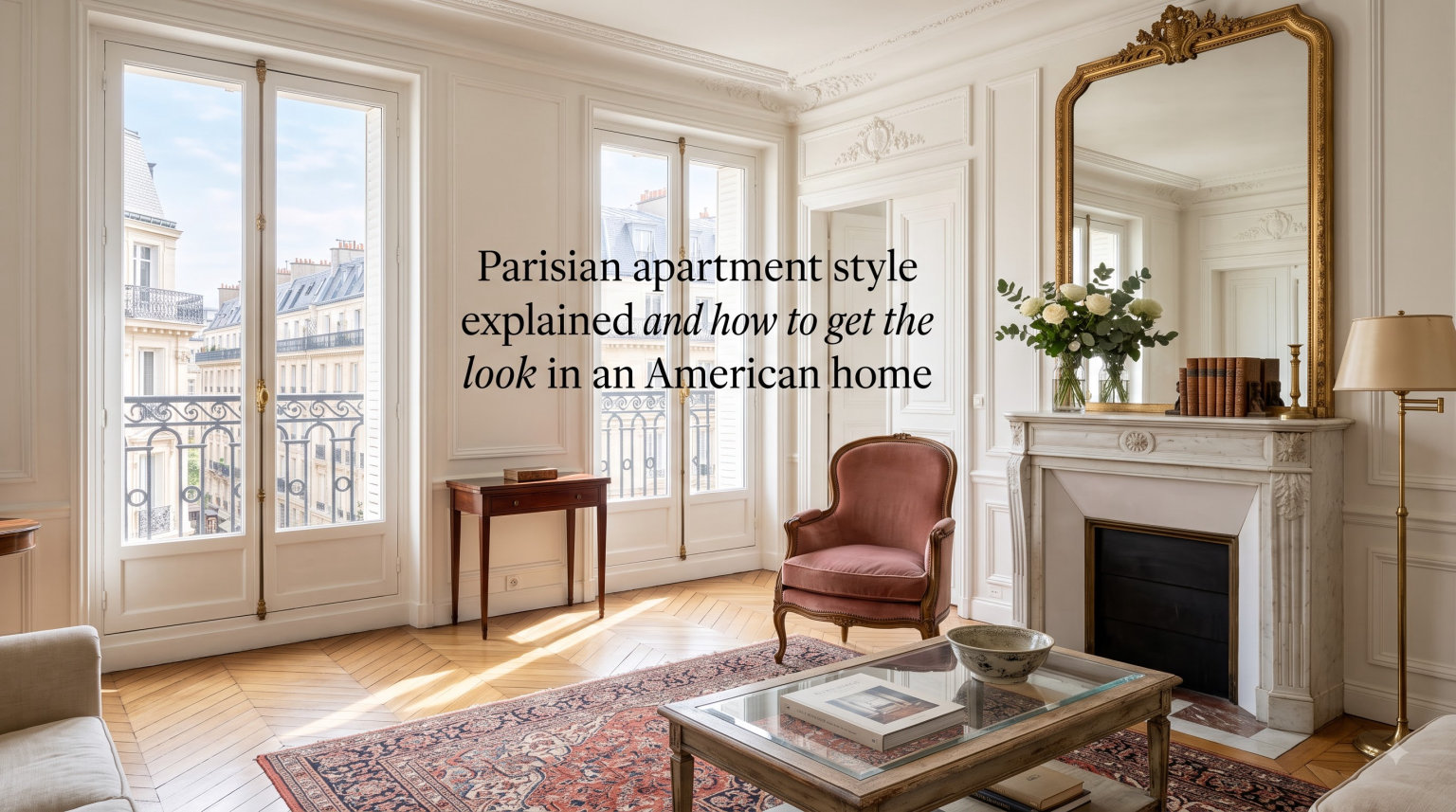
Parisian apartment style is the design world’s quiet power move. Walk into a sixth-floor walk-up on the Rue de Rivoli and you’ll find white walls, herringbone floors, a single gilt mirror catching the afternoon light, and not a single thing that looks brand new. It feels effortless, but the look is anything but accidental.
I’ve spent years studying French interiors for our team at Atypyk E Shop, and the same rules keep showing up in the most photographed homes from Paris to Brooklyn. This guide breaks down what makes Parisian apartment style work, the architectural details you can’t fake, and the exact swaps you can make to get the look in a typical American home, even on a rental budget.
Table of Contents
What Is Parisian Apartment Style?
Parisian apartment style is a curated blend of classic French architecture and modern sensibility. It pairs neutral palettes with gilded mirrors, ornate moldings with sleek contemporary furniture, and centuries-old bones with a lived-in, personal feel.
The style traces back to the mid-1800s, when Baron Haussmann rebuilt Paris with limestone buildings featuring high ceilings, tall windows, and uniform facades with wrought-iron balconies. Inside those buildings, parquet floors, marble fireplaces, and decorative wall paneling called boiseries became the standard backdrop. Today’s Parisians inherited those bones, then layered in pieces from flea markets, family heirlooms, and the occasional IKEA flat-pack to create something that feels collected rather than decorated.
The philosophy is often called art de vivre, the art of living. It treats the home as a backdrop for a real life, not a showroom. A wrinkled linen slipcover, an overflowing bookshelf, or a slightly chipped marble tabletop all add to the charm. The goal is elegance that feels approachable, not precious.
Key Architectural Elements That Define the Look
The bones matter most. Parisian interiors rely on architectural details that frame everything else, so before you pick a single throw pillow, sort out the room’s structure. Here are the five features that show up in nearly every iconic Parisian apartment.
Crown Molding and Ceiling Medallions
Crown molding is the single biggest visual cue of a Parisian interior. It traces the seam where wall meets ceiling and instantly adds a sense of height and refinement. In classic Haussmann apartments, the molding is often a few inches deep with layered profiles that cast soft shadows.
Ceiling medallions are the round plaster medallions around light fixtures. They turn a basic ceiling light into a focal point and connect the fixture to the room’s architecture. A simple medallion under a small brass pendant can transform a builder-grade ceiling.
Wall Paneling (Boiseries)
Boiseries are decorative wooden wall paneling, often painted in soft whites or grays. They frame rooms, line entryways, and add depth to walls that would otherwise feel flat. Authentic boiseries can take years to install and cost a small fortune, but the look is now achievable with peel-and-stick molding kits and a can of paint.
Picture-frame molding, where rectangular boxes are built up on the wall with thin trim, is the easiest version to recreate. It gives the impression of full paneling while costing a weekend and a few hundred dollars in materials.
Herringbone and Chevron Flooring
Parquet floors laid in herringbone or chevron patterns are a Parisian signature. The geometric layout makes a small room feel designed and reflects light in ways straight planks never do. Original floors in Paris apartments are often 100 years old and worn smooth from generations of footsteps.
In American homes, luxury vinyl plank and engineered wood both come in herringbone patterns now. If you rent, large printed floor runners and rug tiles in a herringbone print can fake the effect without permanent change.
Marble Fireplaces and Trumeau Mirrors
Most Haussmann apartments were built around a marble fireplace, even if it was later removed or replaced. When one survives, it’s usually the room’s centerpiece. Surrounding the fireplace with a trumeau, a tall mirror set into the wall above the mantel, doubles the impact and bounces light deeper into the room.
If your American home has no fireplace, you can install a non-working mantel and add a trumeau-style mirror above it. Many are sold as one piece, and they create the same anchor effect even without flames.
Tall Ceilings, Tall Windows, and Wrought-Iron Balconies
The classic Parisian apartment has ceilings over 9 feet, windows that stretch from waist height to the ceiling, and Juliet balconies in black wrought iron. These features were designed to flood rooms with light and to make small square footage feel generous. You can’t raise a ceiling, but you can dress low windows so they read taller: hang curtains as close to the ceiling as possible and let them pool on the floor.
The Essential Decor and Furnishings
Once the architectural bones are in place, the furniture and accessories are what make the room feel collected. Parisian interiors lean on a tight roster of pieces that work together across decades.
Gilded Mirrors as Anchor Pieces
A single large gilded mirror can carry an entire room. Parisians hang them opposite windows to bounce light, above fireplaces for drama, or in hallways to make narrow spaces feel wider. The frame is usually aged gold or painted cream, with carved flourishes or simple stepped profiles.
If real gilt feels out of reach, antique gold spray paint and a thrift-store mirror produce convincing results. We’ve refinished several with chalk paint and gold wax, and the trick is layering rather than spraying one flat coat.
Crystal and Brass Chandeliers
Chandeliers in a Parisian apartment aren’t reserved for the dining room. They appear in bedrooms, hallways, and even bathrooms. Crystal chandeliers add sparkle and a hint of formality, while brass and bronze styles bring warmth and patina. Hanging a chandelier in an unexpected spot, like a small bathroom, is one of the easiest ways to add French character on a tight budget.
Vintage Rugs and Aubusson-Style Textiles
A faded vintage rug is the heart of a Parisian living room. Aubusson and Savonnerie rugs, both traditional French weaves, bring soft color and pattern without overwhelming the room. Look for rugs with gentle wear, faded reds, blues, or golds on cream grounds.
If genuine antique rugs are out of budget, vintage-inspired prints from modern manufacturers offer the same visual texture at a fraction of the price. Layer a smaller patterned rug over a larger neutral jute for a curated look that hides wear.
Tufted Velvet and Linen Upholstery
Parisian seating tends to mix materials and eras. A tufted velvet sofa in a jewel tone can sit across from a linen slipcovered armchair without feeling mismatched. The trick is keeping the color palette tight so the mix reads intentional.
Velvet in burgundy, forest green, or ink blue adds richness without darkening the room. Linen slipcovers in ivory or stone soften the formality and survive real daily use, including pets and children.
Art, Books, and Personal Collections
A Parisian apartment almost always has art, and almost always framed in matching or coordinated frames. Black-and-white photography, vintage portraits, and classical figure drawings are common. Books line shelves horizontally and vertically, and small collections are grouped: a row of blue-and-white porcelain, a stack of antique leather books, a cluster of brass candlesticks.
The principle is curation. Rather than spreading one of each across the room, group like with like. Three candlesticks on a tray read as a collection. One candlestick looks lonely.
The Parisian Color Palette
The signature Parisian palette starts with a soft, warm white. Think creamy ivory, putty, or a slightly grayed linen tone. Walls, ceilings, and trim are often painted the same color so the eye reads one continuous surface, which makes small rooms feel larger.
From that neutral base, Parisians add accents in jewel tones: deep burgundy, forest green, ink blue, mustard gold, or a soft blush pink. Metals stay warm. Brass and aged gold dominate over chrome and brushed nickel. Black is used sparingly, often as a graphic accent in a lamp base, a mirror frame, or a window grille.
If you’re nervous about color, commit to a single accent and repeat it across the room. A pair of velvet pillows, a small upholstered stool, and a single piece of framed art in the same burgundy shade will pull the eye through the space and feel intentional.
Room-by-Room Guide to the Parisian Look
Now that you know the building blocks, here’s how to apply them room by room. The goal isn’t to recreate a French apartment step by step but to layer the right details in each space.
Living Room
Start with a neutral sofa in linen or velvet, then add a pair of antique-style armchairs. A large gilded mirror over the sofa or across from the window will bounce light. Ground the seating with a vintage rug and add a marble or brass coffee table.
Finish with a chandelier or a pair of wall sconces, a stack of coffee-table books, and one piece of art framed in a black or gold frame. Keep electronics hidden, and resist the urge to over-accessorize. Empty shelf space is part of the look.
Bedroom
The Parisian bedroom is calm and softly layered. White or ivory bedding, a pair of matching bedside tables, and a single statement light fixture, often a small chandelier, set the tone. A tufted headboard in linen or velvet adds softness.
Skip the matching furniture set. Mismatched vintage nightstands read as collected, especially when they share a similar wood tone. A full-length mirror in a slim gold frame is both functional and decorative.
Kitchen and Dining
Parisian kitchens are small, practical, and beautiful in their utility. Open shelving displays French stoneware, glass jars of dried goods, and stacks of white plates. A marble or butcher-block countertop is the workhorse surface.
For the dining area, a round bistro table with two bentwood chairs captures the look instantly. Add a small chandelier, a linen tablecloth, and a carafe of water on the table even when you’re not dining. The room should always look ready to host.
Bathroom
Tile the floor in a checkerboard pattern if you can, or use peel-and-stick vinyl tiles as a renter-friendly option. A pedestal sink or a freestanding vanity keeps the floor visible. A small chandelier, even in a half bath, makes the room feel considered.
Stack white towels on open shelves, add a vintage brass mirror, and finish with a single sprig of eucalyptus or a small bunch of dried lavender. Less is more in a Parisian bathroom.
Entryway and Hallway
The hallway is your opportunity to commit to the look. A console table, a large trumeau mirror, and a small bench with a linen cushion welcome guests. A pair of wall sconces or a single ceiling fixture in brass finishes the space.
Hang one piece of art, and leave the rest of the wall empty. Hallways suffer quickly from clutter, so edit aggressively. A single well-chosen mirror will do more for the room than three small frames.
How to Get the Parisian Look in an American Home?
American homes and Parisian apartments start from different places. Most U.S. homes have lower ceilings, fewer architectural details, and open floor plans that work against the layered European feel. None of that is a dealbreaker. Here’s how to translate the look without fighting your house.
Adapting Standard 8-Foot Ceilings
Low ceilings make moldings tricky, but slim profiles work. A 2- to 3-inch crown molding adds shape without crowding the room. Paint the molding the same color as the wall so the eye reads one continuous plane upward, which adds perceived height.
Hang curtains as high as possible, ideally just below the molding, and let them drop to the floor. This draws the eye vertically and tricks the brain into reading the wall as taller than it is.
Solutions for Textured Walls and Rental Restrictions
Textured walls are a common American problem, especially in rentals and newer builds. They make traditional picture-frame molding difficult because thin trim doesn’t sit flat. Two renter-friendly fixes work well: command strips and removable hooks let you hang lightweight decor without nails, while peel-and-stick molding from companies like InStyle or Orac Decor can be applied with adhesive and removed later.
For walls you can’t touch at all, lean large framed art, mirrors, and leaning shelves against the wall. Layer them to add visual weight where wall-mounted pieces would normally go.
American Retailers and Sourcing Tips
Sourcing Parisian-style pieces in the U.S. has gotten easier. Etsy is the best starting point for vintage gilt mirrors, brass chandeliers, and antique rugs. Chairish and 1stDibs offer higher-end vintage with shipping handled. For new pieces, World Market, Target’s Threshold line, and IKEA’s HEMMA and RANARP lamps capture the look affordably.
For the French flea-market feel, shop estate sales, Facebook Marketplace, and local thrift stores. Most Parisian apartments were furnished over decades, so don’t expect to source everything in a single weekend. Build the room in layers.
What to Skip vs What to Splurge On
Splurge on the pieces you’ll see every day and that anchor the room: the sofa, the chandelier, the large mirror. These set the tone and earn their cost over years. Skip on items that trend quickly or that you can swap easily: throw pillows, small accessories, and most wall art.
Invest time more than money on the architectural details. A can of paint, a weekend with a miter saw, and a steady hand can add more Parisian character than a thousand dollars of accessories.
Budget-Friendly and Rental-Friendly Parisian Style Tips
If you’re renting or watching your budget, focus on these moves first. They deliver the highest Parisian impact for the lowest cost and the easiest reversal when you move.
Paint is the single best investment. Repainting walls, trim, and ceilings in a unified warm white instantly shifts a room toward the Parisian palette. Use washable formulas if you’re renting.
Lighting changes everything. Replace basic flush-mount fixtures with a small chandelier or a pair of brass sconces. Most rentals allow this kind of swap, and the original fixture stores easily in a closet.
Curtains are the cheapest architectural fix. Hang them high and wide, and choose linen or linen-blend panels in ivory or stone. The drapery alone will read as European.
Group your accessories. A pile of books stacked by color, a trio of candlesticks on a tray, a row of matching frames above a sofa: small edits, big impact.
Finally, edit ruthlessly. Parisian apartments aren’t full of things. They’re full of the right things. If an object doesn’t earn its place, store it, donate it, or pass it on. The space you create is what makes the room feel elegant.
Frequently Asked Questions About Parisian Apartment Style
What defines Parisian apartment style?
Parisian apartment style is a curated blend of classic French architecture and modern sensibility. It pairs neutral palettes with gilded mirrors, ornate moldings, vintage and contemporary furniture, and personal collections to create an effortlessly elegant, lived-in look.
How can I get Parisian style in my home?
Start with architectural details like crown molding and wall paneling, add a neutral palette, then layer in a gilded mirror, a chandelier, and a vintage rug. Mix old and new furniture, edit accessories, and let the room breathe.
What are the key elements of Parisian decor?
The signature elements are high ceilings, herringbone or chevron flooring, marble fireplaces, boiseries or wall paneling, gilded mirrors, crystal or brass chandeliers, vintage rugs, tufted velvet seating, and curated art and book collections.
How to incorporate Parisian design on a budget?
Focus on paint, lighting, and curtains first. A unified warm-white color, a small chandelier, and linen drapery hung high will transform a room. Source vintage mirrors and brass pieces from thrift stores, estate sales, and Etsy, then layer them with what you already own.
Bringing the Parisian Apartment Style Into Your Home
Parisian apartment style isn’t about spending more. It’s about choosing better, layering patiently, and letting the architecture breathe. Whether you start with a single gilt mirror over your sofa or commit to a full room refresh, the rules translate across continents and budgets.
Pick one room this month. Paint it warm white, hang the curtains high, add a chandelier or a vintage-style lamp, and bring in a single antique piece. Watch how the room shifts. That’s the Parisian secret: less stuff, more intention, and a home that finally feels like the place you actually want to live.