
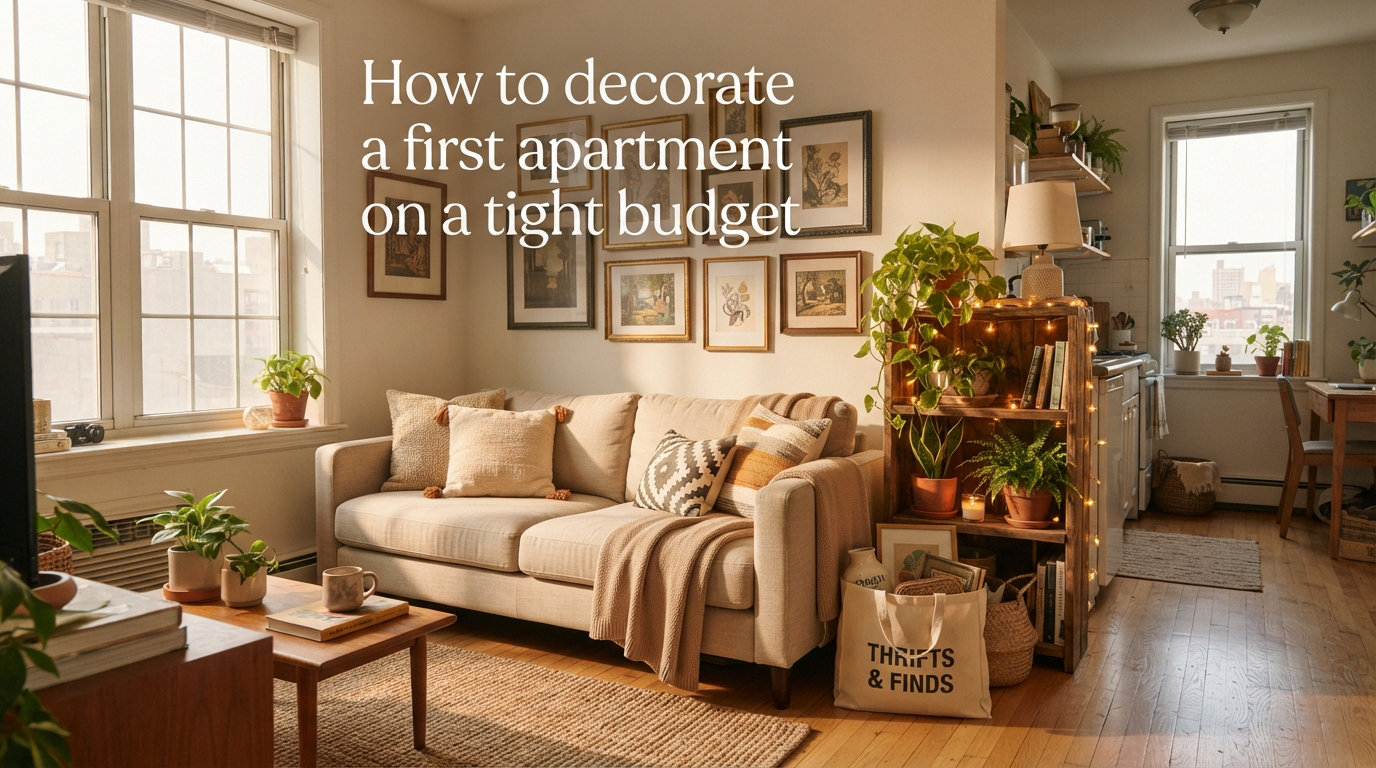
Moving into your first apartment is exciting, but staring at four bare walls with an almost empty bank account is enough to make anyone panic. When I moved into my first place, I had a mattress, a folding chair, and about $300 left after paying the security deposit.
I learned the hard way that you do not need a big budget to create a space that feels like home. You just need a plan, a little patience, and the willingness to get creative.
If you are figuring out how to decorate a first apartment on a tight budget, this guide walks you through every room, every dollar, and every shortcut that actually works. We will cover realistic cost breakdowns, a priority purchase checklist, rental-friendly solutions, and the most common mistakes first-timers make. Everything here comes from real experience and research, not aspirational Pinterest boards that assume you have thousands to spend.
The truth is, most people overestimate how much decorating costs and underestimate how much they can do with secondhand finds, a few smart purchases, and some weekend DIY projects. Our team has talked to renters, scoured forums, and tested budget strategies to compile what actually moves the needle. By the end of this article, you will have a step-by-step roadmap to transform your first apartment without going into debt.
One important note before we get started: the best decorators do not rush. Many experienced renters on forums like r/Apartmentliving recommend living in your space for a few weeks before buying anything beyond the essentials. That advice alone has saved people hundreds of dollars by preventing impulse purchases that do not fit the space.
Table of Contents
How to Decorate a First Apartment on a Tight Budget: Design Principles?
Before you spend a single dollar, you need a few basic design principles in your back pocket. These rules cost nothing to follow and they make every budget purchase look more intentional. Think of them as the foundation that makes cheap decor look expensive.
The 3-5-7 Rule of Decorating
The 3-5-7 rule is a simple guideline for grouping decorative objects in odd numbers. Arrange items in clusters of three, five, or seven rather than pairs or even numbers. Odd-numbered groupings feel more natural and visually pleasing to the human eye because they create a subtle asymmetry that draws attention.
For example, place three candles of varying heights on a shelf, or group five framed photos together on a wall. You do not need expensive items for this to work. Three thrifted objects grouped well will always look better than three random expensive items scattered around the room.
The 70/30 Rule for Color and Texture
The 70/30 rule means that 70% of your room should follow one dominant color or texture theme, and the remaining 30% provides contrast and interest. So if your dominant color is neutral beige, keep your walls, large furniture, and rug in that family. Then use the accent 30% for pops of color through throw pillows, art, and small accessories.
This rule keeps budget decorators from making a classic mistake: buying too many competing colors. When you stick to a 70/30 split, even cheap pieces from different stores look coordinated because they share a cohesive palette.
Create a Focal Point in Every Room
Every room needs one element that immediately draws the eye when you walk in. This is your focal point. It could be a large piece of art above the sofa, a statement rug, or even a well-styled bookshelf.
The focal point anchors the room and gives you a starting point for arranging everything else. On a tight budget, your focal point does not have to be expensive. A gallery wall made from thrifted frames, a bold peel-and-stick accent wall, or a large mirror that reflects light can all serve this purpose.
Layer Textiles for Instant Warmth
Layering is the secret technique that makes budget spaces feel designed rather than thrown together. Start with a base layer like a rug, add a mid-layer like curtains or a throw blanket, and finish with accent pieces like pillows and small textiles. Each layer adds depth, texture, and the feeling that someone thoughtfully put the room together.
You can layer textiles almost entirely from thrift stores and discount retailers. A $5 thrifted wool blanket draped over a budget sofa changes the entire feel of a living room. This technique costs very little but delivers maximum visual impact.
Budget Planning: Realistic Cost Breakdown by Room
Most budget decorating guides tell you to “shop smart” without giving you actual numbers. That is not helpful when you are staring at an empty apartment wondering if $1,000 is realistic or delusional. Let me break down what you can actually expect to spend, room by room, based on real-world costs from budget retailers, thrift stores, and secondhand marketplaces.
These ranges assume you are starting from scratch with no furniture. If you already have some pieces, subtract accordingly. The goal here is to set realistic expectations so you can prioritize where to spend and where to save.
Living Room: $300 to $800
Your living room is typically the most expensive room to furnish because it requires the largest and most-used pieces. A budget sofa or futon runs $200 to $400 if you buy secondhand or from IKEA and Walmart. A coffee table can be found for $20 to $60 at thrift stores or on Facebook Marketplace.
Add a rug for $40 to $100 (look for sales at Target or Amazon), curtains for $20 to $40, and basic lighting for $15 to $30. Throw pillows and a blanket add another $20 to $40. If you shop carefully, a functional and styled living room is doable for around $300 on the low end.
Bedroom: $250 to $600
The bedroom budget is dominated by your bed. A quality mattress should be your single biggest investment, and you should not skimp here. Budget mattresses start around $150 to $300 for a decent foam option.
A bed frame can be as cheap as $50 for a metal frame or $100 to $200 for a platform bed. Bedding sets run $40 to $80 at Target or Amazon. A nightstand can be a $15 thrift store find or a $30 IKEA side table.
Add blackout curtains for $25 and a small rug for $30 to $50. The bedroom comes together quickly because it needs fewer pieces than a living room.
Kitchen: $100 to $300
The kitchen is the least expensive room to decorate because most of it is functional rather than decorative. Your main costs are basics: plates, bowls, cups, pots, and utensils. A starter set of dishes costs $25 to $40, and a basic cookware set runs $30 to $60.
For decor, focus on functional items that look good: a $10 cutting board leaning against the backsplash, a $15 herb planter on the windowsill, and a $20 set of floating shelves for spices and mugs. Total kitchen styling can stay well under $100 if you are strategic.
Bathroom: $50 to $150
The bathroom is the cheapest room to upgrade because small changes have outsized impact. A new shower curtain ($15 to $25) completely transforms the space. Add a matching bath mat ($10 to $15), a set of towels ($20 to $30), and a small piece of art or mirror ($10 to $20).
Use mason jars or thrifted containers for cotton swabs and toiletries instead of buying organizers. A styled bathroom can cost less than $75 total, and it will look intentional and clean.
Total Realistic Budget: $700 to $1,850
For a full first apartment furnished from scratch, expect to spend between $700 and $1,850 total. The low end assumes aggressive thrifting, secondhand furniture, and minimal decor. The higher end includes a few new key pieces and more styling.
If that number feels high, remember that you do not need to buy everything at once. Start with the essentials and add decor over months. Many experienced renters recommend spreading purchases across three to six months to avoid financial strain.
Priority Purchases Checklist: What to Buy First
One of the biggest questions first-apartment renters ask is what to buy first. The answer matters because blowing your budget on the wrong items leaves you sleeping on the floor with a really nice coffee table. Here is the order that experienced renters and budget decorators recommend, based on real discussions from forums like r/Apartmentliving and r/Frugal.
Priority 1: A Bed and Mattress
Always buy your bed and mattress first. You need sleep to function at work, and sleeping on an air mattress for weeks gets old fast. Reddit users consistently rank the mattress as the one item worth spending real money on, even on a tight budget.
A bad mattress affects your health, your mood, and your productivity. Look for budget foam mattresses online starting around $150. If you can stretch to $250 to $300, you will get noticeably better quality.
Pair it with a simple metal frame for $50 or skip the frame entirely and use the floor with a nice bedskirt until you can afford better. The mattress is the one place where spending a bit more pays off every single night.
Priority 2: Basic Seating
After the bed, you need somewhere to sit. A futon, a secondhand sofa, or even a couple of floor cushions will work. The key is having a place to sit that is not your bed, because using your bed as a couch wears out the mattress and makes your bedroom feel like a cramped hotel room.
Check Facebook Marketplace and thrift stores first. Many people give away or sell sofas for $50 to $150 when they move. A clean, used couch with a fresh throw blanket looks just as good as a new one.
Priority 3: Storage Solutions
Storage is the third priority because clutter destroys any decorating effort. You need a dresser for clothes, shelves for books and basics, and some kind of kitchen storage. Budget storage does not have to be ugly.
IKEA cube shelving, thrifted dressers, and even repurposed bookshelves all work. Spend $50 to $150 on storage before you buy any decorative items. A clean, organized space with no decor looks infinitely better than a stylish space buried in clutter.
Priority 4: Lighting
Overhead apartment lighting is almost always harsh and unflattering. Budget for at least two lamps: one floor lamp for ambient light and one table lamp for task lighting. Thrift stores are gold mines for lamps, and a new lamp shade can make a $5 find look brand new.
Warm-toned bulbs (2700K to 3000K) make any space feel cozier instantly. This is a $10 purchase that transforms how your apartment feels in the evening.
Priority 5: A Rug
A rug anchors your space and makes it feel finished. It also dampens sound in apartments with hard floors, which your neighbors will appreciate. Look for sales at Target, Amazon, or Wayfair. A 5×7 rug for $40 to $80 covers most living room setups.
Priority 6: Window Treatments
Curtains make a rental feel like a home. They soften hard lines, add color, and provide privacy. Budget curtains run $15 to $30 per panel at Target or IKEA. Use a tension rod if you cannot drill into the walls.
What to Delay Buying
Hold off on wall art, decorative pillows, vases, candles, and other pure decor until you have the essentials covered. These items are easy to find cheap later, and they are the most fun to hunt for over time. Rushing to fill walls with random art is one of the most common decorating mistakes beginners make.
Living Room Decorating Ideas on a Budget
Your living room is where you will spend most of your waking hours, so it deserves the most attention. Here are seven specific ideas that deliver big impact on a small budget, each tested and recommended by experienced budget decorators.
1. Invest in One Statement Rug
A rug is the single most transformative purchase for a living room. It defines the seating area, adds color and pattern, and makes bare floors feel warm and inviting. Choose a rug that is large enough to sit under at least the front legs of your sofa and chairs.
A rug that is too small makes the room feel disconnected and awkward. Look for sales and clearance sections at Target, Amazon, and Wayfair. You can often find 5×7 or 6×9 rugs for 40 to 60 percent off retail.
Avoid ultra-cheap thin rugs that slide around. A medium-pile rug at a discount price is always better than a thin rug at a rock-bottom price.
2. Build a Gallery Wall with Thrifted Frames
A gallery wall is the most cost-effective way to fill a large blank wall. Visit thrift stores and buy mismatched frames for $1 to $5 each. Spray paint them all the same color (white, black, or gold) to create instant cohesion, then fill them with printable art, postcards, fabric scraps, or pages from old books.
Free printable art is everywhere online. Search for free botanical prints, abstract downloads, or vintage map printables. You can print them at a local copy shop for a few dollars each. A gallery wall of eight frames might cost you $30 total.
3. Add Greenery with Low-Maintenance Plants
Plants are one of the cheapest ways to add life and color to a room. A $5 pothos from a hardware store grows quickly and trails beautifully off a shelf. Snake plants and ZZ plants are nearly impossible to kill and tolerate low light, which makes them perfect for apartments.
If you worry about keeping plants alive, start with one or two hardy varieties. Propagate cuttings from friends to get free plants. A single pothos can produce dozens of cuttings over time, giving you free greenery for every room.
4. Layer Throw Pillows and Blankets
Textiles are the fastest way to make a budget sofa look designed. Three to five throw pillows in coordinating colors and textures, plus a draped blanket, completely change the feel of a room. Mix solid colors with one or two patterned pillows for visual interest.
Pillow covers are cheaper than full pillows. Buy a set of insert pillows once ($15 to $25 for a pack), then swap covers seasonally for $5 to $10 each. This lets you refresh your living room look for the price of a coffee.
5. Use a Large Mirror to Double Your Space
A large mirror is both decorative and functional. It reflects light, makes small apartments feel bigger, and serves as a focal point. Thrift stores often have oversized mirrors for $15 to $40. Even a damaged frame can look great with a coat of spray paint.
Lean a large mirror against the wall instead of hanging it if you cannot drill into drywall. This works especially well in rentals and creates a relaxed, layered look that feels intentional.
6. Install Floating Shelves for Display and Storage
Floating shelves serve double duty as storage and display space. Use them to show off books, plants, framed photos, and collected objects. IKEA and Amazon sell budget floating shelves for $15 to $30 each, and they install with just a few screws.
Style shelves using the rule of thirds: group items in clusters of varying heights, leave negative space between groupings, and mix books with decorative objects. Overloaded shelves look cluttered, so edit ruthlessly.
7. Upgrade Your Lighting with Warm Bulbs and Multiple Sources
Good lighting is the difference between a cozy living room and a depressing one. Replace harsh overhead bulbs with warm-toned alternatives, and add at least two secondary light sources. A floor lamp near the sofa and a table lamp on a side table create layered, inviting light.
Look for lamps at thrift stores and flea markets. A $5 lamp with a new $10 shade looks just as good as a $50 lamp from a home store. The key is the light temperature: stick with warm white bulbs around 2700K for a cozy, homey glow.
Bedroom Decorating Ideas on a Budget
Your bedroom should be your sanctuary, and it is surprisingly easy to make beautiful on a budget. Since the bed dominates the room, styling it well does most of the heavy lifting. Here are six ideas to create a cozy, styled bedroom without overspending.
1. Make Your Bed the Focal Point
Since the bed takes up the most visual space, make it look intentional. Invest in a duvet cover or comforter in a solid, calming color. Layer it with two pillows in shams, plus one or two accent pillows.
A folded throw blanket at the foot of the bed adds texture and a finished look. You do not need expensive bedding. Target’s Threshold line and Amazon’s basic duvet covers offer hotel-quality looks for $30 to $60.
The trick is how you style it. Fold the top of the duvet back over a flat sheet for that crisp, layered hotel bed appearance.
2. Add a Headboard or Create a Faux One
A headboard instantly makes a bed look complete and designed. If you cannot afford one, create a faux headboard effect. Hang a large piece of fabric, a tapestry, or a row of pillows behind the bed.
Peel-and-stick wallpaper behind the bed creates a headboard shape for about $25. Thrift stores sometimes have wood headboards for $20 to $40. A coat of paint or stain refreshes an outdated piece completely. This is one of the highest-impact bedroom upgrades for the lowest cost.
3. Use Curtains to Make Ceilings Look Taller
Hang curtains as close to the ceiling as possible and let them extend past the window width. This trick draws the eye upward and makes the room feel larger and more luxurious. Floor-length curtains that pool slightly on the ground add drama and softness.
Budget curtains from IKEA ($10 to $15 per pair) work perfectly. If you cannot drill into the wall, use a tension rod placed high inside the window frame. The visual effect is nearly identical.
4. Add a Nightstand with Personality
Every bed needs a surface beside it for a lamp, phone, and water glass. Your nightstand does not have to match anything else in the room. A thrifted side table, a stack of sturdy books, a small chair, or a wall-mounted shelf all work.
Style the nightstand with a small lamp, a book or two, and a small plant or framed photo. Keep it minimal. A cluttered nightstand makes the whole bedroom feel messy.
5. Lay Down a Bedside Rug
Stepping onto a soft rug when you get out of bed is a small luxury that costs very little. A 2×3 or 3×5 rug beside the bed adds warmth and color. Layer it over hard floors or even over a larger neutral rug for extra texture.
Thrift stores and clearance sections are the best sources for small rugs. Look for washable materials since bedroom rugs get a lot of barefoot traffic.
6. Keep Surfaces Clear for Calm
The most important bedroom decorating tip is also free: keep it uncluttered. A clean, minimal bedroom feels calm and restful. Use under-bed storage bins to hide clothes and extras, and keep the tops of dressers and nightstands mostly clear.
Clutter is the enemy of relaxation. If your bedroom feels chaotic, remove items until it feels peaceful. You can always add things back later.
Kitchen Decorating Ideas on a Budget
The kitchen is often overlooked in apartment decorating, but it is a room you use every day. The key to a budget kitchen is focusing on functional decor, items that look good and serve a purpose. Here are five ideas that work.
1. Display Your Cookware and Utensils
Instead of hiding pots and utensils in cabinets, display the attractive ones. Hang a few nice pots from a ceiling hook or wall rack. Put wooden spoons and spatulas in a tall jar or crock on the counter.
This frees up cabinet space and adds a styled, functional look. A magnetic knife strip on the wall costs about $15 and looks professional while saving counter space. These small changes make a basic apartment kitchen feel like a real cook’s kitchen.
2. Add Open Shelving for Frequently Used Items
Open shelves turn everyday dishes and glassware into decor. Install two or three floating shelves and arrange your mugs, plates, and bowls neatly. Group items by color or type for a curated, intentional look.
If you cannot drill into walls, use a freestanding shelf unit. IKEA’s basic bookshelves work well in kitchens and cost $30 to $50. Paint the back of the shelf a contrasting color for a custom look.
3. Style Your Countertops with Intention
Keep countertops mostly clear, but add a few styled items. A wooden cutting board leaning against the backsplash, a bowl of fruit, a soap dispenser, and a small herb plant are enough. These items are functional but also add color, texture, and life.
Transfer dish soap and hand soap into matching dispensers ($10 to $15 for a set). This single change makes a kitchen look instantly more put-together. Refill the dispensers from bulk bottles to save money long-term.
4. Add a Rug or Mat for Color
A washable runner rug in front of the sink adds color and cushioning. Look for indoor-outdoor rugs that are easy to clean. Amazon and Target sell kitchen runners for $20 to $40 in dozens of patterns.
A small mat in front of the stove or sink also protects floors from spills and stains. Choose a patterned rug that hides stains, since kitchen rugs take a beating.
5. Upgrade Cabinet Hardware for Under $20
If your apartment has ugly cabinet knobs or handles, swap them out for inexpensive replacements. New knobs cost $1 to $3 each and completely change the look of the kitchen. Keep the old hardware so you can reinstall it when you move out.
This is one of the easiest renter-friendly upgrades available. Matte black or brushed brass knobs look expensive but cost the same as basic silver ones. Ten knobs for $20 transforms an entire kitchen.
Bathroom Decorating Ideas on a Budget
The bathroom is the smallest room in your apartment, which means a tiny budget goes a long way. Three small changes will completely transform a basic apartment bathroom. Here is what to focus on.
1. Start with a New Shower Curtain
The shower curtain is the largest visual element in most bathrooms, so it sets the entire tone. Replace the landlord’s plastic liner with a fabric shower curtain in a color or pattern you love. This single $15 to $25 purchase does more for a bathroom than anything else.
Choose a shower curtain with a subtle pattern or texture rather than a loud print. Linen-look, waffle weave, or simple striped curtains photograph well and look more expensive than they are. Pair it with a clean white or clear liner.
2. Coordinate Your Towels
A set of matching towels makes a bathroom feel intentional and clean. You do not need expensive towels. Target’s Threshold towels and Amazon basics sets offer good quality for $20 to $30 for a full set.
Roll or fold towels neatly and display the best ones on a shelf or towel bar. Hide the worn-out towels in a cabinet for actual use. Displaying nice towels is a free styling trick that costs nothing but looks polished.
3. Add Storage with Style
Most apartment bathrooms have almost no storage. Use styled containers to organize toiletries while adding decor. Mason jars hold cotton swabs and cotton balls. A thrifted tray corrals soap, lotion, and a small plant on the counter.
Add a small floating shelf above the toilet for extra towels and decor. A $15 shelf and a few styled items turn dead wall space into functional, attractive storage. Keep the shelf edited and intentional rather than crammed full.
Rental-Friendly Decorating: No-Paint Solutions
Most first apartments are rentals, which means you cannot paint walls, drill freely, or make permanent changes. This is one of the biggest pain points new renters face, and it is an area where most decorating guides fall short. The good news is that rental-safe decorating has never been easier or more affordable.
Peel-and-Stick Wallpaper for Accent Walls
Removable wallpaper is one of the best tools available to renters. It goes up like a giant sticker and comes down without damaging paint. Use it on one accent wall behind your bed or sofa for instant impact.
Brands like RoomMates and NuWallpaper offer patterns starting at $25 to $40 per roll. Apply it slowly and smooth out air bubbles with a credit card. When you move out, peel it off slowly at a 45-degree angle.
Always test a small corner first to make sure your paint is in good enough condition to handle removal. Most apartments with well-adhered paint handle peel-and-stick wallpaper without any issues.
Command Hooks for Everything
Command hooks let you hang art, mirrors, curtains, and decor without a single nail. They come in various sizes and weight ratings, from small hooks for lightweight frames to large ones for heavy mirrors. A multipack costs $8 to $15 and covers an entire apartment.
Always follow the removal instructions exactly. Pull the tab straight down, slowly, until the hook releases. Yanking it off will damage the wall, which defeats the whole purpose of using them in a rental.
Tension Rods for Curtains and Storage
Tension rods require zero drilling and hold surprisingly well. Use them for curtains, closet organization, under-sink storage, and even as a room divider in studio apartments. A tension rod costs $8 to $15 and can be repositioned anytime.
For curtains, choose a rod that fits snugly inside the window frame. Hang it high to create the illusion of taller ceilings. Tension rods also work inside cabinets to create extra shelving for plates and pantry items.
Removable Shelf Liner for Cabinets and Shelves
Peel-and-stick shelf liner transforms ugly cabinet interiors and bare shelves. Line kitchen cabinets, bathroom shelves, and bookcase backs with patterned contact paper. It costs $5 to $15 per roll and removes cleanly when you move.
This is one of those details that no one sees but you will appreciate every time you open a cabinet. It makes a basic rental kitchen feel cared for and custom.
Floor Cushions and Floor Seating
If you cannot add built-in seating or benches, floor cushions are a flexible alternative. Large floor pillows from Target or Amazon cost $15 to $30 each and provide extra seating for guests. Stack them in a corner when not in use.
Floor seating also works in small apartments where space is tight. A few cushions around a low coffee table creates a cozy, casual lounge area without buying a single piece of furniture.
Budget Shopping Strategies: Where to Score Deals
Knowing where to shop is just as important as knowing what to buy. The right strategy can cut your decorating budget in half without sacrificing style. Here are the best shopping sources and how to use each one effectively.
Facebook Marketplace and Craigslist
Facebook Marketplace is the single best source for budget furniture. People who are moving, upgrading, or downsizing sell quality furniture for fractions of retail prices. Set up saved searches for items you need and check daily.
The best deals go within hours. Negotiate politely but confidently. Most sellers price items expecting buyers to offer less.
Offer 70 to 80 percent of the asking price for furniture in good condition. Always inspect items in person before paying, and bring a friend to help with pickup.
Thrift Stores and Habitat for Humanity ReStore
Thrift stores are treasure troves for frames, lamps, mirrors, and small furniture. Visit regularly because inventory changes weekly. The best thrift finds go fast, so become a regular at two or three stores near you.
Ask staff when new inventory gets put out. Habitat for Humanity ReStore is another underused resource. They sell donated furniture, building materials, and home goods at deeply discounted prices.
You can find dressers, tables, lighting, and hardware for 50 to 80 percent below retail at ReStore locations across the country.
IKEA for Foundational Pieces
IKEA is ideal for basic, functional furniture that you need new. Their bookshelves, bed frames, and storage solutions are hard to beat on price. The KALLAX shelving unit ($40 to $80), LACK coffee table ($20 to $40), and RAST dresser ($40 to $60) are budget decorating staples.
Customize IKEA pieces to make them look more expensive. Paint or stain basic furniture, swap the knobs, or add legs. The IKEA hacker community online has thousands of ideas for transforming basic pieces into custom-looking furniture.
Amazon for Small Decor and Accessories
Amazon is best for small decor items: throw pillow covers, curtains, rugs, lamps, and organizers. Prices are competitive, and reviews help you avoid low-quality items. Look for items with 4-star ratings and at least 500 reviews.
Amazon is not ideal for large furniture because shipping costs and quality can be inconsistent. But for textiles, lighting, and small accessories, it offers unbeatable convenience and pricing. Use wish lists to track items and wait for price drops.
How to Identify Quality Furniture at Low Prices
When shopping secondhand, learn to spot quality. Solid wood is always better than particle board. Check joints for dovetail or mortise-and-tenon construction, which indicates durability.
Wobbly legs, deep scratches, and water damage are red flags. Upholstered furniture is trickier. Smell it first: musty or smoky odors are hard to remove.
Check cushions for firmness and even wear. If the frame is solid wood and the fabric is clean, a $50 used chair can outlast a $200 new one.
DIY Decor Projects You Can Do This Weekend
DIY projects are the secret weapon of budget decorators. They cost a fraction of retail decor and add personal character that store-bought items cannot match. Here are five projects you can complete in a weekend with basic tools and under $30 in materials.
1. Paint Thrifted Frames for a Gallery Wall
Collect five to eight mismatched frames from thrift stores ($1 to $5 each). Lay them on a drop cloth and spray paint them all the same color. White, black, and metallic gold are safe choices that work with any decor style.
Fill the frames with free printable art, pages from old books, or fabric scraps. Arrange them on the floor first to find a layout you like, then hang with Command strips. Total cost: $15 to $30 depending on how many frames you use.
2. Create a Macrame or Fabric Wall Hanging
A large wall hanging adds texture and softens hard walls. You do not need macrame skills. Dip-dye a piece of cotton rope or thick yarn and hang it from a dowel or driftwood branch.
Alternatively, stretch a beautiful piece of fabric or scarf over a canvas frame. This project costs $10 to $20 in materials and takes about an hour. The result looks like a $50 to $100 piece of wall art.
Search online tutorials for “no-knot macrame” or “fabric wall art” for step-by-step guides with photos and video instructions.
3. Upcycle Glass Jars into Vases and Organizers
Save pasta sauce jars, jam jars, and coffee containers. Remove labels with warm soapy water and a scrubbing pad. Paint the jars with acrylic or spray paint, or leave them clear and fill them with fairy lights, flowers, or kitchen utensils.
This project costs almost nothing since the jars are free. Group three or five jars of different sizes together for a styled centerpiece or shelf display. They work as vases, pencil holders, bathroom organizers, and candle holders.
4. Make a Custom Throw Pillow from a Scarf or Fabric
Find a beautiful scarf, napkin, or remnant fabric at a thrift store. Fold it in half, sew or fabric-glue three sides, insert a pillow insert, and close the fourth side. No-sew fabric glue works just as well as stitching for this project.
This costs about $10 total ($5 for the fabric, $5 for the insert) and produces a one-of-a-kind pillow. Use this technique to create seasonal decor by swapping fabrics throughout the year.
5. Build a Simple Plant Stand from Wood Scraps
If you have access to basic tools, build a simple plant stand from a piece of scrap wood and four furniture legs. Drill holes, attach legs with screws, and stain or paint the piece. This elevates a $5 plant into a styled display that looks designer.
Total materials cost $10 to $20 if you buy wood and legs new. With reclaimed wood and thrifted furniture legs, the cost drops to near zero. Search for “DIY plant stand” tutorials for free plans and measurements.
Common First-Apartment Decorating Mistakes to Avoid
Even with a great plan, beginners make predictable mistakes that waste money and make apartments look worse, not better. Learning these in advance will save you hundreds of dollars and a lot of frustration. Here are the most common first-apartment decorating mistakes and how to avoid each one.
Mistake 1: Buying Everything at Once
The biggest mistake is rushing to fill every room in the first week. Impulse purchases rarely fit the space, match your style, or serve a real purpose. Live in your apartment for two to four weeks before buying non-essential items so you understand how you actually use each space.
Forum users on r/Apartmentliving consistently say the same thing: the people who end up with the best spaces are the ones who decorated slowly. Patience leads to better choices and lower total spending.
Mistake 2: Choosing Form Over Function
A beautiful coffee table that is too low to eat at, or a stunning chair that is uncomfortable to sit in, are wastes of money. Prioritize function first, then style. Every piece in a small apartment needs to earn its place by being both useful and attractive.
Before buying anything, ask yourself: will I use this every week? If the answer is no, skip it. Decorative-only items should be the last things you buy, not the first.
Mistake 3: Ignoring Scale and Proportion
A tiny rug under a large sofa looks like a bath mat. A massive painting above a small nightstand looks unbalanced. Scale matters more than price when it comes to making a room look designed.
Always measure your space and furniture before buying anything. When in doubt, go bigger with rugs and art. A slightly too-large rug is always better than one that is too small.
The same goes for curtains: floor-length always looks better than window-length. When in doubt, size up.
Mistake 4: Matching Everything
Buying an entire matching furniture set from one store makes a room look like a showroom, not a home. Mix pieces from different sources, eras, and styles. A thrifted coffee table next to an IKEA sofa with a vintage rug creates depth and personality.
The 70/30 rule helps here. Keep 70% of the room cohesive in color and style, and let the remaining 30% bring in contrast and character. This balance prevents both the matching-set look and the chaotic-mismatched look.
Mistake 5: Forgetting About Lighting
Relying solely on overhead lighting makes any apartment feel cold and institutional. Every room needs at least two to three light sources at different heights. A floor lamp, a table lamp, and a task light create layers of warm, inviting illumination.
This is the easiest fix for any room that feels off. If your space feels depressing and you cannot figure out why, it is probably the lighting. Add a warm lamp and the room transforms instantly.
Mistake 6: Overlooking Vertical Space
Most decorators fill floor space and forget about walls. Vertical space is free real estate for storage and decor. Use tall bookshelves, hang art high, and install shelves near the ceiling in small apartments.
Drawing the eye upward makes rooms feel larger and more designed. A tall plant on a plant stand or a gallery wall that extends toward the ceiling achieves this effect for very little money.
Mistake 7: Not Measuring Before Buying
This sounds obvious, but it is the most common expensive mistake. Always measure your doorways, hallways, and rooms before buying furniture. A sofa that does not fit through the door is money wasted.
Write down your measurements and keep them on your phone for shopping trips. Measure twice and buy once. This simple habit saves more money than any decorating tip on this list.
Frequently Asked Questions
What is the 3-5-7 rule of decorating?
The 3-5-7 rule is a decorating guideline that recommends arranging objects in odd-numbered groupings of three, five, or seven. Odd numbers create natural visual asymmetry that feels more pleasing to the eye than even-numbered pairs. For example, group three candles of varying heights on a shelf or hang five framed photos together. This technique works with budget items from thrift stores just as well as expensive decor.
How to decorate a low income apartment?
Decorating a low income apartment is achievable by following four key steps: prioritize essential furniture first (bed, seating, storage), shop secondhand through Facebook Marketplace and thrift stores, use rental-safe solutions like removable wallpaper and Command hooks, and add personality through low-cost DIY projects. A fully furnished first apartment can cost between $700 and $1,850 total when you shop strategically and build your space over several months.
What things are often forgotten for a first apartment?
The most commonly forgotten items for a first apartment include a plunger, basic tool kit, first aid kit, extension cords and power strips, trash cans for every room, shower curtain liner, dish drying rack, cleaning supplies, and a fire extinguisher. These practical essentials are easy to overlook when you are focused on furniture and decor, but you will need them within the first week of moving in.
What is the 70/30 rule in decorating?
The 70/30 rule means that 70% of a room should follow one dominant color or texture theme, while the remaining 30% provides contrast and visual interest. For example, if your dominant palette is neutral beige for walls, furniture, and rugs, use the accent 30% for colorful throw pillows, art, and accessories. This rule keeps budget spaces looking coordinated and intentional rather than cluttered or random.
How much should I budget to furnish a first apartment?
A realistic budget to furnish a first apartment from scratch ranges from $700 to $1,850 total. Break it down by room: living room $300 to $800, bedroom $250 to $600, kitchen $100 to $300, and bathroom $50 to $150. The low end assumes aggressive thrifting and secondhand shopping, while the higher end includes a few new key pieces. Spread purchases over three to six months to avoid financial strain.
Conclusion
Learning how to decorate a first apartment on a tight budget is less about money and more about strategy. Start with the essentials (bed, seating, storage, lighting), shop secondhand before buying new, use rental-friendly solutions, and layer in style slowly over time. The design principles like the 3-5-7 rule and 70/30 color split cost nothing but make every cheap purchase look intentional.
Remember that the best spaces are built gradually. Live in your apartment first, understand how you use each room, and decorate with purpose rather than urgency. Avoid the common mistakes of buying everything at once, ignoring scale, and relying on overhead lighting alone.
With a budget between $700 and $1,850 and a weekend DIY project or two, you can create a space that feels like home on day one. Your first apartment does not need to be perfect. It needs to be yours.