
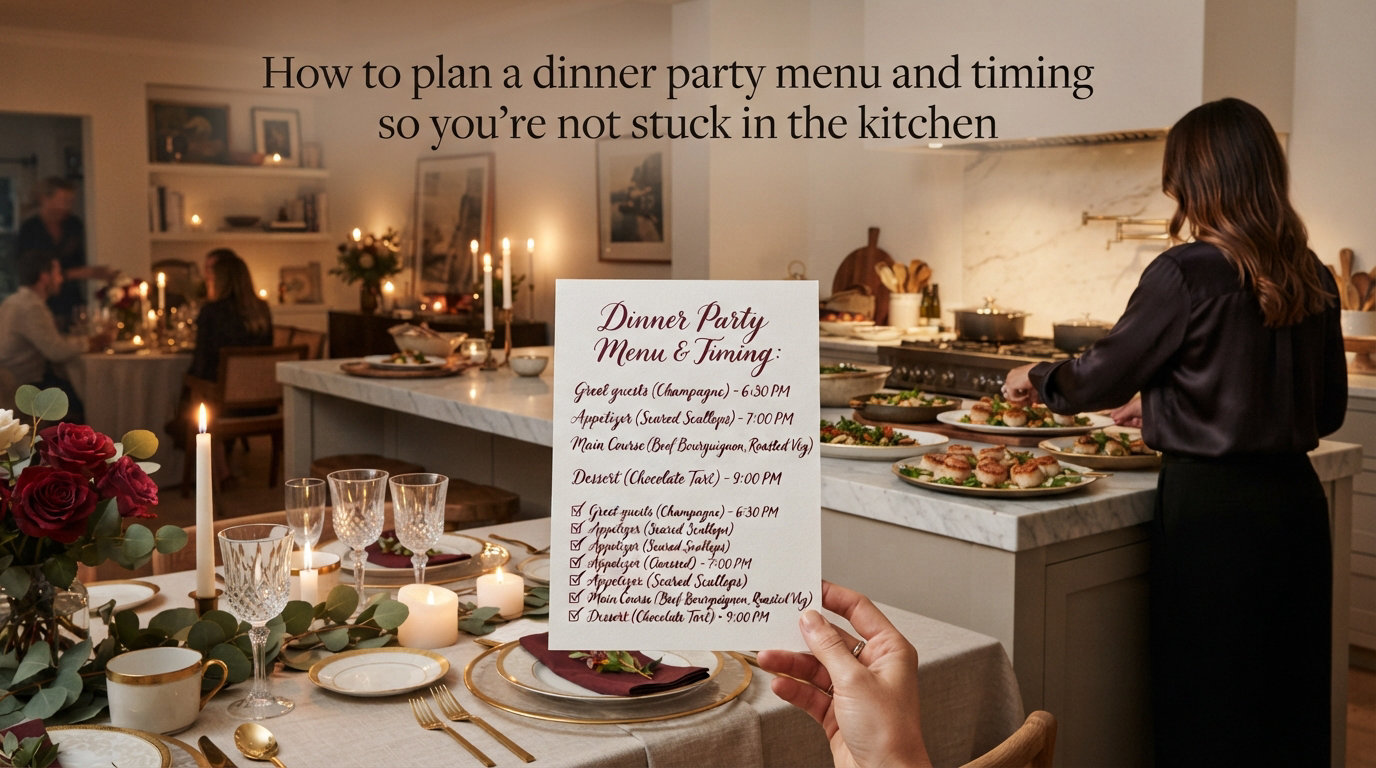
I have been to exactly the kind of dinner party we have all endured. The host disappears into the kitchen forty-five minutes before anyone shows up. They resurface at midnight looking like they survived a war. The food was great, but nobody actually saw them between the appetizers and the coffee.
If you are reading this, you have probably lived that scenario from one side or the other. You want to throw a dinner party that feels generous and warm without turning into a one-person catering operation. That is exactly what I will walk you through here.
Learning how to plan a dinner party menu and timing so you are not stuck in the kitchen comes down to two things: a smart menu and a backwards timeline. Get those two pieces right and you can actually sit down, eat your own food, and have a conversation with the people you invited into your home.
After hosting more dinner parties than I can count, from cramped apartment gatherings to holiday feasts for twelve, I have built a system that works. It is not about finding some magical stress-free formula. It is about preparation, realistic expectations, and a timeline that keeps you out in the dining room instead of chained to the stove.
Here is the complete guide to planning your menu, building your timing, and actually enjoying the party you are throwing.
Table of Contents
The Dinner Party Mindset: Managing Expectations
Let me start with a truth that took me years to accept. There is no such thing as a completely stress-free dinner party. Anyone who tells you otherwise is either lying or has a private chef hiding in the pantry.
The goal is not zero stress. The goal is manageable stress that peaks well before your guests arrive and then drops to nearly nothing by the time the doorbell rings. I think of it like preparing for a performance. The rehearsal is where you sweat. Opening night, you just play your part.
Here is the mindset shift that changes everything. Your job as host is not to impress people with your cooking skills. Your job is to create an evening where people feel comfortable, fed, and connected. Nobody remembers if the sauce broke. Everybody remembers if you spent the entire night looking frantic.
I once watched a friend serve burnt chicken and store-bought rolls to six guests. She laughed about it, poured more wine, and ordered a pizza. That party is still talked about years later because she was present, relaxed, and fun. The food was a footnote.
So before we get into menus and timelines, commit to this: you will prioritize being with your guests over perfecting your dishes. Every decision from here flows from that one commitment.
How to Plan a Dinner Party Menu and Timing: The 5-Step Framework
This is the core of the system. When people ask me how to plan a dinner party menu and timing, I walk them through these five steps in order. Each one builds on the last, and skipping any of them is what gets you stuck in the kitchen at 7 PM wondering what went wrong.
Step 1: Choose Food You Absolutely Love and Know How to Make
The number one rule of dinner party cooking is this: a dinner party is not the night to try a recipe for the first time. I learned this the hard way with a souffle that collapsed in front of eight people.
Pick a main dish you have cooked at least three times. You should know how it behaves, how long it actually takes in your oven, and what it looks like when it is done. Confidence in your main dish is the foundation of a calm evening.
Step 2: Use the Something Old, New, Bought, Brought, Yesterday Framework
This framework, popularized by cooking experts at The Kitchn, has saved my hosting life more than once. The idea is to balance your menu so no single category of food requires your full attention. Here is how it works:
Something old: A dish you have made many times and could cook blindfolded. This is your anchor. For me, it is usually a roast chicken or a braised short rib. You know this dish inside and out, and it requires zero mental energy.
Something new: One dish that pushes you slightly out of your comfort zone. Maybe a new side or a sauce you have been wanting to try. Keep it to one item only. The old dishes provide safety while the new one keeps things interesting.
Something bought: A component you purchase ready-made. This could be bread from a bakery, a cheese board, olives from the deli, or a dessert from a local pastry shop. Nobody expects you to bake your own baguettes. Outsourcing one or two items is smart, not lazy.
Something brought: A dish or component a guest contributes. When someone asks what they can bring, give them a specific assignment. A bottle of wine, a dessert, or a salad frees you from one more task and makes your guest feel involved.
Something yesterday: A dish that can be made the day before and either served cold or reheated. Braises, marinated vegetables, most desserts, and many soups actually improve overnight. These are your insurance policy against kitchen chaos on party day.
Step 3: Build Your Timeline Working Backwards
This is the single most important step. I will cover it in depth in the next section, but the principle is simple. Start from the moment you want to serve dinner and work backwards in 15-minute increments until you reach the start of your day. Every task gets a time slot.
Step 4: Set the Table and Atmosphere Ahead of Time
Do this the night before, or at minimum the morning of your party. Setting the table, arranging flowers, putting out candles, and prepping your serving dishes removes a massive amount of last-minute scrambling. When guests arrive, your space should already look ready.
I also recommend setting out all serving bowls, platters, and utensils with sticky notes labeling what goes where. Label the serving spoon that goes with the salad, the platter for the main, and the bowl for the sides. When it is time to plate, you grab and go.
Step 5: Decide What Guests Do When They Arrive
This is the step most people skip, and it is the one that keeps you stuck in the kitchen. If you have not planned the arrival experience, guests will mill around awkwardly while you abandon them to finish cooking. Plan it instead.
Have appetizers already plated or set out on a buffet. Have a drinks station where guests can serve themselves. Designate someone, your partner, a friend, or a roommate, to greet guests at the door, take coats, and pour first drinks. Your only job at arrival is to appear, say hello, and join the gathering.
Work Backwards: Creating Your Dinner Party Timeline
If there is one technique I want you to take away from this entire guide, it is the backwards timeline. This is the method that experienced hosts on cooking forums, home cooks, and professional chefs all agree on. It works because it forces you to confront the math of cooking before you are in the middle of it.
Here is how to build a backwards timeline for any dinner party.
Start with Your Serving Time
Decide the exact time you want food on the table. Let us say 7:30 PM for a dinner party where guests arrive at 6:30. Write that time down. Everything else flows from this single anchor point.
List Every Dish and Its Requirements
Write down every item on your menu. Next to each one, note the total active cooking time, the total passive time (like a braise that sits in the oven), and whether it needs to be served hot, warm, or at room temperature. This list becomes the raw material for your schedule.
Work Backwards in 15-Minute Intervals
Starting from your serving time, place each task on the timeline. Here is an example for a party serving at 7:30 PM:
7:15 PM – Pull main dish from oven, let it rest. Plate the salad. Put bread in to warm.
7:00 PM – Check vegetables, adjust seasoning. Set out serving platters with labels.
6:30 PM – Guests arrive. Appetizers and drinks are already out. You are present, not cooking.
6:00 PM – Main dish goes in the oven or on the stove. This is your last major cooking task.
5:30 PM – Finish any stovetop sides that need to be warm. Cover and hold.
5:00 PM – Prep any last-minute components. Chop herbs, dress the salad greens (hold the dressing), set out butter.
4:00 PM – Kitchen mise en place. Measure ingredients, set up your cooking station, confirm everything is ready.
2:00 PM – Make the dessert if it is not already done from yesterday.
12:00 PM – Marinate the main protein. Prep vegetables that can sit.
The night before – Make the something yesterday dish. Set the table. Empty the dishwasher.
Build in Buffer Time
Every timeline needs cushion. I add 15 minutes of buffer for every hour of cooking. If something runs late, and something always runs late, the buffer absorbs it without cascading into disaster.
Reddit users in cooking communities consistently mention that underestimating cooking time is the single most common hosting mistake. Your oven runs cold. Your pan is smaller than the recipe assumed. The meat takes ten minutes longer than expected. Buffer time is how you survive all of it.
Day-of Prep Schedule: Your Hour-by-Hour Guide
Now let us turn the backwards timeline into a practical day-of schedule. This is the version you tape to your refrigerator and follow step by step. I have refined this over dozens of parties, and it works whether you are cooking for four or fourteen.
The Night Before: Setting Up for Success
Do as much as humanly possible the night before. This is not optional if you want to stay out of the kitchen. Here is your pre-party evening checklist:
Cook your something yesterday dish completely. Cool it, store it, and cross it off your list. Make any marinades, dressings, or sauces that improve with overnight rest. Wash and chop any vegetables that will hold. Set the table completely, including water glasses, napkins, and candles. Run and empty the dishwasher so you start party day with clean dishes and an empty machine.
That last tip, emptying the dishwasher the night before, is universally recommended by experienced hosts on forums. A full clean dishwasher means dirty dishes during the party go straight in instead of piling in the sink.
Morning of the Party
Start with the things that need time. If you are braising meat, get it going by mid-morning. If bread dough needs to rise, start it now. Marinate proteins. Prep anything that benefits from sitting at room temperature.
This is also when I do a final grocery run for anything fresh. Herbs, salad greens, bread from the bakery. Get it done early so the afternoon is pure cooking, not shopping.
Afternoon: The Main Push
This is your active cooking window. Roughly three to four hours before serving, start the dishes that need to be freshly cooked. Work your backwards timeline. Knock out tasks in order, crossing them off as you go.
I keep a written checklist on the counter with every task and its assigned time. There is deep satisfaction in physically crossing off completed items, and it prevents you from forgetting the bread in the oven while you fuss over a sauce.
One Hour Before Guests Arrive: The Cutoff
This is the most important time boundary in the entire schedule. One hour before guests arrive, all major cooking should be done or in passive mode. The oven should be loaded with things that cook unattended. Stovetop items should be covered and holding.
Use this final hour for yourself. Shower, change clothes, pour a drink. Set out the appetizers and arrange the drinks station. When the doorbell rings, you should look and feel like a host, not a line cook.
Guest Arrival Strategy: Getting People Fed Without Disappearing
The arrival window is where most dinner parties go off the rails. Guests show up, and the host immediately abandons them to finish cooking. Twenty minutes later, everyone is standing around wondering if they should help, and the mood is awkward.
Here is how to prevent that entirely.
Have Food Ready Before They Walk In
Appetizers should be plated and on the table, or arranged on a buffet, before the first guest arrives. I am talking cheese and crackers, olives, nuts, a dip with vegetables. Nothing that requires last-minute assembly or heating. Guests should be able to eat within two minutes of walking through your door.
Set Up a Self-Serve Drinks Station
Create a drinks area where guests can help themselves. Put out wine, beer, a pitcher cocktail, water, and glasses. Add an ice bucket and a small trash bin. Label anything that might confuse people, like a signature cocktail or a non-alcoholic option.
Pitcher cocktails are a hosting secret weapon. Mix a batch of margaritas, sangria, or a gin fizz ahead of time and keep it in the fridge. Guests pour their own refills and you never have to play bartender.
Delegate the Door
If you live with someone or have a close friend attending, ask them to be the door person. Their job is to welcome arrivals, take coats, and offer a first drink. This frees you to circulate, check on food, or simply enjoy the party. Experienced hosts on Reddit swear by this tactic. Having one designated greeter transforms the arrival experience.
Join Your Own Party
Once guests are settled with food and drinks, sit down. Talk to people. If you need to check on something in the kitchen, do it quickly and explain what you are doing. Guests understand a two-minute absence to pull something from the oven. They do not understand a thirty-minute disappearance.
Pro Tips for Staying Out of the Kitchen
Beyond the timeline and menu framework, here are the tactics I rely on to remain present at my own parties. Some of these took me years of trial and error to figure out.
Serve Family Style
Plating individual portions for six or eight people is a recipe for kitchen entrapment. Serve everything family style in large bowls and platters on the table. Guests pass dishes around and serve themselves. You sit down at the same time as everyone else.
Choose Dishes That Hold Well
Some foods are forgiving. Braises, stews, roasted meats that rest, pasta bakes, and grain salads all hold beautifully for twenty to thirty minutes without suffering. Build your menu around these flexible dishes and avoid anything that demands split-second timing, like individual souffles or pan-seared fish that must be served immediately.
Pre-Portion Where You Can
If you are serving dessert, slice the cake or portion the tart before guests arrive. Plate it, cover it, and stash it in the fridge. When it is time for dessert, you carry out ready plates instead of cutting and plating while everyone watches.
Keep a Kitchen Timer in Your Pocket
Set a timer on your phone for each cooking milestone. When the main dish needs to come out, your phone buzzes and you excuse yourself for ninety seconds. Without timers, you end up hovering in the kitchen checking the oven every five minutes. With timers, you can fully engage with your guests and trust the alerts.
Accept Imperfection
Something will not go exactly as planned. The bread will be slightly overdone. The sauce will be thinner than you wanted. Let it go. Your guests are not food critics. They are friends and family who came to spend time with you. Serve what you have with confidence and move on.
Common Mistakes to Avoid
Knowing what not to do at a dinner party is just as valuable as knowing what to do. Here are the mistakes I see most often, many of which I have made personally.
Trying a new recipe for the first time. This is the classic error. You found an amazing looking dish online and decide to debut it for eight people. Do not do this. Cook what you know. Save experiments for a Tuesday night with your family.
Not tasting as you go. If you season everything at the end in a panic, you will get it wrong. Taste every component during the afternoon prep window while you have time to adjust.
Overloading the menu. Five courses sounds impressive until you are trying to coordinate them. Most great dinner parties need a main, two sides, bread, and dessert. That is it. Restraint is a sign of a confident host.
Leaving dishes for later. A sink full of pots during the party creates stress you do not need. Clean as you go during the afternoon prep. Load the dishwasher between courses. A tidy kitchen keeps your head clear.
Forgetting to eat yourself. Hosts are notorious for skipping meals on party day and then getting lightheaded by 8 PM. Eat a real lunch. Snack on the appetizers. You cannot be a good host if you are running on empty.
Serving everything at once. Pacing matters. Let appetizers linger for thirty to forty minutes. Give the main course time to breathe before bringing dessert. A rushed meal feels like a cafeteria. A paced meal feels like an event.
Weeknight vs Weekend Dinner Party Schedules
Not every dinner party happens on a Saturday. Weeknight parties are increasingly popular, and they require a different approach to timing and prep. Here is how the two compare.
Weeknight Dinner Party
A Wednesday or Thursday dinner party demands ruthless efficiency. You are likely coming home from work at 6 PM with guests arriving at 7. Your strategy should be almost entirely make-ahead.
Choose a main that can be fully cooked the night before and reheated, like a braise, a lasagna, or a curry. Prep all vegetables in advance. Set the table the night before. On the day of the party, your only tasks are reheating and assembling. Appetizers should be store-bought and the dessert should be pre-made.
Weeknight parties work best with simpler menus. Three components instead of five. Guests understand that a Tuesday night dinner is going to be more relaxed than a Saturday celebration.
Weekend Dinner Party
A Friday or Saturday party gives you breathing room. You can start prep in the morning, cook throughout the afternoon, and still have time to shower and set the mood before guests arrive. This is when you can attempt that something new dish, build a more elaborate menu, and create a longer evening with multiple courses.
Weekend parties also allow for a more relaxed timeline. Guests may arrive for drinks at 5:30 with dinner at 7, followed by dessert and conversation that stretches past 11 PM. You have the luxury of pacing the evening rather than rushing through it.
The Key Difference
Weeknight parties are about make-ahead efficiency. Weekend parties are about time to breathe. Match your menu ambition to the day of the week and you will set yourself up for success either way.
Small Space Entertaining: Hosting in a Small Apartment
If you are working with a galley kitchen and a dining table that seats four, dinner party planning takes on a different flavor. I hosted for years in a 500-square-foot apartment, and I learned that small spaces have surprising advantages once you stop fighting them.
The biggest constraint is oven and stove space. You likely have four burners and a standard oven, which means you cannot cook six different things simultaneously. Solution: choose dishes that share equipment. A sheet pan dinner with protein and vegetables on the same pan. A one-pot braise. A pasta dish where the sauce and noodles come together in one pan.
Use your counter as staging space. Before the party, clear everything off your counters except what you need for cooking and serving. Every inch matters when you are plating in a tight space. Pre-set serving dishes on the dining table so they do not compete for kitchen real estate.
Embrace the intimacy. Small dinner parties in small spaces are some of the best conversations you will ever have. Guests are close together, the host is never far away, and the energy is warm and connected. Do not apologize for your space. Lean into what it does well.
Using AI to Build Your Custom Dinner Party Timeline
This is a tip that has emerged in the last couple of years, and it has genuinely changed how I plan parties. Experienced home cooks on Reddit have been recommending it enthusiastically, and after testing it myself, I am a convert.
You can use an AI assistant like ChatGPT to generate a detailed, customized prep and cooking timeline for your specific menu and guest count. Instead of building the backwards timeline by hand, you describe your menu and let the AI do the scheduling math.
Here is a prompt template that works well:
I am hosting a dinner party for [number] people. Guests arrive at [time] and I want to serve dinner at [time]. My menu is: [appetizer], [main dish], [side dish 1], [side dish 2], [bread], and [dessert]. Create a detailed backwards prep and cooking timeline starting from the night before, broken into 15-minute intervals. Include when to start each dish, when to set the table, and when to stop cooking and get ready. Build in 15 minutes of buffer time per hour of cooking.
The AI will produce a timeline you can print or save to your phone. It accounts for oven sharing, rest times, and serving order. You still need to review it against your own knowledge of your kitchen and your recipes, but it does the heavy lifting of the scheduling logic.
I have used this method for my last six dinner parties, and it has shaved real mental effort off the planning process. The timeline it generates is a starting point, not gospel, but having that structured starting point means you are never staring at a blank page wondering where to begin.
FAQs
How to plan a menu for a dinner party?
Start by choosing a main dish you have cooked before and feel confident making. Then add one or two simple sides, bread, and a dessert. Use the something old, new, bought, brought, yesterday framework to balance dishes you cook yourself with items you purchase or delegate. Keep the total to five or six components so nothing requires last-minute scrambling.
What not to do at a dinner party?
Do not try a new recipe for the first time. Do not overload the menu with more dishes than you can manage. Do not leave all cleanup for after guests leave. Do not skip eating yourself before the party. Do not disappear into the kitchen for long stretches while guests are present. Do not serve everything at once without pacing the courses.
What are the 5 basic steps of menu planning?
First, choose a main dish you know well. Second, select sides that complement it and can be prepped ahead. Third, add a bought or delegated component like bread or dessert. Fourth, choose one dish to make the day before. Fifth, create a backwards timeline from your serving time so every task has a scheduled slot.
What can I cook in advance for a dinner party?
Braised meats, stews, soups, and most sauces improve overnight and reheat beautifully. Marinated vegetables and grain salads can be made a day ahead. Desserts like cakes, tarts, and cookies are perfect for advance preparation. Dressings and marinades can be mixed the day before. Anything that does not depend on being served immediately hot is a good make-ahead candidate.
How far in advance should I start preparing for a dinner party?
Plan your menu three to five days ahead so you have time to grocery shop without rushing. Do your major prep and make-ahead dishes the night before. Start active cooking three to four hours before serving time. Stop all major cooking one hour before guests arrive so you can get ready and be present when they walk in.
How do I keep food warm without being stuck in the kitchen?
Use your oven on its lowest setting, around 200 degrees, as a holding station for finished dishes. Cover pots and pans with foil and lids to retain heat. Choose dishes that hold well, like braises and roasted vegetables, rather than items that demand immediate serving. A chafing dish or slow cooker can also keep food warm on a buffet without your attention.
Conclusion: Actually Enjoying Your Own Party
If you take away one thing from this guide, let it be this: learning how to plan a dinner party menu and timing so you are not stuck in the kitchen is a skill, not a talent. Nobody is born knowing how to backwards-plan a cooking timeline. It is a method you practice, refine, and get better at every time you host.
Start with a menu built on dishes you trust. Build a backwards timeline from your serving time. Prep everything you can the night before. Stop cooking one hour before guests arrive. Have food and drinks ready before the doorbell rings. Then sit down and have the dinner party you actually wanted.
Your guests came to see you, not to evaluate your plating technique. Give them your time and attention. The food is the excuse. The connection is the point. Now go plan your menu, build your timeline, and throw a party where you get to be a guest at your own table.