
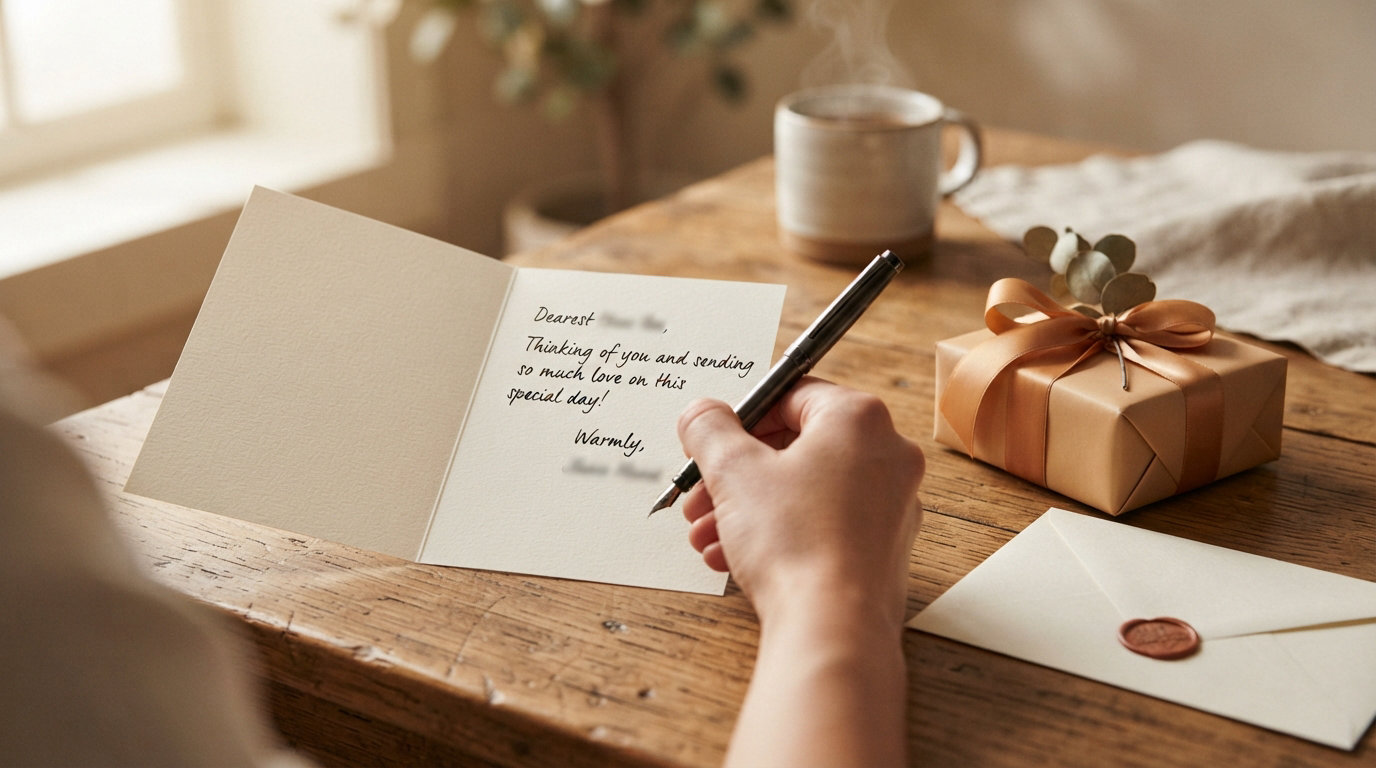
We have all been there. You pick out a thoughtful present, wrap it nicely, and then stare at the blank card wondering what to actually write. Learning how to write a note to include with a gift so it doesn’t feel empty is one of those small skills that completely changes how a present lands.
The note is where a generic object becomes something personal. Our team has spent years writing gift messages for friends, family, colleagues, and clients, and we noticed the same patterns every time. The best notes are not the longest ones. They are the ones that say something specific and real.
In this guide, you will learn a simple formula for writing meaningful gift notes, see templates for every major occasion, and find the small mistakes that make a note feel hollow. Everything here works for handwritten cards, printed enclosure notes, or quick gift-tag messages in September 2026.
Table of Contents
Why Gift Notes Matter (The Emotional Payoff)?
A gift without a note is just an object. The note is what tells the recipient why this thing, why now, and why from you.
People tend to remember the message long after they forget the wrapping paper. In fact, many people keep the card itself as a keepsake. That is the real value of a handwritten note. It turns a one-time exchange into something you can revisit years later.
There is also a quieter reason notes matter. When you take time to write, you are signaling that the recipient was on your mind before the gift ever arrived. That small act of attention does most of the emotional work. The present confirms it, but the note is what actually carries the feeling.
Reddit users in communities like r/Etsy and r/secretsanta consistently say the same thing. Simple, specific messages land harder than polished, formal ones. Sincerity beats eloquence every time.
How to Write a Note to Include With a Gift So It Doesn’t Feel Empty
If you want a reliable method, here is the exact framework our team uses. It works whether you have five minutes or five words of space.
Step 1: Name the recipient and the moment
Start with their actual name, not a generic greeting. Then reference the specific occasion or reason for the gift. This immediately tells the reader the note was written for them, not copied from a template.
Good example: “Happy 30th, Maya.” Bad example: “To a special person on a special day.”
Step 2: Add one specific, true detail
This is the step that prevents the empty feeling. Include one concrete thing that only you and the recipient would understand. An inside joke, a memory from a specific day, or a reason you chose this particular gift.
“I saw this and immediately thought of that rainy afternoon we spent arguing about the best pizza in Brooklyn” beats “Hope you love this” every single time.
Step 3: Say what the gift means or what you wish for them
Connect the object to a feeling or a hope. You are not describing the gift. You are describing the sentiment behind it. A single sentence about why you picked it, or what you hope it brings, is enough.
Step 4: Close with warmth, not formality
End the way you would actually talk to the person. “Love,” “With so much love,” “Cheers,” or “Your proud big brother” all work. Avoid stiff closings like “Sincerely” unless the context is genuinely formal.
That four-step structure is what separates a note that gets reread from one that gets recycled. Write it on a sticky note if you need to, and follow it the next time a card stumps you.
The Anatomy of a Meaningful Gift Note
A heartfelt message does not need to be long, but it does need structure. Think of a gift note as four small moving parts that work together.
The Greeting
Open with the recipient’s name and a warm acknowledgement of the occasion. This is where you set the tone, whether it is playful, tender, or professional. Keep it short, one line is plenty.
The Personal Hook
This is the line that makes the note yours and not anyone else’s. Reference a shared memory, a specific trait you appreciate about them, or the exact moment you decided on this gift. The hook is what makes the message feel handwritten even when it is printed.
The Occasion Reference
Name what you are celebrating. A birthday, a thank you, a new home, a tough week. Tying the gift to a clear reason gives the recipient context and makes the present feel intentional rather than random.
The Closing Wish
Wrap up with a forward-looking line. Wish them well, express love, or simply sign off in a way that feels true to your relationship. This is the line that lingers.
When all four parts are present, even a three-sentence note feels complete. Skip any one of them and the card starts to feel generic, which is exactly the problem we are trying to solve.
Quick Gift Message Templates by Occasion
Sometimes you just need a starting point. Here are short, adaptable templates you can use directly or tweak with a personal line. Each one follows the structure above so it never reads as hollow.
Birthday
“Happy birthday, [name]. Another year of you being the person who always remembers everyone else’s stories. I picked this because it made me think of that one. Hope this year brings you as much as you give to the rest of us.”
Thank You
“[Name], I am still thinking about how you showed up for me last month when everything was chaotic. This is a small way of saying I noticed and I will not forget it. Thank you, truly.”
Anniversary
“[Name], another year and somehow it still feels new. This is for all the ordinary Tuesdays that turned into my favorite memories. Here is to many more of them, with you.”
Holiday
“Merry Christmas, [name]. Thank you for making this season feel warm even when the rest of the year was a lot. Wishing you a quiet, happy few days with the people you love most.”
Get Well
“[Name], take it slow and let people help you, even though I know that is not your style. This is a small thing to make the recovery days a bit easier. Missing you and sending strength.”
Sympathy
“[Name], there are no right words, so I will just say I am thinking of you and I am here, whenever and however you need. No reply expected. With love.”
Just Because
“[Name], no occasion. I just saw this and thought of you immediately. That is the whole story. Hope it makes you smile.”
The “just because” template is one of our favorites. People on Reddit repeatedly say that an unprompted gift with a note like this is the most memorable kind. The lack of an occasion is itself the message.
Relationship-Specific Guidance
The right tone depends on who is reading. Here is how to adjust the same four-part structure for different relationships.
For Close Friends and Family
You can be candid, funny, and tender all in the same card. Use nicknames, reference old arguments, and skip the formalities. This is where inside jokes do the heaviest lifting, so lean into them.
For Colleagues and Professional Contacts
Stay warm but a touch more measured. Acknowledge the working relationship, the specific project or milestone, and keep the closing professional. A corporate gift note lands best when it sounds like a real person rather than a press release.
For Someone You Do Not Know Well
This is the situation people worry about most. The fix is to be honest about the distance. A simple “I do not know you well yet, but I have heard wonderful things and wanted to welcome you” is far better than pretending to a closeness that is not there. Sincerity about the gap feels respectful.
For Giving Money or Gift Cards
Cash and gift cards are practical but can feel impersonal without context. Acknowledge the choice directly. “I wanted you to pick exactly what you wanted, because you have expensive taste and I trust it” reframes a transactional gift into a thoughtful one.
Pro Tips for Making Notes Feel Personal
The difference between a forgettable note and a memorable one usually comes down to a handful of small habits.
Write the recipient’s name first, before anything else. It forces you to picture them while you write, and that picture shows up in the words you choose.
Mention a specific moment rather than a general compliment. “You always know how to make people laugh” is fine, but “I still laugh about the elevator incident in Chicago” is unforgettable.
Write the way you actually speak. If you would never say “wishing you abundant joy” out loud, do not write it. Stilted phrasing is what makes notes feel empty, even when the words are positive.
When in doubt, write less. A tight three-line note with one true detail beats a paragraph of filler. Forum users across multiple communities say the same: short and specific wins every time.
Choose your pen and paper with the recipient in mind. A slightly heavier card stock, a pen that does not smear, and a color you would actually pick for that person all add quiet signals of care. None of this needs to be expensive.
Common Gift Note Mistakes to Avoid
No competitor covers this well, which is exactly why it matters. These are the slip-ups that make a note feel hollow even when the gift is thoughtful.
The biggest mistake is copying a message verbatim from a list online. Templates are starting points, not final drafts. If your note could appear on a hundred other cards unchanged, it will read that way.
Avoid generic compliments with no anchor. Words like “amazing,” “wonderful,” and “special” mean almost nothing on their own. Pair every adjective with a concrete example or it evaporates.
Do not over-explain the gift. A long justification of why you chose it can sound defensive, as if you are worried the present is not good enough. Trust the choice and let the note reinforce it.
Skipping the personal detail entirely is the most common error of all. People default to “Hope you like it!” because they cannot think of anything else. That line is the definition of an empty note. Even one specific sentence fixes it.
Finally, watch the tone. Overly formal closings, excessive exclamation points, or heavy humor in a serious moment can all feel off. Match the energy of the relationship and the occasion, not a template you found.
Handwritten vs Digital Notes
Most competitors do not address this, but it comes up constantly in forums. Here is the honest tradeoff.
Handwritten notes almost always feel more personal. The physical mark of your hand, the slight imperfections, the choice of card, all of it adds weight. If the relationship matters and you have the time, write by hand.
Digital notes, including typed enclosure cards for online orders, have their place. They are practical when you are sending a gift remotely, ordering for a client list, or adding a message to an e-commerce purchase. They can still feel personal if you follow the same four-part structure and include one specific line.
The middle ground for business owners is to handwrite a short signature or add a personal postscript to an otherwise printed note. Etsy sellers in particular report that this small touch earns repeat customers.
FAQs
What to say in a note with a gift?
Name the recipient, reference the occasion, include one specific detail only the two of you would understand, and close with a warm wish. Even two sentences that follow this pattern feel complete. Avoid generic lines like “hope you like it” with no personal anchor.
How do you write a heartfelt gift note?
Write the way you actually speak, mention a specific shared moment, and say what the gift means rather than describing the object itself. Sincerity matters more than length. A tight three-line note with one true detail beats a long paragraph of filler.
What’s a good short gift message?
A strong short message pairs a greeting, one specific personal line, and a closing wish. Example: “Happy birthday, Maya. Still laughing about that rainy pizza debate in Brooklyn. Here is to another year of you being you.” Short, specific, and unmistakably yours.
How do you make a gift feel more personal?
The note does most of the work. Use the recipient’s name, reference a real memory, choose a card or pen that suits them, and write in your natural voice rather than formal phrasing. A handwritten signature on a printed note also adds a personal touch for business gifts.
What to write on a note for a gift when you do not know the person well?
Be honest about the distance. A line like “I do not know you well yet, but I have heard wonderful things and wanted to welcome you” reads as sincere and respectful. Avoid pretending to a closeness that is not there, and keep the tone warm but measured.
Conclusion
Writing a meaningful gift note is a learnable skill, not a talent you are either born with or not. Pick the recipient’s name, add one true detail, name the moment, and close warmly. That is the entire framework.
Once you know how to write a note to include with a gift so it doesn’t feel empty, the blank card stops being intimidating. It becomes the part of the gift you actually look forward to. Use the templates above as a starting point, swap in your own specific memory, and the rest takes care of itself.