
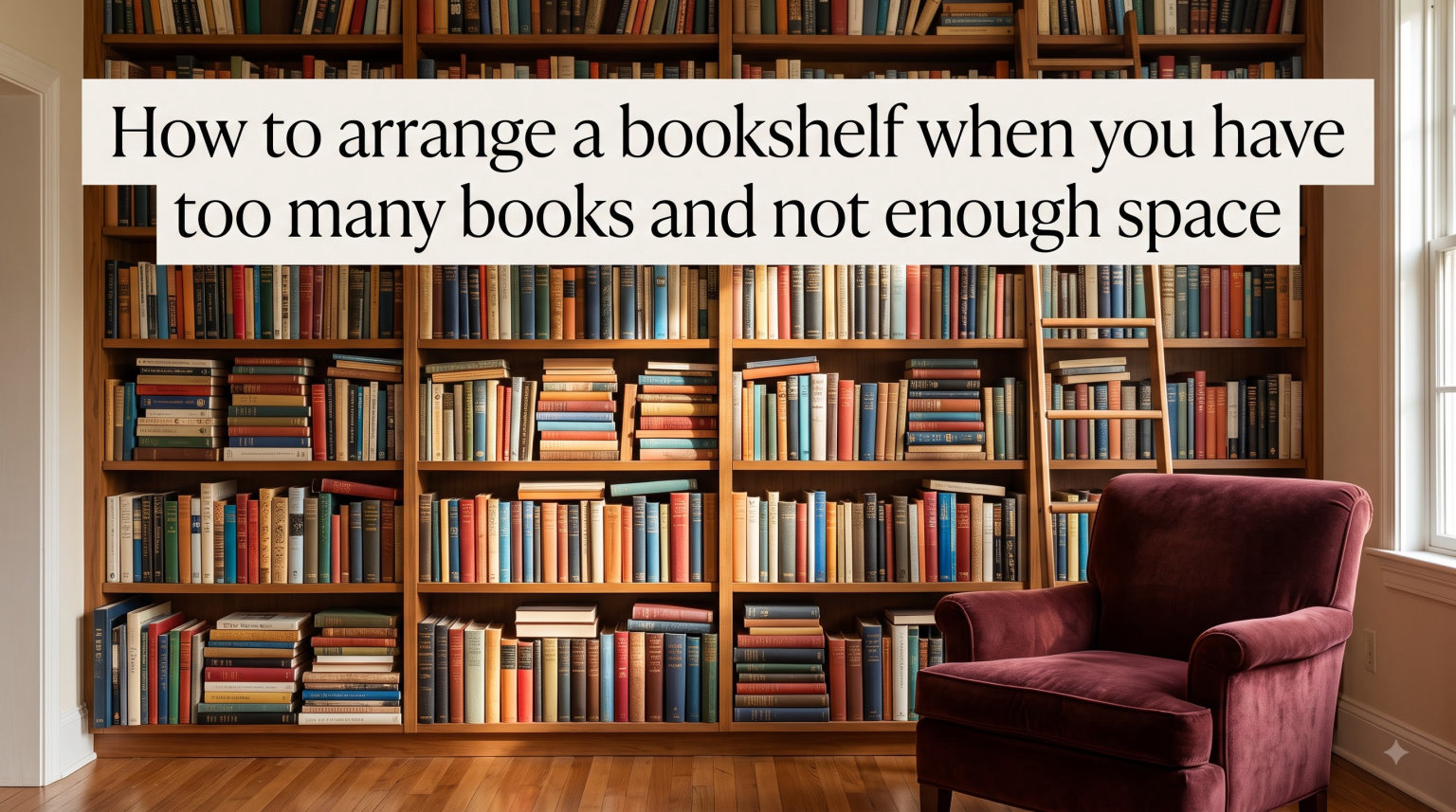
If your books are spilling onto the floor, doubling up on shelves, and quietly taking over every flat surface in your home, you are not alone. Bibliophiles everywhere face the same daily battle: how to arrange a bookshelf when you have too many books and not enough space.
I have lived this problem in three different apartments, including a 480-square-foot studio where I owned around 600 books. After years of trial, error, and more than a few panic-purchases of IKEA shelves, I have landed on a system that works.
This guide pulls together practical space-saving strategies, real reader-tested hacks from Reddit’s book communities, and styling tips that make overloaded shelves look intentional instead of chaotic. By the end, you will have a clear plan to reclaim your space without giving up the books you love.
Table of Contents
How to Arrange a Bookshelf When Space Is Tight?
The fastest way to arrange a bookshelf with too many books is to sort by size, stack shorter titles horizontally in front of taller upright books (the double-layer method), then photograph any books hidden behind so you can find them later. Combine this with vertical stacking up to the ceiling, repurposing unused ledges and corners, and donating 10 to 20 percent of your collection to free up breathing room.
Think of it as a three-part formula: reduce the pile, rearrange what remains, and expand where you store it. Each step below walks through one piece of that formula in detail.
Quick Space-Saving Checklist
Before you start the deep work, here is a rapid-fire list of the strategies covered in this guide. Use it as your reference while you rearrange.
Sort books into keep, donate, and store-away piles.
Fill every shelf from floor to ceiling instead of leaving empty top space.
Use double-layer stacking with shorter books in front.
Photograph hidden books so you remember what is where.
Add shelves in unused corners, hallways, and above door frames.
Slide books under beds, benches, and window seats.
Group by color or size for a calmer visual look.
Rotate seasonal reads in and out instead of displaying everything.
Move overflow to plastic bins, a friend garage, or an e-reader.
Apply the bookshelf rule: leave about 20 percent breathing room.
Step 1: Decide What Stays and What Goes
Decluttering books feels painful, but it is the single most effective way to solve the not-enough-space problem. Start with the keep-versus-donate test I learned from organizing a home library for a friend in 2026.
Pull every book off your shelf and stack them on the floor in three piles: keep, donate, and unsure. For the unsure pile, ask yourself three questions. Will I realistically reread this in the next two years? Does it hold sentimental value beyond a single memory? Would I buy it again today at full price?
If the answer is no, no, and no, it goes in the donate pile. Be honest. Most people keep more books out of guilt than genuine love, and that is exactly the guilt that creates the overflow.
Aim to free up at least 15 to 20 percent of your current shelf space. That is enough room to give the rest of your collection breathing room and stop the visual overwhelm that makes a packed shelf feel chaotic.
For the keep pile, sort further by genre, author, or topic. Sorting first makes Step 5’s styling work much easier because you already know which groups you have.
Step 2: Maximize Vertical Space on Existing Shelves
Most people stop stacking where the last book ends. That is leaving free real estate on the table. Look up. Look down. Look at the gaps between shelves.
Top shelves are gold mines. Add a small step stool, stack books in two horizontal layers up high, and store the titles you rarely touch on the very top. Reference books, old textbooks, and sentimental hardcovers are great top-shelf candidates.
Tighten shelf spacing too. Most bookcases allow you to remove a shelf and reinstall it a few inches higher or lower. Measure your tallest books, then arrange the rest so shorter shelves handle paperbacks and taller ones handle hardcovers. Even saving an inch per shelf can add one full extra row across a five-shelf unit.
Do not forget the space above the bookshelf itself. A single floating shelf mounted a foot above the unit can hold another thirty to forty paperbacks. The same trick works above door frames and below ceiling corners.
Step 3: Try the Double-Layer Stacking Method
This is the single best trick I picked up from a Reddit thread in r/books where a reader described handling exactly this problem. The idea is simple but surprisingly powerful.
Stand your tallest books upright in the back of the shelf. Then lay a second row of shorter books horizontally in front of them, with their spines facing out. You essentially double your capacity on a single shelf without losing access to the books behind.
The catch is remembering what is hidden. Take two minutes to photograph the back layer before you cover it up. Keep the photo on your phone with a simple filename like “Bedroom shelf 3 – back row.” When you want a specific title, you flip to the picture and find it in seconds.
This method works especially well for series, cookbooks, and reference books you reach for occasionally but not daily. Mix orientations deliberately: vertical-back, horizontal-front keeps the eye moving and stops the shelf from looking like a single block.
If a double layer still does not cut it, try triple-layer stacking for paperbacks. Two upright rows behind one horizontal row can triple the books per shelf, though you will want even clearer photos to track everything.
Step 4: Find Alternative Storage Locations
Once your existing shelves are maxed out, the next frontier is the rest of your home. Most apartments have far more storage potential than people realize.
Start with the foot of the bed. A low bookshelf or rolling cart tucked against the bedframe holds dozens of paperbacks without taking up visual space. The same logic applies to under-bench storage in entryways and dining nooks.
Look at your window ledges, doorway frames, and the awkward wall above the toilet. Floating shelves or a single narrow ledge can hold twenty or thirty paperbacks each. In hallways, a slim bookcase (under 8 inches deep) turns dead wall space into a personal library.
Corners are criminally underused. A corner shelf unit pulls books out of the way while filling a space most people decorate with plants. Likewise, the gap above kitchen cabinets and below ceiling beams often holds a full row of cookbooks with no effort.
Do not overlook vertical wall storage either. A tall narrow bookcase from floor to ceiling uses the same floor footprint as a short wide one but holds three times the books. In studios and small bedrooms, swapping a wide low shelf for a tall narrow one is the single biggest space-saver I have found.
Step 5: Style Overloaded Shelves So They Look Intentional
Even a packed shelf can look beautiful if you arrange it with a system. The bookshelf rule suggests leaving about 20 percent of each shelf empty so the eye has somewhere to rest. When that is impossible, fake it with breathing-room tricks.
Group books by size first, then by color or genre. Sorting by genre, as many home-library enthusiasts recommend, gives a calm rhythm that reads as intentional rather than chaotic. Adding small objects between groups – a plant, a candle, a single framed photo – breaks up the visual block and tricks the eye into seeing less clutter.
Horizontal stacks at the end of a row of upright books also break up the vertical lines and create visual punctuation. Place a small object on top of each horizontal stack to anchor it. This is the same trick stylists use on Pinterest-perfect shelves.
If you truly cannot fit everything, rotate. Keep your current favorites and seasonal reads on display, then box up the rest and swap them in every few months. A smaller, curated shelf always looks better than a stuffed one, and you still get to enjoy every book in your collection eventually.
Long-Term Storage Solutions for Overflow
Sometimes you need real off-shelf storage. Plastic bins with lids work well for long-term archival, especially in climates with humidity swings. Acid-free boxes are worth the upgrade for rare or sentimental titles.
If your collection has outgrown your home entirely, consider a small storage unit, a friend’s garage shelf, or a library book sale donation. Many local libraries accept large donations and will even pick them up.
For future overflow, an e-reader can quietly absorb your reading list without taking up any shelf space at all. It is not a replacement for the books you love, but it can stop the collection from growing past what your home can hold.
The honest truth is that not every book needs to live on a shelf forever. Letting a few hundred go does not mean you love reading less. It means you are making room for the next hundred, and the next hundred after that.
FAQs
How to organize a bookshelf with a lot of books?
Start by sorting books by size and genre, then stack shorter titles horizontally in front of taller upright books to double your capacity. Photograph hidden books so you can find them later, group by color for visual calm, and rotate seasonal reads in and out instead of displaying everything at once.
What is the bookshelf rule?
The bookshelf rule is a styling principle that suggests books should occupy no more than 80 percent of shelf space. The remaining 20 percent stays empty or holds decorative objects so the eye has somewhere to rest, which prevents a packed shelf from feeling visually overwhelming.
How to style a bookcase when you have a lot of books?
Sort by size first, then group by color or genre to create intentional-looking clusters. Break up rows of upright books with horizontal stacks, and place small objects like plants, candles, or framed photos between groups to create visual breathing room and a calmer overall look.
What is the 3 book rule?
The 3 book rule is a simple guideline: for every three books you buy, you should donate or remove one from your collection. It keeps your library actively growing without letting the shelves overflow, and it encourages readers to pass along titles they have already finished.
Final Thoughts on How to Arrange a Bookshelf
Running out of shelf space is a good problem. It means you read, you collect, and you care about the books you own. The trick is to stop trying to fit everything onto one wall and start using your whole home as a library.
Declutter honestly, stack vertically, double-layer with photography, and expand into corners, ledges, and ceilings. By 2026, you can turn even the smallest apartment into a calm, intentional reading space without giving up a single book you truly love.