
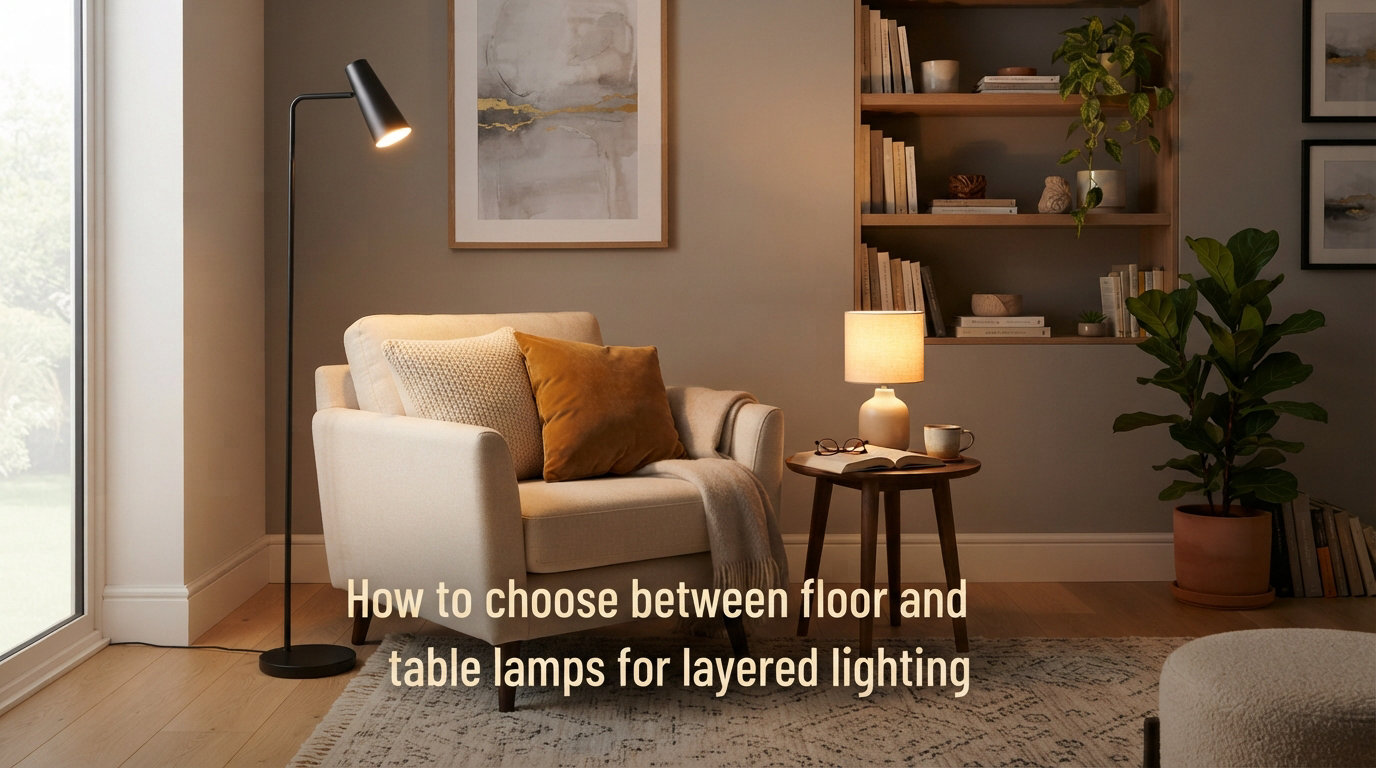
Learning how to choose between floor and table lamps for layered lighting can completely change how your home feels after sunset. I have spent years rearranging lamps in my own apartments, testing what works in tiny studios and open-plan living rooms alike. The right combination turns a flat, overhead-lit box into a warm, inviting space that people genuinely want to linger in.
The problem most people face is not a lack of lamps. It is a lack of strategy. You buy a floor lamp because a corner looks dark, then a table lamp because the side table feels empty, and somehow the room still looks off. This guide breaks down exactly when each type earns its place and how to blend them into a layered lighting plan that actually works.
You will learn the three layers every room needs, the practical strengths of floor lamps versus table lamps, the 5’7″ lighting rule that designers rely on, and a room-by-room breakdown you can follow this evening. By the end, you will know precisely how to choose between floor and table lamps for layered lighting without second-guessing every purchase.
Table of Contents
What Is Layered Lighting? The 3 Layer Lighting Theory Explained
Layered lighting is a design technique that combines ambient, task, and accent lighting to create depth, comfort, and visual interest in a room. Instead of relying on a single overhead fixture to do everything, you build a system where each light serves a specific purpose. The result is a space that feels balanced at every hour of the day.
The 3 layer lighting theory is the foundation behind every well-designed room. Once I understood these three layers, my own lighting choices stopped feeling random. Here is how the theory breaks down:
- Ambient lighting provides the overall base brightness for a room. This is your ceiling fixture, recessed lights, or a torchiere floor lamp that bounces light upward. Think of it as the canvas.
- Task lighting adds focused brightness where you actually do things. A table lamp next to a reading chair, a desk lamp for paperwork, or a floor lamp angled over a sewing spot all count. This layer protects your eyes during close work.
- Accent lighting highlights features you want to draw attention to. Picture lights over art, uplights washing a textured wall, or a small lamp tucked into a bookshelf create drama and dimension.
Floor and table lamps fit primarily into the task and accent layers, though a tall torchiere floor lamp can contribute to ambient lighting too. That dual role is exactly why choosing between them matters so much for your layered lighting plan.
Why does layering matter so much? A room lit only from above feels flat, clinical, and often harsh. Shadows fall in unflattering places, and there is no way to shift the mood. When you add task and accent layers with lamps, you create pockets of warmth that your eye can travel between. The room instantly feels more expensive and more comfortable.
I noticed this the first time I turned off my overhead light and relied on two table lamps and a floor lamp in my living room. The change was dramatic. Guests started commenting on how cozy the space felt, even though I had changed nothing but the lighting.
Ambient vs Task vs Accent: A Quick Way to Remember
If you ever forget which layer is which, use this simple test. Ambient light lets you walk through the room safely. Task light lets you see what your hands are doing. Accent light makes you say, “Oh, that looks nice.” Every lamp you add should clearly serve at least one of those functions.
Floor Lamps: Strengths, Placement, and Best Uses
Floor lamps are freestanding light fixtures that stand directly on the floor, typically between 58 and 72 inches tall. They shine when you need to fill a large, dark area or add height to your lighting scheme without needing a surface to sit on. I think of floor lamps as the structural backbone of a layered lighting plan.
What Floor Lamps Do Best
The biggest advantage of a floor lamp is reach. Because the bulb sits high, a floor lamp can illuminate a wider area than a table lamp positioned at waist height. A torchiere style throws light across the ceiling, which then reflects down softly as ambient fill. This trick alone can brighten a dark corner that no table lamp could ever reach.
Floor lamps also free up your surfaces. If your end tables are small, cluttered, or simply nonexistent, a floor lamp lets you add task or ambient light without sacrificing tabletop space. In my first studio apartment, this was the only way I could light my reading nook without giving up a surface for my coffee mug.
Scale is another strength. A well-chosen floor lamp acts as a vertical design element that draws the eye up and makes ceilings feel taller. In rooms with low furniture, that vertical lift keeps the space from feeling heavy and grounded.
Where Floor Lamps Work Hardest
Floor lamps earn their keep in corners that need lifting, next to large sofas where a table lamp would sit too low, and in open-plan spaces where you need to define a zone. A reading corner formed by an armchair, a small side table, and a floor lamp is one of the most reliable lighting setups in interior design.
I also love floor lamps for dark, windowless hallways or the awkward dead space behind a couch. A slim arc lamp can reach over seating to provide task light without occupying floor space in your walking path.
Placement Tips for Floor Lamps
Place a floor lamp so that its light source lands roughly at or just above eye level when you are seated nearby. This prevents the glare that comes from a bare bulb shining directly into your eyes. For reading, position the lamp on the opposite side of your dominant hand to avoid casting shadows across your book or tablet.
Tuck floor lamps behind furniture whenever possible. When the lamp base is hidden behind a chair or sofa, the light feels more integrated and less like an afterthought. Just make sure you leave room for the cord to reach an outlet without creating a tripping hazard.
Avoid the common mistake of placing a floor lamp dead-center in an empty corner. Instead, anchor it next to a chair, a plant, or a piece of art so it feels intentional rather than stranded.
Table Lamps: Strengths, Placement, and Best Uses
Table lamps are portable light fixtures designed to sit on a surface like a side table, desk, console, or nightstand. They create a cozy, human-scale glow at eye level that no overhead or floor light can replicate. I consider table lamps the secret ingredient that makes a room feel finished rather than just furnished.
What Table Lamps Do Best
The magic of a table lamp is intimacy. Because the bulb sits close to where you sit, the light wraps around you in a soft, contained pool. This is the glow that makes a sofa feel like a destination rather than just a piece of furniture. Forum discussions on Reddit repeatedly point out that modern homes have a serious lack of table lamps, and I agree.
Table lamps give you incredible flexibility. You can move them from room to room, swap shades to change the mood, and place them wherever a surface allows. If you rent or move frequently, this portability is invaluable. Your floor lamp stays anchored to an outlet, but a table lamp goes wherever you do.
They also double as decorative objects. A sculptural base or a beautiful shade becomes part of your styling even when the lamp is off. Pairs of matching table lamps on either end of a console or sofa instantly create symmetry and a sense of intention.
Where Table Lamps Work Hardest
Table lamps are perfect for bedside reading, desk work, dining room sideboards, and anywhere you sit and need close-up light. They are the workhorse of the task layer. I rely on them most at my desk and beside my bed, where the focused beam lets me read or work without lighting the entire room.
They are also the fastest way to add warmth to a room that feels cold or impersonal. A single table lamp switched on in an otherwise dark living room instantly shifts the mood toward intimate.
Placement Tips for Table Lamps
The bottom of the lampshade should sit at about eye level when you are seated next to it. If the bulb peeks out below the shade, the lamp is too short or too tall for that surface. This simple ratio keeps light where you want it and glare out of your eyes.
For bedside lamps, the bottom of the shade should roughly align with your shoulder when you are sitting up in bed. On a console or sofa table, aim for the lamp to occupy about one-third of the surface so it does not feel cramped or oversized.
Always consider the switch. A table lamp you have to stand up and fumble for is one you will stop using. Choose lamps with easy-to-reach switches, or pair them with smart bulbs so you can control them from your phone or with a voice command.
How to Choose Between Floor and Table Lamps for Layered Lighting
The decision between a floor lamp and a table lamp comes down to four factors: the function you need, the available surface and floor space, the height of your furniture, and the mood you want to create. Once I started weighing these four factors instead of buying on impulse, every lamp purchase became an easy call.
Here is the quickest way to decide. If you need to fill a dark, empty corner or light a large zone and you have no surface available, choose a floor lamp. If you need focused, eye-level warmth right where you sit and you have a surface to spare, choose a table lamp. For the best layered lighting, you will usually end up using both.
Before diving into the detailed comparison, let me share a rule that has saved me from countless bad placements.
The 5’7″ Lighting Rule, Explained Simply
The 5’7″ lighting rule is a designer guideline stating that the bottom of a lampshade should sit at roughly 5 feet 7 inches, or about eye level for an average standing adult. This applies primarily to floor lamps and the overall height of your lighting sources. When your lamp’s light source lands near eye level, it produces balanced, flattering illumination without harsh glare or deep shadows.
Why 5 feet 7 inches? That number approximates average adult eye height, which is the most important measurement in lighting. If a light source sits well below eye level, it can feel dim and cast upward shadows that make faces look gaunt. If it sits too far above, it can create an unflattering top-down glare.
I use this rule as a starting point, not a law. When you are seated, the relevant eye level drops considerably, which is why table lamps work best with their shades around seated shoulder-to-eye height. The 5’7″ rule is most useful when you are standing a floor lamp in a general-use area and want the light to feel balanced for everyone moving through the space.
Floor Lamps vs Table Lamps: A Side-by-Side Comparison
To make choosing easier, I put together this comparison of how each lamp type stacks up across the factors that matter most.
| Factor | Floor Lamps | Table Lamps |
|---|---|---|
| Primary layer served | Ambient and task | Task and accent |
| Typical height range | 58 to 72 inches | 20 to 30 inches |
| Surface required | None (freestanding) | Table or shelf |
| Illumination reach | Wide, fills large areas | Focused, intimate pools |
| Portability | Low (tied to outlet) | High (move freely) |
| Best for | Dark corners, open spaces, sofa-side reading | Bedside, desk, console, cozy seating |
| Visual role | Vertical structure, height | Decorative object, symmetry |
| Rental friendliness | Medium | High |
Use this table as a quick reference whenever you are standing in a room wondering what it is missing. Notice that the two lamp types almost never compete for the same role. They complement each other, which is the whole point of layering.
Combining Floor and Table Lamps for the Best Layered Lighting
The strongest lighting plans use floor and table lamps together rather than choosing one over the other. A typical living room setup I recommend starts with a floor lamp in a dark corner for ambient fill, then adds a table lamp on a side table next to the sofa for task light, and finishes with a smaller accent lamp on a bookshelf or console for depth.
This three-lamp combination hits all three layers of lighting theory in a single room. The floor lamp handles ambient, the table lamp handles task, and the accent lamp adds that third dimension that makes the space feel designed rather than just lit.
A good ratio to aim for is at least one floor lamp per large zone of the room, paired with one or two table lamps per seating area. You can always add more, but this baseline prevents the two most common problems: a room that feels like a dark cave or a room that feels like a hospital under harsh overheads.
Do Floor Lamps and Table Lamps Need to Match?
Floor lamps and table lamps do not need to match, and in most cases they should not. Designers almost universally agree that coordinating your lamps is far more effective than buying an identical matching set. Matching everything can make a room feel flat and catalog-like, while thoughtfully different lamps create depth and personality.
The trick is to coordinate rather than duplicate. I like to repeat one element across my lamps, such as the metal finish, the shade material, or the overall style era, while letting the shapes and sizes vary. Two brass lamps in different silhouettes feel related without looking boring.
If you prefer a more collected, layered look, you can mix finishes freely as long as the scale and proportion feel right. The only thing I avoid is placing two lamps so different in style that they compete for attention in the same sightline.
Bulb Color Temperature: Why 2700K Matters
Bulb color temperature determines whether your light feels warm and cozy or cool and clinical. Color temperature is measured in Kelvin, and for residential lamps, the sweet spot is 2700K. This temperature produces a soft, warm white that flatters skin tones and makes rooms feel relaxing.
I learned this the hard way after buying a batch of 5000K daylight bulbs that made my living room feel like a grocery store. At 2700K, the same lamps instantly felt like home. For spaces where you occasionally need more alertness, like a home office, you can step up to 3000K, but I would not go higher than that in living areas.
Whatever temperature you choose, keep it consistent across the lamps in a single room. Mixing a warm 2700K table lamp with a cool 4000K floor lamp creates a jarring effect that undermines all your layering effort.
Using Dimmers to Control the Mood
Dimmers are the finishing touch that turns a good lighting plan into a great one. With a dimmer, your bright task lamp becomes a gentle accent light the moment you stop reading. Smart bulbs make this even easier, since you can dim, warm up, or schedule every lamp from your phone without rewiring anything.
If rewiring a switch feels daunting, start with plug-in dimmers or smart bulbs. I use smart bulbs in most of my lamps, and the ability to set an evening scene that drops every light to 20 percent warmth is one of my favorite home upgrades.
Room-by-Room Layered Lighting Guide
Every room has different lighting needs, and the balance between floor and table lamps shifts accordingly. Here is how I approach the main rooms in a home.
Living Room
The living room is where layered lighting shines most. Start with one floor lamp positioned behind or beside the sofa to fill ambient light into the seating area. Add a table lamp on one or both end tables for task light and to anchor the seating arrangement visually.
If you have a console table behind the sofa or against a wall, a pair of table lamps there adds symmetry and another layer of warmth. Finish with a small accent lamp on a bookshelf or side table for depth. The goal is at least three light sources that you can mix and match depending on the occasion.
Bedroom
The bedroom calls for soft, calming light at eye level. Bedside table lamps are the natural choice here, positioned so the shade bottoms sit around shoulder height when you sit up in bed. This gives you focused reading light without forcing you to light the whole room.
If your bedroom is large or has a reading chair, add a floor lamp in that corner rather than relying on the bedside lamps to carry the whole space. I also like a dim lamp on a dresser to serve as a low accent glow during the evening wind-down.
Avoid bright overhead lights as your primary bedroom source. They are too harsh for a room meant to signal rest. Lamps do the heavy lifting here, which is exactly why getting the floor-versus-table balance right matters so much.
Home Office
The home office prioritizes task lighting above all. A table lamp or dedicated desk lamp positioned opposite your dominant hand provides focused, shadow-free light for screens and paperwork. This is where brightness matters more than ambiance.
Add a floor lamp in a corner to provide ambient fill so your eyes are not strained by the contrast between a bright desk and a dark room. The ambient layer reduces fatigue during long work sessions, something I noticed immediately after adding one to my own workspace.
Keep color temperature at 3000K in the office for alertness without harshness, and consider a lamp with an adjustable arm or head so you can direct light exactly where you need it.
Dining Room and Entryway
The dining room usually centers on a pendant or chandelier, but a table lamp on a sideboard adds a low, warm layer that makes the room feel intimate during dinner. I love the look of a single lamp glowing on a buffet while the overhead pendant is dimmed low.
In an entryway, a console table lamp creates an instant welcome. If you have no table, a slim floor lamp beside the door achieves a similar effect. Either way, the goal is a soft, inviting glow that greets you the moment you walk in.
Common Lighting Mistakes to Avoid
Even with the right lamps, a few common mistakes can sabotage your layered lighting. Here are the ones I see most often, along with how to fix them.
Relying on a single overhead light. This is the number one culprit behind rooms that feel flat and uninviting. Overhead light fills a room evenly but adds no depth or warmth. Always add at least two lamp-based layers to break up the flatness.
Choosing the wrong scale. A tiny table lamp on a massive console looks lost, while an oversized floor lamp next to a low armchair feels top-heavy. Match lamp proportions to the furniture around it, and use the 5’7″ rule as your height guide.
Mixing color temperatures. A warm bulb in one lamp and a cool bulb in another creates visual tension that makes the room feel unsettled. Pick one temperature, ideally 2700K, and stick with it across the room.
Ignoring cord management. Tangled cords ruin the look of an otherwise great lamp arrangement and create tripping hazards. Use cord covers, run cables along baseboards, or choose lamps with clear cord paths. For renters especially, a little cord planning goes a long way.
Placing lamps where you cannot reach the switch. A lamp you have to get up to turn off is a lamp you will eventually stop using. Position switches within arm’s reach, or invest in smart bulbs for effortless control.
Frequently Asked Questions About Layered Lighting
Do floor lamps and table lamps need to match?
Floor lamps and table lamps do not need to match. Most designers recommend coordinating rather than duplicating, so repeating one element like a metal finish, shade material, or style era across your lamps creates a related look without feeling flat or catalog-like.
What is the 5’7″ lighting rule?
The 5’7″ lighting rule is a designer guideline stating that the bottom of a lampshade should sit at roughly 5 feet 7 inches, or about average adult eye level. Placing your light source near this height produces balanced, flattering illumination without harsh glare or deep shadows.
What is the 3 layer lighting theory?
The 3 layer lighting theory combines ambient lighting for overall room brightness, task lighting for focused activities like reading, and accent lighting to highlight specific features. Together these three layers create depth, comfort, and visual interest in any space.
What floor lamps are in style right now?
In 2026, the most popular floor lamp styles include slim arc lamps that reach over seating, sculptural and brass fixtures that double as art, adjustable pharmacy-style reading lamps, and minimalist matte-black designs. Natural materials like rattan and wood are also trending for a warmer, organic feel.
Bringing It All Together
Knowing how to choose between floor and table lamps for layered lighting comes down to understanding what each type does best and letting them work together. Floor lamps deliver reach, height, and ambient fill for large or dark areas. Table lamps provide the intimate, eye-level warmth that makes a room feel lived-in and welcoming. The strongest lighting plans use both.
Start with the three-layer theory as your foundation, apply the 5’7″ rule for height, pick a consistent 2700K color temperature, and add dimmers or smart bulbs for flexibility. From there, walk through each room with fresh eyes and ask whether every corner has the light it needs.
Your next step is simple. Walk into your most-used room tonight, turn off the overhead light, and switch on only your lamps. Notice where the room still feels dark or flat. That is where your next lamp belongs, and now you know exactly which type to choose.