
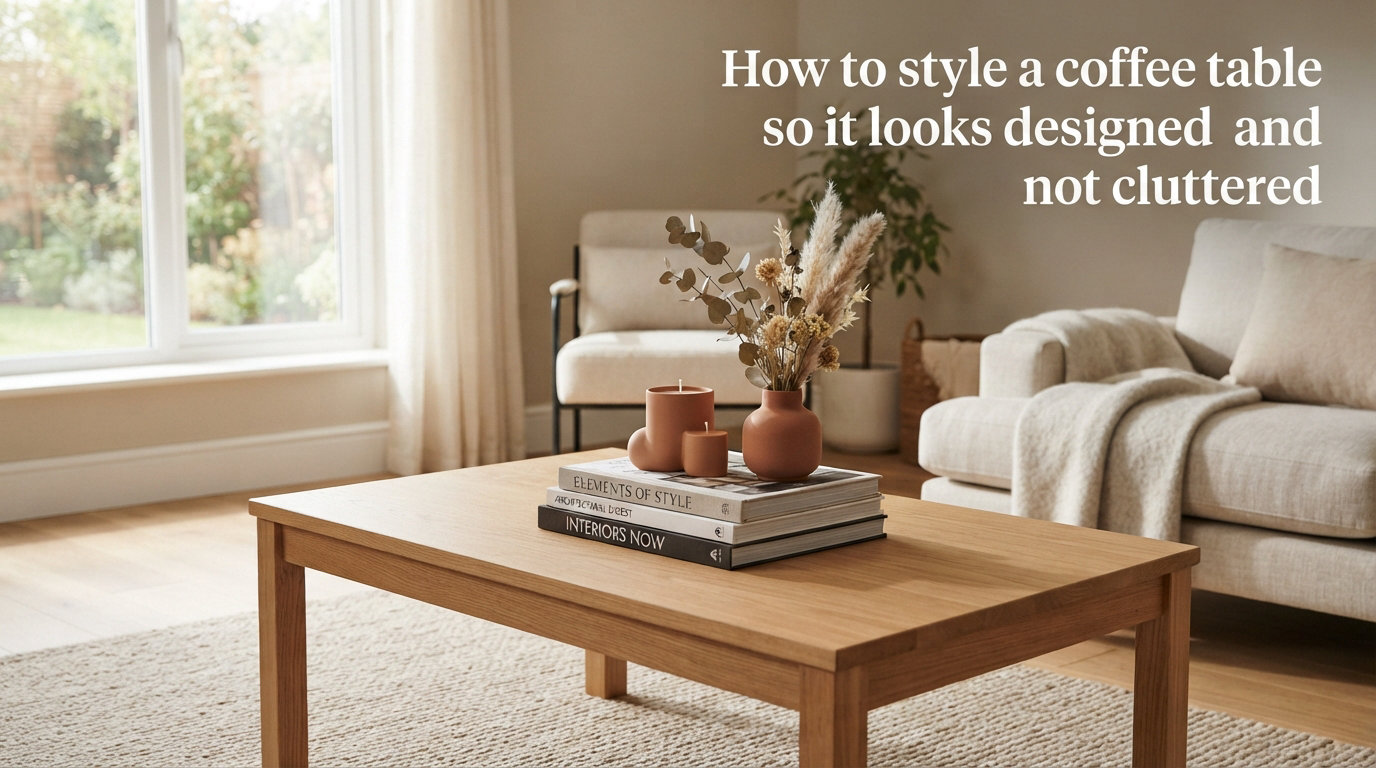
Your coffee table is the unsung hero of your living room. It sits dead center in your seating area, collects everything from remote controls to coffee mugs, and quietly sets the tone for the entire space. Yet most people either leave it bare or pile it so high with random objects that it looks like a yard sale rather than a styled focal point.
If you have ever walked into a beautifully designed room and wondered why the coffee table looks so effortlessly perfect, there is a method behind it. Interior designers do not randomly scatter objects and hope for the best. They follow repeatable principles that balance proportion, texture, and negative space to create what looks like effortless styling.
Learning how to style a coffee table so it looks designed and not cluttered comes down to eight simple steps. I have broken down each principle below with specific examples, common mistakes to avoid, and shape-specific guidance for round, square, and rectangular tables. By the end of this guide, you will have a clear framework you can apply today.
Table of Contents
How to Style a Coffee Table in 8 Simple Steps?
The secret to a designed-looking coffee table is following a structured process rather than randomly placing objects. Think of your coffee table as a small stage where each item plays a specific role. When you build the arrangement one layer at a time, the result looks intentional and polished.
Step 1: Start With a Completely Clear Surface
Before you style anything, clear every single item off your coffee table. I mean everything. Remotes, coasters, yesterday’s mail, that candle you never light. Wipe down the surface so you are working with a true blank canvas.
This step matters because you cannot evaluate proportion and balance when old items are still sitting there. You need to see the table’s surface material, shape, and size without distraction. Take note of whether your table is glass, wood, marble, or metal, because this will guide your material choices later.
A clean surface also lets you mentally divide the space into zones. Picture an invisible grid over the table. Where is the visual center? Where will people sit relative to the table? These questions are much easier to answer when nothing is competing for your attention.
Step 2: Master the Rule of Three
The rule of three is the single most powerful principle in coffee table styling. It states that objects arranged in odd numbers, particularly groups of three, look more natural and visually appealing than even-numbered arrangements.
Our brains are wired to find odd numbers more dynamic and interesting. Three items create a triangle shape when viewed from above, which gives the eye a path to follow without feeling trapped in symmetry. Even numbers tend to look rigid and formal, like soldiers lined up for inspection.
Here is how to apply the rule of three on your coffee table. Choose three objects of varying heights. For example, a stack of books, a small plant, and a decorative object like a sculptural bowl. Arrange them in a loose triangular formation rather than a straight line.
You can scale this principle up for larger tables. Five or seven items work beautifully on a generous surface, as long as you maintain the odd-number grouping and vary the heights. The key is that each cluster of items should feel like a self-contained vignette rather than a random scatter.
One important variation is the 2/3 rule for coffee tables. This guideline suggests that your styled objects should occupy roughly two-thirds of the table surface, leaving the remaining third as open negative space. This ratio keeps the arrangement feeling full without crossing into cluttered territory.
Step 3: Use a Tray to Contain and Anchor Your Items
A decorative tray is the secret weapon that separates amateur styling from designer-level results. A tray acts as a frame within a frame, grouping small items together so they read as one intentional cluster rather than a collection of loose objects.
Think about what happens without a tray. You place a candle, a small vase, and a few coasters on the table. Individually, each item floats aimlessly. Together inside a tray, they instantly become a styled vignette that looks deliberate and curated.
Choose a tray material that contrasts with your table surface. This is a tip I have seen repeated across designer forums and Reddit communities alike. If your table is glass, skip the glass tray and choose wood, rattan, or lacquered metal. If your table is wood, a brass or marble tray creates striking contrast.
Keep the tray proportional to your table. It should take up no more than one-third to one-half of the surface area. A tray that is too large overwhelms the table, while one that is too small looks lost.
Use the tray to corral practical items too. Remotes, coasters, and small trinket dishes can live inside the tray so they look intentional rather than like everyday clutter. This is how you maintain function without sacrificing style.
Step 4: Stack Coffee Table Books as Your Foundation
Coffee table books are the structural backbone of any well-styled surface. They add height, color, and personality while serving as a platform for smaller objects to sit on top.
When selecting books, choose thick, oversized volumes with covers that complement your room’s color palette. Art books, photography collections, travel books, and design monographs all work beautifully. Avoid thin paperbacks, which look flimsy and do not provide enough visual weight.
Stack two to four books horizontally, with the largest book on the bottom. Offset the stack slightly rather than placing it dead center on the table. This creates a more relaxed, designer feel.
Top the book stack with a single small object. A tiny sculpture, a delicate bowl, or a pair of reading glasses perched on the upper book adds personality and draws the eye upward. This technique creates instant height variation without much effort.
You can also create two separate book stacks of different heights on larger tables. Place one stack on the left side and another smaller one on the right, then fill the middle with a taller object. This creates balance and rhythm across the surface.
Step 5: Create Height Variation for Visual Dimension
Height variation is what gives a coffee table its three-dimensional appeal. If every item sits at the same level, the arrangement looks flat and lifeless. Designers aim for a mix of low, medium, and tall elements.
Low items include book stacks, shallow bowls, and flat trays. Medium-height objects might be a small vase with flowers, a candle in a holder, or a medium-sized sculpture. Tall elements could be a branching plant, a tall candlestick, or a slender vase with long stems.
The goal is to create a visual rhythm. When someone glances at your coffee table, their eye should travel up and down across the arrangement rather than sliding across a flat line. This movement is what makes the styling feel dynamic.
A simple formula I recommend is low plus medium plus tall. One book stack provides the low element. A medium decorative object sits nearby. A taller plant or vase rises above the rest. This trio hits every height level and satisfies the rule of three simultaneously.
Avoid the trap of using only short objects. A table covered in flat items like coasters, small books, and shallow dishes looks like a display case rather than a styled surface. You need at least one element that breaks above the rest.
Step 6: Mix Textures for Visual Interest
Texture mixing is the difference between a coffee table that looks flat and one that feels rich and layered. When all your items share the same material and finish, the arrangement reads as monotonous. Mixing textures adds depth even when the color palette stays simple.
The golden rule here is contrast. Look at your table surface first, then choose materials that stand apart from it. Reddit users in the HomeDecorating community consistently recommend this approach. If your table is glass, avoid glass candles or a glass tray. If your table is wood, skip the wooden bowl.
Here are some texture combinations that work well together. Pair smooth ceramic with rough woven rattan. Combine polished brass with matte stone. Layer glossy lacquer against natural linen. Each pairing creates friction that makes the arrangement visually interesting.
Think about tactile contrast too. A cool marble sphere next to a warm wooden bead garland. A spiky succulent beside a soft velvet-covered book. These textural pairings engage the senses and make the styling feel curated rather than assembled from a single store shelf.
Natural elements deserve special attention here. A piece of coral, a geode, a chunk of driftwood, or a collection of smooth river stones brings organic texture that manufactured decor cannot replicate. These items add authenticity and ground the arrangement in the real world.
Step 7: Add a Plant or Organic Element
Every styled coffee table benefits from something living or organic. A plant, a bowl of fruit, fresh flowers, or even dried botanicals inject life into what would otherwise be a collection of static objects.
Greenery softens hard surfaces and introduces movement. Even a single stem in a small vase transforms the energy of a tablescape. The slight asymmetry of a natural element prevents the arrangement from looking too stiff or showroom-like.
For low-maintenance options, consider a small succulent, a trailing plant in a low bowl, or a sculptural branch in a tall vase. Dried pampas grass and eucalyptus bundles last for months and require zero water. A bowl of lemons or artichokes doubles as both decor and a pop of color.
Match the scale of your greenery to the table. A tiny succulent gets lost on a large rectangular table, while an oversized arrangement overwhelms a small round one. When in doubt, a low bowl with a single plant creates maximum impact with minimum risk.
Step 8: Embrace Negative Space and Let Items Breathe
Negative space is the empty area around and between your styled objects. It is not wasted space. It is the breathing room that makes each item stand out and prevents the table from looking cluttered.
Many people make the mistake of filling every square inch of their coffee table. The result is visual overload. When there is no empty space, the eye cannot rest, and the arrangement feels chaotic rather than designed.
Aim to leave at least one-third of your table surface empty. If you have a round table, this might mean styling one cluster and leaving the opposite side bare. On a rectangular table, leave gaps between your groupings.
Negative space also serves a practical purpose. You need room to set down a coffee cup, a plate, or a laptop. A table that is styled wall to wall is beautiful to look at but impossible to actually use. The best coffee table styling balances beauty with everyday function.
How to Style a Coffee Table Based on Shape?
Every table shape requires a slightly different approach to styling. What works on a long rectangular surface will look completely wrong on a round table. These shape-specific tips will help you adapt the eight principles above to your specific furniture.
How to Style a Round Coffee Table
Round coffee tables benefit from a single central cluster. Because the shape has no corners and no natural division, a centered vignette works best. Place your tray or main grouping in the middle, and let the curved edges of the table frame it naturally.
A round table is perfect for a radial arrangement. Think of your items arranged around a center point, like the hours on a clock face. A low bowl of flowers in the center with three objects spaced around it creates a pleasing circular composition.
Avoid pushing items to the edges of a round table. Unlike rectangular tables where items can sit along the perimeter, a round table’s edge is curved, and items placed too close will look precarious. Keep everything comfortably toward the center.
For small round tables, stick to three items maximum. A book stack, a small plant, and one decorative object is all you need. Adding more will quickly tip the balance into cluttered territory.
How to Style a Square Coffee Table
Square coffee tables offer a unique opportunity for quadrant styling. You can mentally divide the surface into four equal sections and create a small vignette in each corner, leaving the center open. This approach works particularly well for larger square tables.
Alternatively, you can style one dominant corner cluster and leave the remaining space open. This asymmetric approach feels more contemporary and relaxed than a four-corner treatment. Place your tallest item in one corner and let it anchor the arrangement.
Symmetry is your friend on a square table. Two matching candlesticks on opposite corners, or a pair of identical book stacks flanking a central object, creates a formal and balanced look. This works well in traditional or classic interiors.
For a modern look, abandon symmetry entirely. Cluster three items tightly in one corner and leave the other three quadrants mostly empty. The contrast between the styled area and the open space creates visual tension that feels intentional and designed.
How to Style a Rectangular Coffee Table
Rectangular coffee tables are the most common shape, and they offer the most flexibility. The key is dividing the long surface into zones rather than treating it as one flat plane. The grid system, popularized by styling experts, works beautifully here.
Imagine three vertical columns running across your rectangular table. The left column holds a book stack topped with a small object. The center column stays mostly open or holds a single low item. The right column features a taller element like a plant or vase.
This left-center-right distribution creates a natural left-to-right reading flow. The eye starts at the books, pauses at the open center, and finishes at the tallest item. It feels like a well-composed photograph.
For very long tables, you can create two separate vignettes rather than spreading items across the entire surface. One cluster near each end with open space in the middle prevents the arrangement from looking like a display shelf.
Avoid lining items up in a straight row down the center of a rectangular table. This creates what designers call a bowling alley effect, where every object sits at the same depth. Instead, push some items forward toward the seating side and pull others back.
Common Coffee Table Styling Mistakes to Avoid
Even with the right principles in mind, certain pitfalls can sabotage your styling efforts. I see these mistakes repeated constantly in home tours, social media posts, and questions from people struggling to get their coffee tables right. Here are the seven most common errors and how to fix them.
Mistake 1: Too many small items. A collection of tiny trinkets scattered across the table reads as clutter, not styling. Replace several small objects with fewer larger pieces. One substantial sculpture beats five miniature figurines every time.
Mistake 2: Wrong scale and proportion. Tiny items on a massive table look lost, while oversized objects crowd a small table. Match the size of your decor to the footprint of your furniture. When in doubt, go slightly larger than you think you need.
Mistake 3: Matching the table material. A wooden bowl on a wooden table disappears. A glass candle on a glass table is invisible. Always choose materials that contrast with your table surface so each item stands out.
Mistake 4: Ignoring function entirely. A beautifully styled table that leaves no room for a coffee cup is a styling failure. Always reserve space for real-life use. Practical items can live inside a decorative tray.
Mistake 5: Forgetting height variation. When everything sits at the same level, the arrangement looks flat. Always include at least one tall element to create vertical interest and draw the eye upward.
Mistake 6: Over-styling with trends. Filling your table with the latest trendy objects makes it look like a store display. Choose a few timeless pieces and add just one or two trend-driven items for freshness.
Mistake 7: Never changing it up. A coffee table styled three years ago that has not been touched since looks stale. Refresh your arrangement seasonally by swapping the plant, rotating the books, or adding a seasonal element.
Coffee Table Styling Trends for 2026
Styling trends evolve, and 2026 brings some exciting directions for coffee table decor. The overarching theme is a return to tactile, handcrafted objects with personality and soul rather than mass-produced minimalism.
Sculptural objects are having a major moment. Think hand-carved wooden bowls, ceramic forms with organic imperfections, and stone objects that look like small works of art. These pieces serve as conversation starters while adding genuine artistic value to your space.
Natural materials continue to dominate. Travertine, unglazed clay, aged brass, and raw wood are appearing in styled coffee tables across design publications. These materials age beautifully and develop patina over time, making them feel more personal the longer you live with them.
Bold accent colors are replacing the all-neutral palette that dominated the past few years. A single brightly colored object, like a cobalt blue ceramic vase or a burnt orange lacquered box, adds energy without overwhelming the arrangement.
Layered styling is gaining traction over the single-tray approach. Designers are creating depth by layering a small object directly on top of a book stack, then placing that stack inside a tray, and adding a tall element just outside the tray. This multi-layered approach creates richness and complexity.
Personal and collected objects are replacing generic decor. Travel souvenirs, family heirlooms, handmade pottery, and found objects from nature tell a story that no catalog can replicate. In 2026, the most stylish coffee tables are the ones that feel genuinely personal.
Personal Touches That Spark Conversation
The best coffee table styling reflects the person who lives there. Generic decor pulled from a single big-box store looks like a showroom, not a home. Meaningful objects are what transform a styled surface into a personal statement.
Travel souvenirs make excellent styling pieces. A carved wooden box from Morocco, a ceramic tile from Portugal, or a small sculpture picked up at a local market abroad carries a story that guests will ask about. These items add authenticity that manufactured decor simply cannot match.
Family photographs can work on a coffee table when done thoughtfully. Skip the traditional standing frames, which look dated and take up too much vertical space. Instead, lean a single framed photo against a larger object inside a tray, or prop one against the back of a book stack.
Hobby-related items connect your styling to your interests. A beautiful chess set, a stack of vinyl record sleeves, a vintage camera, or a collection of interesting rocks all reflect who you are. Choose one hobby element and make it a focal point.
The golden rule of personal touches is restraint. One or two meaningful objects integrated into your arrangement add soul. Ten personal items piled together create visual noise. Let each piece have its own space to be noticed and appreciated.
FAQs
What is the 2/3 rule for coffee tables?
The 2/3 rule for coffee tables suggests that your decorative objects should fill approximately two-thirds of the table surface, leaving the remaining third as open negative space. This ratio creates a full, styled look without crossing into cluttered territory. It ensures your arrangement feels intentional while leaving room for practical use like setting down a drink.
How to minimally decorate a coffee table?
To minimally decorate a coffee table, choose just three items of varying heights: one stack of two coffee table books, one small organic element like a single stem vase or succulent, and one decorative object such as a ceramic bowl or sculptural piece. Keep everything clustered in one zone and leave the rest of the surface empty. Minimalist styling works best when each object is high quality and visually substantial on its own.
What are common coffee table styling mistakes?
The most common coffee table styling mistakes include using too many small items instead of fewer larger pieces, matching the tray or decor material to the table surface, ignoring height variation so everything sits flat, overfilling the surface with no negative space, and choosing generic mass-produced decor instead of meaningful personal objects. Avoiding these mistakes immediately elevates your styling results.
How many items should be on a coffee table?
Most coffee tables look best with three to five styled items arranged in odd-number groupings. A small round table may need only three pieces, while a large rectangular table can support five to seven items divided into two clusters. The key is varying heights and leaving at least one-third of the surface empty as negative space.
What are the trends in coffee tables in 2026?
In 2026, coffee table styling trends favor sculptural handcrafted objects, natural materials like travertine and unglazed clay, bold accent colors replacing all-neutral palettes, and deeply personal collected items over generic decor. Layered styling with objects stacked inside trays and on book stacks is also popular, creating depth and visual richness.
What should be in the middle of a coffee table?
The center of a coffee table works well as a focal point for round tables, where a low bowl of flowers or a sculptural object anchors the arrangement. On rectangular tables, the middle is often best left as negative space with items clustered toward the ends. Choose based on your table shape and leave enough open space for everyday function.
Bringing It All Together
Learning how to style a coffee table so it looks designed and not cluttered is not about buying expensive decor or following rigid formulas. It is about understanding a few core principles and applying them with intention. Clear your surface, group items in odd numbers, use a tray as an anchor, build height with books, mix your textures, add something living, and always leave room to breathe.
Start with just three items today and build from there. The beauty of coffee table styling is that nothing is permanent. You can rearrange, swap, and refresh whenever the mood strikes. Your coffee table is a small canvas waiting for your personal touch, so have fun with it.