
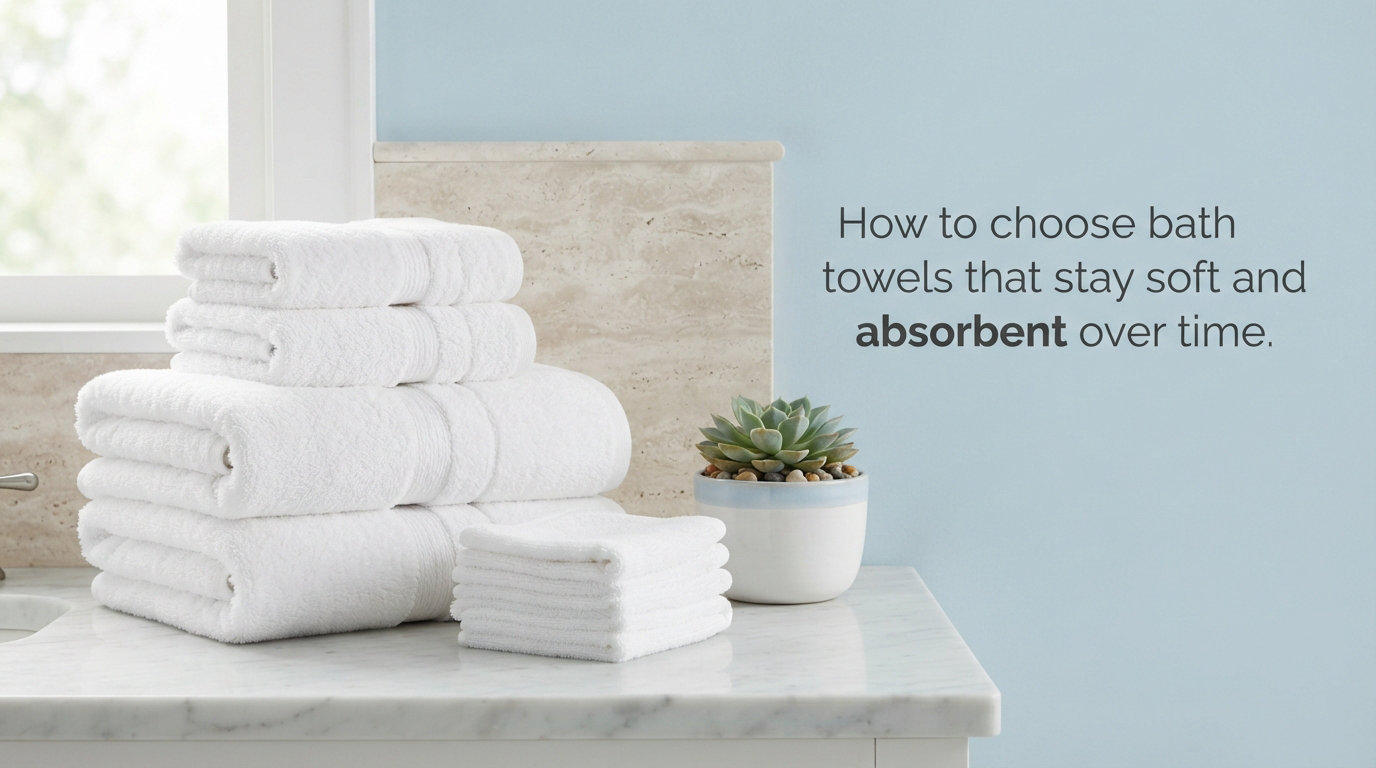
There is nothing worse than stepping out of a warm shower and wrapping yourself in a towel that feels like sandpaper. I have been there, and after replacing three sets of towels in two years, I decided to figure out what actually keeps bath towels soft, fluffy, and thirsty for moisture over the long haul.
Learning how to choose bath towels that stay soft and absorbent over time comes down to understanding four things: the cotton type, the weight (GSM), the weave, and how you care for them. Most people get the first three right at the store but destroy all that quality with the wrong laundry routine at home.
The towels in your bathroom take more abuse than almost any other fabric in your house. They soak up water multiple times a day, get rubbed against skin, tossed in damp piles, and run through hot wash cycles with harsh detergents. A cheap towel might feel fine on day one, but give it 20 washes and it turns into a stiff, lint-covered disappointment.
I spent weeks researching cotton varieties, testing different GSM weights, and reading hundreds of forum discussions from people who have owned the same towels for five-plus years. What I found is that the difference between a towel that lasts six months and one that lasts five years is not just about spending more money. It is about knowing what to look for and how to treat what you buy.
In this guide, I will walk you through everything that matters. We will cover Turkish versus Egyptian cotton, what GSM numbers actually mean, why your towels are going rough, and the care habits that keep fibers intact for years. By the end, you will know exactly what to buy and how to make it last.
Table of Contents
How to Choose Bath Towels That Stay Soft and Absorbent Over Time?
Choosing bath towels that stay soft and absorbent over time requires attention to cotton quality, fabric weight, weave construction, and ongoing care. The best towels use long-staple cotton fibers, fall in the 600 to 900 GSM range, feature intact loop piles, and are washed without fabric softener.
Here are the key factors I check before buying any towel:
Cotton type: Long-staple Turkish, Egyptian, or Pima cotton resists breaking down and stays softer longer than short-staple alternatives.
GSM weight: Grams per square meter tells you density. The sweet spot for softness and absorbency sits between 600 and 900 GSM.
Weave and loop construction: Terry cloth with dense, intact loops absorbs moisture far better than flat weaves or sheared velour.
Certifications: OEKO-TEX and GOTS labels confirm the cotton was grown and processed without harmful chemicals.
Care routine: Skipping fabric softener, washing in warm water, and adding vinegar to the rinse cycle extends softness by years.
Staple length: Longer fibers create stronger yarns that resist fraying, pilling, and thinning over hundreds of washes.
Initial treatment: New towels arrive with chemical sizing coatings that must be washed out before they become truly absorbent.
If you get these factors right, your towels will still feel luxurious two or three years down the road. Get them wrong, and even an expensive towel will feel scratchy within months.
Understanding Cotton Types: The Foundation of Towel Quality
The single biggest predictor of long-term towel softness is the type of cotton used. Not all cotton is created equal, and the length of the individual fibers, called the staple length, determines how well a towel holds up over hundreds of wash cycles.
Short-staple cotton fibers are cheap but fragile. They break under friction, leaving loose ends that poke out of the fabric and create that rough, scratchy feel. Long-staple and extra-long-staple cotton fibers run longer and smoother, producing yarns that stay intact and soft for years.
Turkish Cotton
Turkish cotton is grown primarily in the Aegean region of Turkey and is known for its long, smooth fibers. It has a unique property that makes it one of the best choices for bath towels: it actually gets softer and more absorbent with each wash.
The reason Turkish cotton performs so well over time is its moderate absorbency combined with quick drying. The fibers absorb water efficiently but do not hold onto it stubbornly, which means the towel dries faster between uses. This faster drying reduces the buildup of mildew and musty odors that can degrade fibers.
I have found that Turkish cotton towels strike the best balance between plushness and practicality. They are thick enough to feel luxurious but not so heavy that they stay damp for hours. In humid climates, this quick-dry advantage matters more than most people realize.
Egyptian Cotton
Egyptian cotton is grown along the Nile River and produces some of the longest cotton fibers in the world. Extra-long-staple Egyptian cotton creates towels that are exceptionally plush, dense, and absorbent right out of the package.
The trade-off with Egyptian cotton is that its higher absorbency means it holds more water and takes longer to dry. In a well-ventilated bathroom, this is not a problem. But in a small, humid bathroom with poor airflow, an Egyptian cotton towel might stay damp long enough to develop that sour smell.
Genuine Egyptian cotton carries a certification logo from the Cotton Egypt Association. Unfortunately, many towels labeled “Egyptian cotton” contain only a small percentage of actual Egyptian-grown fibers. If the price seems too good to be true for Egyptian cotton, it probably is.
Pima and Supima Cotton
Pima cotton is a long-staple variety grown primarily in the United States. It shares many qualities with Egyptian cotton but is produced domestically under strict quality standards. Supima is a licensed trademark that guarantees the cotton is 100% American-grown Pima.
Forum users on BuyItForLife consistently recommend Pima and Supima cotton towels for longevity. The fibers are strong, resist pilling, and maintain their softness through years of regular washing. If you want a towel that genuinely lasts five or more years, Supima cotton is one of the safest bets.
One thing I appreciate about Pima and Supima is the consistency. Because production is regulated in the US, you are less likely to encounter mislabeled or blended fibers than you are with imported Egyptian cotton.
GSM Explained: What Weight Means for Softness and Absorbency
GSM stands for grams per square meter, and it is the standard measurement for towel density and weight. Think of it as a thread count for towels. The higher the GSM, the more cotton fiber is packed into the fabric, which generally means a thicker, plusher, and more absorbent towel.
Here is how GSM ranges break down and what each tier means for your everyday experience:
300 to 400 GSM: Lightweight and quick-drying. These towels feel thinner and are common in gyms and kitchens. They dry fast but lack the plush feel most people want for bath use.
400 to 600 GSM: Medium weight and a good everyday option. These towels balance absorbency with reasonable drying time. Solid choice for guest bathrooms and daily family use.
600 to 900 GSM: Heavyweight and luxurious. This is the sweet spot for spa-quality softness and maximum absorbency. These towels feel thick and fluffy but take longer to dry.
Above 900 GSM: Extremely dense and heavy. These are specialty towels that feel incredible but may stay damp too long in typical home bathrooms.
My recommendation for most people is a GSM between 600 and 800. This range delivers that hotel-quality plushness while still drying within a few hours on a standard towel rack. Go above 900 GSM and you risk towels that stay damp, which leads to mildew and actually shortens the towel’s lifespan.
It is also worth noting that GSM alone does not guarantee quality. A 700 GSM towel made from short-staple cotton will not feel as good or last as long as a 600 GSM towel made from long-staple Turkish cotton. Always consider GSM alongside cotton type.
One common mistake I see is assuming heavier always means better. A 900 GSM towel that never fully dries between showers will develop a musty odor and break down faster than a lighter towel that dries completely. Match your GSM to your bathroom’s ventilation and your climate.
Weave Types and How They Affect Feel and Durability
The way a towel is woven affects everything from how it feels against your skin to how well it absorbs water to how long it lasts. Three main weave types dominate the bath towel market, and each has distinct advantages and drawbacks.
Terry Cloth
Terry cloth is the classic bath towel weave, featuring uncut loops of yarn that stand up from a flat backing fabric. These loops are what give terry towels their ability to absorb large amounts of water quickly. The loops create more surface area for moisture to cling to, and they wick water away from your skin efficiently.
For long-term softness and absorbency, terry cloth is the gold standard. The loops stay intact through hundreds of washes if cared for properly, and they maintain that plush, springy texture. The key is avoiding anything that snags or pulls the loops, which is why I always wash towels separately from items with zippers or hooks.
Loop density matters too. A towel with more loops per square inch will absorb more water and feel plusher than one with sparse loops, even at the same GSM. When shopping, look closely at how tightly packed the loops appear.
Velour Finish
Velour towels are made from terry cloth where the loops have been sheared off on one side, creating a smooth, velvet-like surface. They feel incredibly soft and silky to the touch, which makes them popular in luxury settings and as beach towels.
The catch with velour is that shearing the loops removes the very structure that makes terry cloth so absorbent. Velour towels are noticeably less absorbent than their full-loop counterparts. They feel amazing but do not dry you off as effectively.
I would not recommend velour as your primary everyday bath towel. The sheared surface also tends to show wear and flattening more quickly than intact loops. Reserve velour for decorative or occasional use.
Waffle Weave
Waffle weave towels feature a distinctive honeycomb pattern created by a specialized weaving technique. They are significantly lighter and thinner than terry cloth, which makes them incredibly fast-drying and easy to store.
Waffle weave towels have grown in popularity because they excel in small spaces, travel, and humid environments. They absorb well for their weight and dry in a fraction of the time a plush terry towel needs. Many people who struggle with damp, musty towels switch to waffle weave and never look back.
The trade-off is that waffle weave does not deliver that thick, wrapped-in-a-cloud feeling. If plushness is your priority, stick with terry. If fast drying and space-saving matter more, waffle weave is an excellent alternative.
Why Towels Lose Softness Over Time
Even the highest quality towels will degrade if subjected to the wrong conditions. Understanding what causes softness loss helps you prevent it. Here are the most common culprits, ranked by how much damage they do.
Fabric softener residue: This is the number one killer of towel softness and absorbency. Fabric softeners coat fibers in a waxy film that makes them feel smooth initially but blocks their ability to absorb water. Over time, the coating builds up and leaves towels stiff, flat, and practically useless for drying.
Detergent buildup: Using too much laundry detergent leaves residue trapped in the dense fibers of thick towels. This residue hardens over time and creates a crusty texture. Most people use far more detergent than they need.
Hard water minerals: Calcium and magnesium in hard water bind to towel fibers and create a mineral crust. This is a major issue in many homes and is often mistaken for poor towel quality. If your towels feel rough and your showerhead has white buildup, hard water is likely the cause.
Chemical coatings on new towels: Manufacturers apply sizing agents and finishes to make new towels look fluffy and appealing on store shelves. These coatings actually repel water. A brand-new towel often will not absorb properly until these chemicals are washed out.
Overdrying: Running towels through a high-heat dryer cycle for too long bakes the fibers and makes them brittle. The heat damages the cotton’s natural structure, leading to a harsh, scratchy texture that no amount of washing will fix.
Chlorine bleach damage: Bleach weakens cotton fibers and causes them to break down prematurely. Each bleach treatment strips away some of the fiber’s natural softness and strength, shortening the towel’s usable life.
Friction and snagging: Washing towels with clothing that has zippers, hooks, or Velcro pulls and tears the delicate loops. Once loops are damaged, the towel loses both its absorbency and its smooth texture.
The good news is that most of these causes are preventable. If you eliminate fabric softener, use the right amount of detergent, address hard water, and dry on lower heat, your towels will stay soft for years instead of months.
How to Care for Towels to Keep Them Soft
Proper care is where most people undo the quality they paid for. The right washing and drying routine can add years to a towel’s life. Here is the system I use and recommend after testing different methods.
Step 1: Wash before first use. New towels arrive coated with chemical sizing that makes them look fluffy on the shelf but repels water. Run new towels through a warm wash cycle with half the normal detergent before using them. This strips the coating and unlocks their real absorbency.
Step 2: Use the right water temperature. Warm water cleans effectively without stressing cotton fibers the way hot water does. Reserve hot water for occasional deep-cleaning washes every few weeks. Cold water is fine for regular washing but may not dissolve detergent completely.
Step 3: Measure detergent carefully. Use half the amount the detergent bottle recommends. Towels do not need much soap to get clean, and excess detergent is one of the leading causes of residue buildup. If you have a high-efficiency washer, use HE detergent only.
Step 4: Never use fabric softener. This bears repeating because it is the most common mistake. Fabric softener, whether liquid or dryer sheets, coats towel fibers in wax and destroys absorbency over time. Skip it entirely for all towel loads.
Step 5: Add vinegar to the rinse cycle. Pour half a cup of white distilled vinegar into the fabric softener dispenser or directly into the rinse cycle. Vinegar dissolves detergent residue and mineral buildup, strips away old fabric softener coatings, and naturally softens fibers without leaving any scent behind.
Step 6: Dry on low or medium heat. High heat damages cotton fibers and makes them brittle. Use a low or medium heat setting and remove towels while they are still slightly damp. Shake them out before hanging to fluff the loops and help them air-dry the rest of the way.
Step 7: Skip the bleach. Use oxygen-based cleaners like OxiClean instead of chlorine bleach for stain removal. Oxygen cleaners are gentler on cotton and will not weaken fibers the way chlorine does.
Step 8: Wash towels separately. Washing towels with regular clothing exposes them to zippers, buttons, and hooks that snag loops. Towels also produce a lot of lint that can cover your clothes. Give towels their own load.
Vinegar vs Fabric Softener: What Actually Works
This topic comes up constantly in forum discussions, and the answer is clear from both testing and user experience. Fabric softener is bad for towels, and vinegar is the better alternative.
Fabric softeners work by depositing a thin layer of lubricating chemicals on fabric fibers. On clothing, this makes fabric feel smooth and reduces static. On towels, that same coating seals the fibers and prevents them from absorbing water. The more you use it, the more the coating builds up, and the worse your towels perform.
Vinegar works differently. Instead of coating fibers, it dissolves and removes the residue that makes towels stiff. The acetic acid in vinegar breaks down detergent buildup, mineral deposits from hard water, and old fabric softener coatings. It leaves fibers clean and free to do their job.
I use half a cup of white vinegar in every towel wash. There is no vinegar smell left on the towels after drying. The cost is minimal compared to fabric softener, and the results are dramatically better.
If your towels have months of fabric softener buildup, you may need to strip them. Run the towels through a hot wash with no detergent, just a full cup of vinegar, and then dry normally. You may need to repeat this process once or twice to remove all the buildup.
How to Restore Softness to Old Towels
If your towels are already rough and stiff, do not throw them out yet. There is a reliable method to strip away the residue that is causing the problem and bring back much of the original softness.
Step 1: Check for hard water. If you live in a hard water area, mineral deposits are likely contributing to the roughness. You may need a water softener or a washing machine cleaner to address the root cause.
Step 2: Run a hot wash with no detergent. Fill the washer with the hottest water setting and add the rough towels. Do not add any detergent or fabric softener. The goal is to start breaking down residue without adding more.
Step 3: Add one cup of white vinegar. Pour the vinegar directly into the wash water or the fabric softener dispenser. Let the full cycle run. The vinegar will dissolve detergent residue, mineral deposits, and fabric softener coatings.
Step 4: Run a second hot wash with half a cup of baking soda. Baking soda helps remove any remaining buildup and deodorizes the towels. The combination of vinegar followed by baking soda is a proven residue-stripping method recommended by forum users and cleaning experts alike.
Step 5: Dry on low heat with dryer balls. Wool dryer balls help separate the towel fibers and restore fluffiness as they tumble. Avoid dryer sheets completely. Remove the towels while slightly damp and shake them vigorously before hanging.
This method will not make a genuinely worn-out towel brand new again. But if the roughness is caused by residue rather than actual fiber damage, you will notice a dramatic improvement. I have rescued towels I was ready to throw away using exactly this process.
Bath Towel Size Guide: Towel vs Bath Sheet
Size affects more than coverage. A towel that is too small for your body requires more rubbing to dry off, which increases friction wear on the fibers over time. Choosing the right size extends the life of your towels.
Standard bath towels measure approximately 27 by 52 inches. They work for most adults but can feel small for taller or larger people. Bath sheets measure around 35 by 60 inches or larger, providing full-body coverage with less effort.
I switched to bath sheets a few years ago and noticed two things. First, drying off takes less aggressive rubbing, which means less wear on the towel loops. Second, the larger surface area means the towel spreads out more when hanging, which helps it dry faster between uses.
Washcloths typically measure 13 by 13 inches and are useful for face and body cleansing. Hand towels run about 16 by 28 inches. If you are buying a set, make sure the bath towel or sheet is the size you actually need for daily use.
Certifications to Look For
Certifications provide third-party verification that a towel meets specific quality and safety standards. They are especially helpful when shopping online, where you cannot feel the fabric before buying.
OEKO-TEX Standard 100 certifies that every component of the towel, from the cotton to the dyes and threads, has been tested for harmful substances. This is the most common certification and a good baseline for safety.
GOTS (Global Organic Textile Standard) guarantees that the cotton was grown organically without synthetic pesticides and processed according to strict environmental and social criteria. GOTS-certified towels are ideal if you want chemical-free options for sensitive skin.
The Cotton Egypt Association logo verifies that a towel contains genuine Egyptian-grown cotton. Look for the gold seal rather than trusting the words “Egyptian cotton” alone on the packaging.
Supima licensed label confirms that the towel is made from 100% American Pima cotton. This label is tightly controlled and reliable.
How Hotels Keep Their Towels Soft?
Hotel towels endure hundreds of wash cycles and still feel soft and fluffy. The secret is not magic or a special product line. Hotels use specific practices that anyone can replicate at home.
Hotels wash towels in high-capacity commercial machines that rinse more thoroughly than residential washers. Better rinsing means less detergent residue, which is one of the main causes of towel stiffness. They also use specialized commercial detergents that are low-sudsing and designed to leave no film.
Hotels almost never use fabric softener on towels. Instead, many use a small amount of vinegar or a commercial pH balancer in the rinse cycle to keep fibers clean and soft. They also calibrate their dryers carefully to avoid overdrying.
Perhaps most importantly, hotels retire towels on a schedule. They rotate stock regularly and replace towels before they show significant wear. The towels you encounter at a hotel are typically much newer than the ones sitting in your bathroom closet.
You can apply these same principles at home. Wash thoroughly with minimal detergent, use vinegar instead of softener, dry on moderate heat, and replace towels every two to three years for daily-use sets.
Signs It Is Time to Replace Your Towels
Even the best towels eventually wear out. Holding onto towels past their useful life means drying off with fabric that no longer performs. Here are the clear signals that replacement is overdue.
Permanent roughness: If you have tried the vinegar and baking soda stripping method and the towel still feels scratchy, the fibers themselves are damaged. No amount of cleaning will fix broken fibers.
Lingering odors: A towel that smells musty even right after washing has likely developed bacterial growth deep in the fibers. This is common in towels that have stayed damp too long or have been stored while not fully dry.
Thinning and holes: If you can see light through the towel when held up, or if small holes are appearing at the edges, the fabric has broken down. Thinning towels also lose absorbency because there are fewer fibers to hold water.
Lost absorbency: A towel that used to dry you in one pass but now requires repeated rubbing is no longer functioning properly. This happens when loops are damaged or fibers are coated with residue that stripping cannot remove.
Frayed edges and loose threads: The borders and hems of a towel take the most stress. Once these start unraveling, the towel will continue to deteriorate rapidly.
Faded, matted appearance: Towels that have lost their color vibrancy and look flat rather than fluffy have typically exceeded their lifespan. The fibers have compressed and lost their spring.
For daily-use towels, expect a lifespan of two to three years with proper care. Higher quality long-staple cotton towels can last five years or more. Guest towels and sparingly used sets can last even longer.
FAQs
What bath towels get softer over time?
Turkish cotton towels are known for getting softer and more absorbent with each wash. The long-staple fibers loosen slightly over repeated washing, which enhances both the texture and moisture-wicking ability. Egyptian and Pima cotton towels also maintain and improve their softness when washed properly without fabric softener.
What are the best bath towels for absorbency and softness?
The best towels for both absorbency and softness are made from long-staple Turkish, Egyptian, or Supima cotton with a GSM between 600 and 900 and a full terry loop weave. These towels combine dense loop construction for maximum water absorption with smooth long fibers that stay soft through hundreds of washes.
Which is softer, Turkish or Egyptian cotton towels?
Egyptian cotton towels are generally softer and plusher initially because they use extra-long-staple fibers that create a denser, more luxurious pile. Turkish cotton towels start slightly less plush but become progressively softer with washing. For immediate softness, choose Egyptian cotton. For improving softness over time, choose Turkish cotton.
Do towels become less absorbent over time?
Yes, towels lose absorbency over time when fabric softener residue, detergent buildup, or hard water minerals coat the fibers. The cotton itself does not lose its ability to absorb water, but the coatings block moisture from penetrating the fibers. Stripping towels with vinegar and baking soda can often restore absorbency.
Why are my new 100% cotton towels not absorbent?
New towels often arrive coated with chemical sizing and finishing agents applied during manufacturing to make them look fluffy and appealing in stores. These coatings repel water. Wash new towels once or twice in warm water with half the normal detergent and half a cup of vinegar before first use to remove the coating and unlock absorbency.
How do hotels keep their towels soft and fluffy?
Hotels keep towels soft by washing them in high-capacity machines that rinse thoroughly, using low-sudsing commercial detergents, avoiding fabric softener entirely, adding vinegar or pH balancers to the rinse cycle, drying on calibrated moderate heat, and replacing towels on a regular rotation schedule before they show significant wear.
How often should you replace bath towels?
Replace daily-use bath towels every two to three years with proper care. High-quality long-staple cotton towels can last five years or more. Guest towels and lightly used sets can last longer. Replace towels immediately if they develop permanent roughness, lingering odors, thinning, holes, or significantly reduced absorbency.
Conclusion
Knowing how to choose bath towels that stay soft and absorbent over time comes down to a few clear principles. Pick long-staple cotton, whether Turkish, Egyptian, or Supima. Look for a GSM between 600 and 900 with a full terry loop weave. Wash with minimal detergent, add vinegar to every rinse, and never touch fabric softener again.
The biggest difference between towels that last six months and towels that last five years is not price. It is care. A moderately priced Turkish cotton towel, washed correctly and dried gently, will outperform an expensive towel that has been destroyed by fabric softener and high heat.
Start by checking your current towels. If they are rough, try the vinegar and baking soda stripping method before replacing them. If they are genuinely worn out, use the factors in this guide to choose your next set with confidence. Your future self, wrapping up in a towel that still feels like day one, will thank you.