
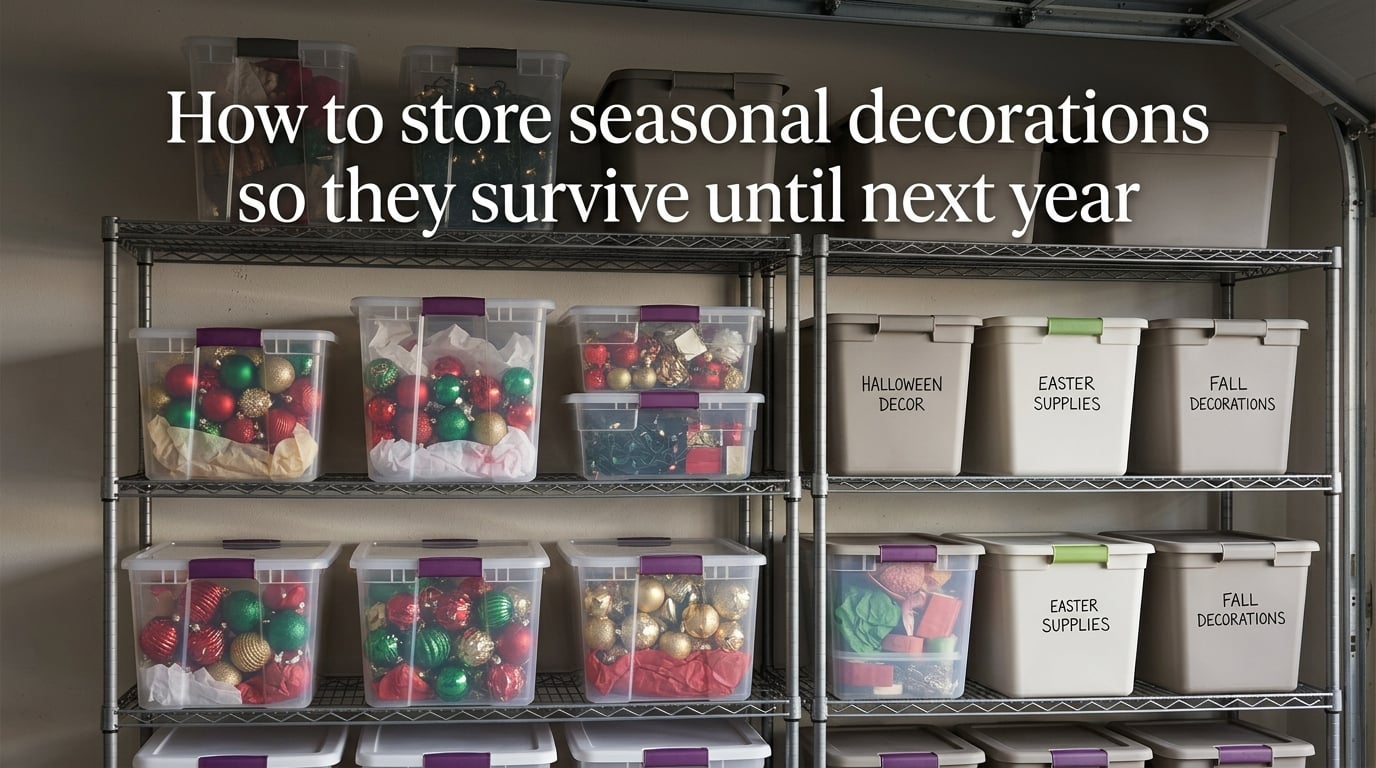
Every year, families unpack their holiday boxes only to find shattered ornaments, tangled light strings, and wreaths that have lost their shape. Learning how to store seasonal decorations the right way saves you money, protects items with real sentimental value, and turns decorating day from a frustrating scavenger hunt into something you actually enjoy.
The average household spends well over $200 a year on holiday and seasonal decor. Multiply that across a decade of birthdays, Halloween parties, and Christmas mornings, and you are looking at a significant investment sitting in your attic or garage. A few smart storage habits keep that investment safe.
In this guide, I will walk you through a proven five-step process for packing away decorations so they come out looking exactly the way they went in. I will also share storage tips for specific decoration types like ornaments, string lights, and wreaths, plus solutions for small apartments and long-term preservation of heirloom pieces.
Table of Contents
Step 1: Declutter and Sort Before You Pack
The biggest mistake people make is boxing up items they no longer want or use. You end up storing broken, outdated, or duplicate decorations for years, wasting space and creating frustration every time you open a bin. Take 30 minutes to sort before you store a single thing.
Lay everything out in a wide-open space, like a dining table or living room floor. Group your decorations by holiday or season so you can see exactly what you have. You might be surprised to find three identical wreaths or a strand of lights you forgot existed.
Create three piles as you go. The first pile is for items you love and will definitely use again. The second is for broken or damaged items that go straight into the trash. The third pile is for items in good condition that you simply do not want anymore, which you can donate to a local thrift store or community group.
Be honest during this process. If an ornament has sat untouched for three years, ask whether it truly deserves storage space. Decluttering before you store means you buy fewer containers, save time next season, and only hold onto the decorations that genuinely bring you joy.
While you sort, jot down a rough inventory. Note how many ornament bins you have, how many light strands, and which wreaths made the cut. This list becomes the foundation of your labeling system later on, so you always know what is in storage without opening every box.
Step 2: Choose the Right Storage Containers
The container you choose makes or breaks your holiday decoration storage system. Cardboard boxes might seem fine, but they absorb moisture, attract pests, and collapse when stacked. For long-term seasonal decor organization, plastic bins with tight-fitting lids are the gold standard.
Clear plastic bins let you see what is inside at a glance, which saves time when you are hunting for specific items. Colored bins work well if you want to color-code by holiday. Use red or green for Christmas, orange for Halloween, and pastel shades for spring celebrations. Either way, look for bins with secure latching lids that will not pop open if a stack shifts.
Think about size and shape carefully. Shallow, wide bins are perfect for flat items like window clings and table runners. Deep bins work better for bulky items like inflatables and large figurines. Specialty containers with built-in compartments are available specifically for ornaments and wreaths, and they are worth the investment if you have fragile pieces.
Aim for uniform bin sizes wherever possible. Matching bins stack neatly, use vertical space efficiently, and look much tidier on a shelf than a hodgepodge of mismatched boxes. Most home organization experts recommend standard 27-gallon totes for general decor and smaller 12-gallon bins for delicate items.
One last tip: avoid overpacking. Bins that are stuffed to the brim are harder to carry, more likely to crack at the seams, and put pressure on the items inside. Leave a little breathing room at the top of each container.
Step 3: Wrap and Protect Fragile Items
Fragile ornaments are the items most likely to get damaged in storage. Glass baubles, ceramic figurines, and heirloom pieces need individual attention before they go anywhere near a storage bin. The goal is to eliminate movement and cushion against impact from every direction.
Start by wrapping each fragile piece individually. Bubble wrap is the classic choice because it provides excellent shock absorption. If you want a more eco-friendly option, acid-free tissue paper or natural excelsior works surprisingly well for lighter items. For particularly valuable pieces, layer both for maximum protection.
Build a cushioned base at the bottom of your bin before placing anything inside. A layer of bubble wrap, tissue paper, or even a soft towel creates a buffer between your items and the hard plastic floor. Then place your heaviest and sturdiest pieces at the bottom and lighter, more delicate pieces on top.
Fill every gap and empty space inside the bin. When items can shift during transport or stacking, they collide and break. Use crumpled tissue paper, packing peanuts, or spare bubble wrap to lock everything firmly in place. You should not hear any rattling when you gently shake a properly packed bin.
If you are storing sentimental items that can never be replaced, take a photo of each piece before you wrap it. That way you have a record for insurance purposes, and you can see at a glance what is inside without unpacking the whole bin.
How to Store Specific Decoration Types?
Not all decorations are created equal. Different items require different storage approaches, and this is where most generic guides fall short. Here is how to handle the most common seasonal decorations so each type stays in top condition.
Christmas Ornaments
Orament storage is all about keeping each piece separated and cushioned. Specialty ornament boxes with individual slots are ideal because they hold dozens of ornaments in a compact, stackable format. If you do not have one, use egg cartons for small ornaments or wrap each piece in tissue paper and nestle them in a lined shoebox.
Keep hooks and hangers in a small zip-top bag stored inside the same bin. There is nothing more frustrating than hunting for ornament hooks when it is time to decorate the tree.
Holiday String Lights
Tangled lights are one of the most common complaints in forum discussions about holiday storage. The fix is simple: wrap each strand around a piece of sturdy cardboard before boxing it up. Cut a rectangle from an old shipping box, cut a small slit in one end, and wind the light strand around it. This keeps the cord from tangling and makes it easy to check for broken bulbs.
Alternatively, you can use plastic cord reels or wrap lights around coffee cans. Whatever method you choose, store each strand separately and never stuff multiple tangled bundles into a single bag.
Wreaths and Garlands
Wreaths lose their shape when they get crushed, so they need rigid, structured storage. Wreath storage boxes and bags are specifically designed to hold a wreath flat without squishing it. If you do not have one, hang your wreath on a sturdy hanger and slip a garbage bag over it to keep off dust.
For garlands, coil them loosely and store them in a wide, shallow bin. Avoid folding or creasing them, as bends in artificial greenery are difficult to smooth out. Tuck a few silica gel packets inside to absorb any trapped moisture.
Faux Florals and Greenery
Faux florals are best stored upright rather than laid flat. Many people keep them in empty vases or buckets in a closet, which prevents the stems from bending and the petals from getting crushed. If you must store them in a bin, wrap the blooms loosely in tissue paper and stand them upright whenever possible.
Avoid compressing faux florals under heavy items. The artificial petals and leaves can become permanently creased under weight, and no amount of fluffing will fully restore them.
Step 4: Label Everything and Build an Inventory
If there is one tool that storage experts and forum users universally recommend, it is a label maker. Forgetting what is inside each box is a problem I hear about constantly, and the solution is as simple as a clear label on every container. Label the outside of each bin with its contents and the holiday or season it belongs to.
Take it a step further by taping a photo of the bin contents on the outside. A quick smartphone snapshot printed on regular paper gives you an instant visual reference. You can see exactly which ornaments, lights, or figurines are inside without opening the lid, which saves enormous time when you are decorating.
For a more thorough system, create a simple inventory document. A basic spreadsheet or even a notebook page listing each bin number and its contents takes 15 minutes to set up and pays off for years. Number your bins and reference them in your inventory so you can direct yourself to the right container instantly.
Color-coded labels are another popular strategy among organization enthusiasts. Assign a color to each holiday and stick a matching label or dot on every bin. A red label means Christmas, an orange label means Halloween, and a pastel label means spring. At a glance, you know exactly which bins to pull for each season.
Store your most-used items in the most accessible bins. If your Christmas tree stand and main light strands go up first every year, put them in a clearly labeled bin near the front of your storage area. Save the back of the shelf for items you rarely need.
Step 5: Choose the Right Storage Location
Where you store your decorations is just as important as how you pack them. Temperature and humidity fluctuations are the enemies of seasonal decor, causing fading, warping, mold, and rust. The ideal storage location is cool, dry, and climate-controlled.
An indoor closet, temperature-controlled attic, or spare room corner is ideal. These spaces maintain relatively stable temperatures year-round, which protects delicate materials like painted ceramics, fabric, and artificial greenery. If your home has a climate-controlled basement, that works well too, provided you keep bins off the floor on shelves to guard against any unexpected water.
Garages and unheated sheds are popular for storage, but they come with real risks. Extreme summer heat can melt candles and adhesives, warp plastic items, and fade colors. Winter cold can make some plastics brittle. If you must use a garage, choose the area closest to your home’s interior wall, where temperatures are more moderate, and use weather-proof totes with tight seals.
Make use of vertical space wherever you store your bins. Sturdy shelving units let you stack containers safely without putting excess weight on the bottom bins. Vertical storage also keeps bins off the floor, protecting them from pests and moisture. Label the spine of each bin so you can read it when containers are lined up on shelves.
Small Space and Apartment Storage Solutions
Not everyone has a spacious attic or garage. If you live in an apartment or a small home, storing seasonal decorations takes a more creative approach. The good news is that with a few smart strategies, even a studio apartment can accommodate a full holiday collection.
Under-bed storage is one of the most underused spaces in any home. Flat, rolling bins designed to slide under a bed or sofa are perfect for lightweight items like table runners, wall hangings, and smaller decorations. Measure your bed clearance before buying bins so you know they will actually fit.
Vacuum-sealed storage bags are a lifesaver for soft items. Inflatable yard decorations, fabric tablecloths, and plush holiday characters can be compressed to a fraction of their normal size. Just be aware that vacuum bags are not suitable for anything with rigid structure, as the compression can permanently crush delicate shapes.
Over-the-door shoe organizers are surprisingly useful for seasonal decor. The individual pockets are perfect for small ornaments, light strands, ribbons, and decorative accents. Hang one inside a closet door and you have instant, visible organization without taking up any shelf space.
Think vertically in every closet. Stackable bins, hanging shelves, and tension rod dividers can transform a single closet shelf into an efficient multi-level storage system. Even the space above your kitchen cabinets can hold a couple of decorative bins if you use attractive containers that blend with your decor.
If you truly have no room at home, consider splitting your collection. Keep one or two bins of current favorites at home and rotate a few items into a small self-storage unit. A 5×5 climate-controlled unit costs very little per month and can hold an entire holiday collection with room to spare.
Long-Term Preservation Tips for Sentimental Items
Some decorations are irreplaceable. A handmade ornament from a grandparent, a vintage piece passed down through generations, or a first Christmas keepsake deserves extra protection beyond standard storage practices.
Use acid-free tissue paper rather than regular tissue or newspaper for these items. Standard paper is acidic over time and can cause yellowing or deterioration of delicate materials. Acid-free archival tissue is inexpensive and provides a chemically neutral environment that preserves fabric, paper, and painted surfaces.
Toss a few silica gel packets into bins containing metal or paper items to absorb trapped moisture. You can save these from shoe boxes and electronics packaging throughout the year. Replace them every season to keep them effective.
Keep sentimental items in the most stable environment in your home. Avoid attics with extreme temperature swings and basements prone to dampness. An interior closet on a main floor is usually the safest spot for heirlooms and vintage decorations.
FAQs
Can I leave my Christmas decorations up until February?
You can, but it is not recommended. Leaving decorations up past the holiday season exposes them to prolonged sunlight, dust, and potential damage from daily household activity. Taking them down within a few weeks of the holiday keeps them cleaner and in better condition. Some traditions, like Candlemas on February 2nd, mark the traditional end of the Christmas season, but from a preservation standpoint, earlier is better.
What is the 3-5-7 rule of decorating?
The 3-5-7 rule is a design principle that suggests grouping decorative items in odd numbers, typically three, five, or seven. This creates visual interest and a more natural, balanced look than even-numbered arrangements. It applies to mantel displays, tablescapes, and vignettes throughout your home.
How do you store seasonal decorations?
Store seasonal decorations in five steps: declutter and sort before packing, use plastic bins with tight-fitting lids, wrap fragile items individually in bubble wrap or tissue paper, label every container with its contents, and store bins in a cool, dry, climate-controlled location. Organize by holiday and keep an inventory list for easy reference.
Can I store Christmas decorations in an unheated garage?
You can store decorations in an unheated garage, but it carries risks. Extreme heat can melt candles, fade colors, and warp plastic items, while extreme cold can make some materials brittle. If you must use a garage, use weather-proof totes with tight seals, keep bins off the floor, and store them near interior walls where temperatures are more moderate. Avoid storing candles, delicate electronics, or sentimental items in unheated spaces.
Wrapping It Up
Knowing how to store seasonal decorations properly is the difference between unpacking joyful memories and unpacking a box of broken disappointment. The process comes down to five straightforward steps: declutter first, choose quality containers, protect fragile items individually, label everything clearly, and pick the right storage location.
Start with the decorations you already have this season. Even implementing just two or three of these steps will make a noticeable difference the next time you open your holiday bins. Your future self, standing in front of a perfectly organized storage shelf next December, will thank you.