
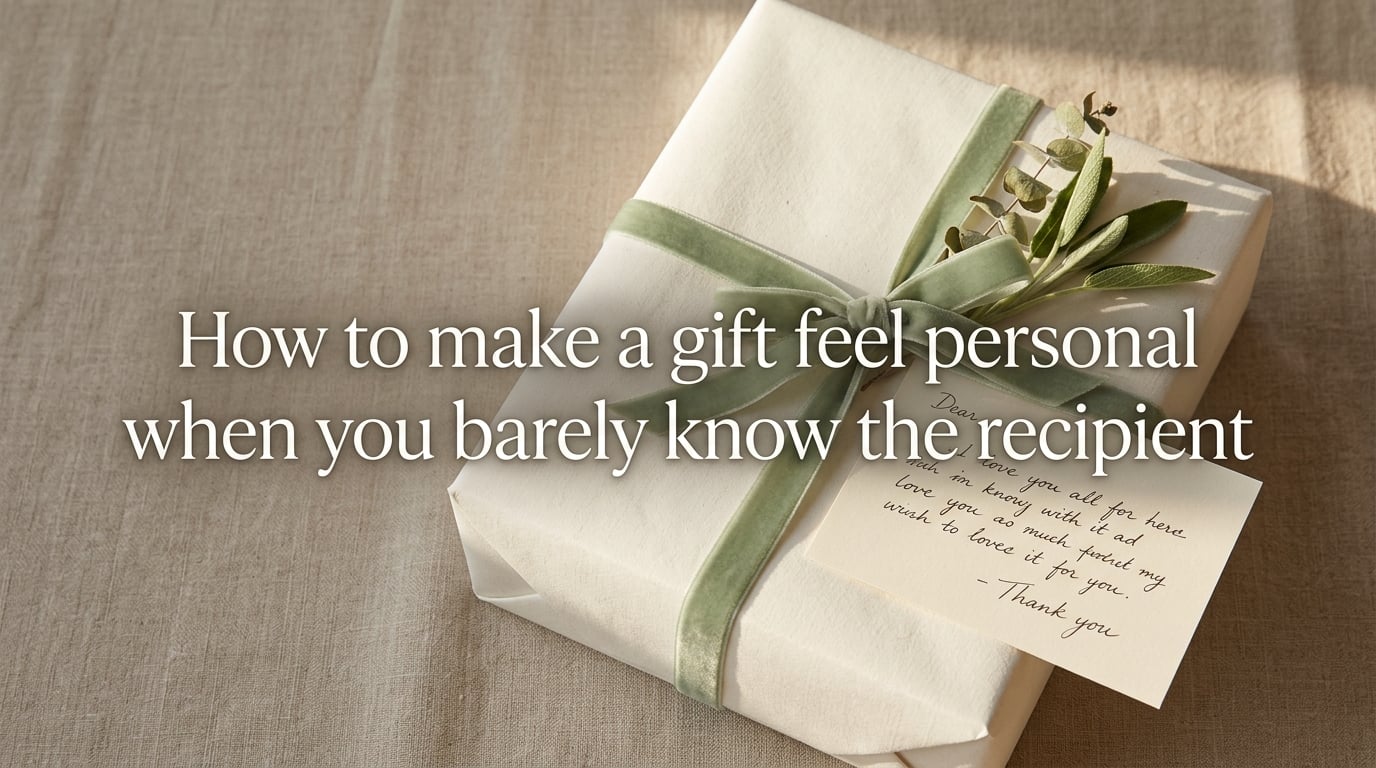
I have stood in the gift aisle more times than I can count, holding a perfectly nice candle and wondering if it screams “I panicked at the last minute.” That feeling is the heart of the problem: how to make a gift feel personal when you barely know the recipient is less about the gift itself and more about the thinking behind it.
Our team has spent years writing about gift-giving etiquette, and one pattern keeps showing up. People who nail this skill are not closer to the recipient. They are simply better at observation, packaging, and the art of adding a small personal touch. In this guide, I will walk you through the same techniques we use, plus a simple framework you can use today for any coworker, distant relative, new neighbor, or office gift exchange.
Table of Contents
How to Make a Gift Feel Personal When You Barely Know the Recipient?
The short answer is this: a gift feels personal when it reflects specific attention to the recipient, even if that attention comes from quick observation rather than long friendship. Three ingredients do the heavy lifting: a relevant item, a clear personalization token, and thoughtful presentation.
Skip any one of those three and the gift can read as generic, no matter how expensive it is. Combine them, and even a small bottle of olive oil feels like you spent weeks thinking about it. The rest of this guide shows exactly how to do that.
Signal Scanning: What to Notice Before You Buy
Signal scanning is the habit of picking up small details about a person before you ever set foot in a store. When you barely know someone, these details are the only real information you have, so treat them like gold. I keep a quick mental note every time I meet someone new, and it has saved me from dozens of awkward gifts.
Clothing, Accessories, and Desk Cues
Clothing is the loudest signal you get. A subtle enamel pin, a university hoodie, a smartwatch, a reusable water bottle, or a tote bag with a band logo all tell you something about how the recipient sees themselves. Even the color of their everyday bag is a hint if you slow down enough to notice.
Desk and home cues are equally useful. A miniature succulent, a stack of vinyl, a particular mug, a coffee table book on travel, or a candle that clearly has been burned halfway through all tell a story. You do not need to be a detective. Just look once and remember.
Conversation Hooks and Casual Mentions
Most people drop hints they never realize they are dropping. A coworker says “I have been trying to find a good French press” and walks away. A neighbor mentions in passing that her dog loves long walks. A relative at a family dinner says they finally started running again. These are not throwaway lines. They are gift leads.
I keep a tiny note on my phone labeled “Gift Leads” and I jot these down whenever they happen. By the time a birthday or holiday shows up, I usually have three or four options ready without ever having to ask directly.
Observing Their Environment and Scent
Many people unconsciously surround themselves with quiet signals. Someone whose home smells of citrus probably enjoys bright, fresh scents. Someone whose kitchen is full of cookbooks enjoys cooking. Someone whose car is cleanly organized may appreciate tidiness or organization tools. None of this is scientific, but it is closer to the truth than guessing.
The 3-3-1 Rule: A Simple Framework for Low-Aquaintance Gifting
The 3-3-1 rule is the framework I use when I have no idea what to buy. It works because it forces you to slow down just enough to make the gift feel considered. It is built on three observations, three candidate gifts, and one personalization token.
Observe 3 signals. Look at clothing, environment, and conversation for three small details about the recipient.
Shortlist 3 gifts. Pick three neutral-but-specific items that map to those signals. Neutral means broadly safe. Specific means it actually reflects one of the signals.
Add 1 personalization token. Choose one handwritten note, monogram, custom label, or tailored wrapping that ties the gift to the recipient.
This rule keeps you from overthinking. It also keeps you from defaulting to a generic gift card with no context. The token is what makes the gift feel personal, even if the gift itself is simple.
Personalization Techniques That Work Without Personal Facts
Personalization is what makes a gift feel individually chosen. The good news is that you do not need to know someone’s middle name or childhood pet to add a personal touch. You just need to use one of the universal personalization techniques that work on anyone.
Handwritten Notes and Messages
A handwritten note is the single highest-impact personalization you can add. It costs nothing, takes two minutes, and signals that you stopped what you were doing to think about the recipient. I write notes for every gift I give, even small ones, and I have never had a recipient treat it as an afterthought.
Keep the note short. Two or three sentences is plenty. Mention something specific you appreciate about the person, wish them well for the occasion, and sign it. Avoid generic phrases like “Just a little something.” Aim for something that could only be written to them.
Monogramming, Engraving, and Custom Printing
Monogramming, engraving, and custom printing turn a normal item into a one-of-one. A leather wallet with their initials, a cutting board with their last name, a tote with a small embroidered detail, or a notebook with a foil-pressed name all carry the same effect: the gift could only be for them.
Most personalization services take a few days, so plan ahead. If you are in a rush, choose a product that already accepts custom text at checkout, so you can skip the lead time entirely.
Personalized Wrapping and Labels
Personalized wrapping is the underrated hero of gift-giving. A simple kraft paper wrap, a fabric ribbon in their favorite color, a custom tag with their name, or a small attached charm turns a plain package into a moment. I have wrapped a $12 item so beautifully that recipients assumed it was worth far more.
Presentation and Packaging That Turns Any Gift Into a Moment
Presentation does as much work as the gift itself. Two identical items, one tossed in a bag and one wrapped with care, send completely different messages. I treat presentation as a non-negotiable part of the gift, not a finishing touch.
Here are presentation techniques that consistently work for me and our team:
Choose wrapping paper in a color that matches the recipient’s home or style, not yours.
Use fabric wrapping (furoshiki or a tea towel) for a gift that doubles as a second present.
Skip the store bow. A simple sprig of greenery or a dried flower tucked under the ribbon feels more thoughtful.
Place the handwritten note on top of the gift so it is the first thing they see.
Choose a sturdy gift box or reusable container that they will actually want to keep.
Timing matters too. The element of surprise can make any gift feel more personal. A small gift delivered at an unexpected moment often lands harder than a larger one given on the exact date. Think about when the recipient will appreciate it most, not just when the calendar says they should.
Universal Gift Options for Someone You Barely Know
Some gifts work across almost any recipient. The trick is to pick items that are neutral-but-specific, meaning they are universally appropriate yet still feel aimed at the person. Here are the safest options I keep coming back to.
High-quality consumables. A nice olive oil, single-origin coffee, loose-leaf tea, gourmet chocolate, or a small charcuterie set. Everyone eats, and most people enjoy a small upgrade.
Candles with a soft, neutral scent. Choose warm vanilla, soft linen, or light citrus. Avoid heavy florals or polarizing fragrances.
Plants or flowers. A small potted succulent, a fresh bouquet, or a low-maintenance houseplant is thoughtful and lasting.
Notebooks and pens. A linen-bound journal or a sleek pen is practical and feels personal without being intrusive.
Books tied to a known interest. A cookbook for a self-described foodie, a guide to a city they love, or a beautifully illustrated volume on a hobby they mentioned.
Experience gifts. A class, a tasting, a museum pass, or a streaming subscription they can enjoy at their own pace.
Gift cards with a specific store. Pick a store connected to a known interest, not a generic card. The specificity is what counts.
Gift cards can absolutely feel personal when you choose them with intention. A card to a bookstore they mentioned, a coffee shop they frequent, or a local restaurant you both enjoy signals that you listened.
Budget Guidelines by Relationship Type
Budget signals how well you know the person. Spend too little and the gift feels dismissive. Spend too much and the recipient feels pressure to match it. The sweet spot is usually modest, with most of the budget going into presentation and personalization rather than the item itself.
Here is the general guideline I follow and recommend for 2026:
Casual coworker or office gift exchange: Keep it modest. Focus on universal consumables and a thoughtful note.
New neighbor or acquaintance: A small housewarming item or a shared snack basket works well. Aim for friendly, not lavish.
Distant relative at a family event: A mid-range item that reflects something they mentioned at a previous gathering is ideal.
Host or hostess gift: A nice bottle, a small plant, or a homemade treat with a handwritten tag is the gold standard.
Whatever you spend, the item should never feel like you swung by the gas station on the way. Modest is fine. Last-minute is the issue.
Scenario-Based Examples: Choosing the Right Gift
Examples help turn principles into action. Here are four common scenarios and the choices I would make in each.
The Coworker Birthday
You share a break room with them but have not hung out outside work. Look at their desk mug, the sticker on their laptop, and the snack they keep in the shared fridge. Pair a high-quality snack or coffee with a simple handwritten card signed by a few mutual teammates. This is friendly, low-pressure, and shows awareness without crossing into too-personal territory.
The New Neighbor
You just moved in next door and want to introduce yourself. Bring a small potted herb, a bag of local coffee, or a homemade treat with a tag that includes your name and apartment number. The goal is to open the door to a future conversation, not to win them over in one visit.
The Distant Relative
You see them once a year at a family gathering. Listen to what they talk about at dinner. Last year my great-uncle spent twenty minutes talking about a new hobby, and I used that to choose a small themed gift the next year. It made an impression that a generic family gift never would.
The Acquaintance’s Housewarming
They just moved into a new place. A small plant, a set of tea towels, a candle, or a specialty food item feels like a contribution to their new chapter. Pair it with a card that says you are glad they are nearby and look forward to running into them.
Culture, Timing, and Common Mistakes to Avoid
Cultural awareness matters even when you think you know someone. Avoid giving items that carry strong religious or dietary meaning unless you are certain the recipient welcomes them. Skip alcohol if you are unsure of their preferences. Avoid anything with a strong fragrance, since scent preferences are deeply personal.
Timing is the most overlooked element of gift-giving. A coffee delivered on a tough Monday morning is more memorable than a coffee given on a forgettable Friday. A small birthday gift given in a quiet moment often lands harder than one given in a crowded party. Surprise is a personal touch in itself.
Common mistakes I see over and over:
Choosing a gift that reflects your taste, not the recipient’s. The gift is for them, not for you.
Skipping the card. A gift without a note can feel transactional.
Wrapping last-minute in a torn gift bag. Presentation sets the tone before the gift is even opened.
Over-apologizing for the gift. Confidence in your choice shows that you put thought into it.
Giving something too personal, like clothing or fragrance, when you barely know the person.
Frequently Asked Questions
What to get as a gift for someone you barely know?
Choose a neutral-but-specific item tied to a small signal you have noticed, like a nice coffee, a book on a hobby they mentioned, or a small plant. Pair it with a handwritten note and a thoughtful wrapping. The gift does not need to be expensive. It needs to feel chosen.
How to make a gift more personal?
Add a single personalization token such as a handwritten note, a monogram, a custom label, or wrapping in their favorite color. The token is what makes the gift feel like it was chosen for them specifically, even if the gift itself is simple.
How to give someone a gift without them knowing?
Leave the gift at their door with a small note, ship it to their address with a personal message, or arrange a delivery through a mutual friend. Keep the note simple and signed so they know who to thank without putting them on the spot.
What is the 5 gift rule?
The 5 gift rule is a budgeting framework that assigns categories like something they want, something they need, something to wear, something to read, and something unexpected. It is most useful for close family and is less commonly used for acquaintances, where the 3-3-1 rule fits better.
Final Thoughts on Personal Gifting
Learning how to make a gift feel personal when you barely know the recipient is really about slowing down and giving a small amount of attention. You do not need a long friendship, a big budget, or insider knowledge. You need three signals, three candidate gifts, and one personalization token.
Start with the next occasion on your calendar. Observe. Shortlist. Personalize. Wrap well. Add a handwritten note. That is the recipe I have used for years, and it has worked for coworkers, neighbors, distant relatives, and everyone in between. The gift will be remembered less for its price and more for the thought behind it.